

Can a sneaker make you lose a Grand Slam?
Nike, Jaime Yzaga, and the debacle of the US Open 1994. Today we tell you in detail one of the most curious anecdotes in the career of Pete Sampras.

At Punto de Break, we have made it a habit to travel with the time machine on important days of Grand Slam tournaments. History lessons, as if we were in university. If yesterday we revisited Venus Williams's most painful defeat, today it's time to talk about Pete Sampras and one of the most surprising moments of his professional career. We are talking about a man who in the 90s was rarely seen losing a match outside of clay courts, especially against opponents who were not part of the most established elite. However, life always gives you some exceptions to allow you the luxury of writing articles like this.
Let's travel to the 1994 Wimbledon tournament, exactly three decades ago. Sampras had just won his second consecutive title at the All England Club after a dull final against Goran Ivanisevic, a match where he received fierce criticism for his monotonous style and a lack of charisma that frustrated many. You could like him more or less, but that was already his fifth Grand Slam at just 23 years old, confirming that his reign in the men's circuit had only just begun. However, not everything was good news as he left London. A foot injury did not prevent him from being crowned champion, although the feeling as he left was that it might cause him future problems.
Where does this injury originate from? As Pete describes in his autobiography, the origin dates back just a few weeks before Wimbledon, when he decided to end his sponsorship deal with Sergio Tacchini to sign a new clothing and footwear contract with Nike. His new adventure began on the British grass, excited to have linked his image to such a colossal American company. Everything fit the theory, although money was never an issue, as they would have buried him in bills both in Italy and Oregon. However, in terms of representation, it is always better to make agreements with your own. Let's say it was the most logical path for both parties to be able to make the most out of the golden goose.
THE DANGER OF CHANGES
At that moment, Nike was already developing a shoe that would be part of an exclusive line for Sampras, a very traditional model integrated into the 'AIR' massive campaign, which still generates millions of dollars to this day. Everyone assumed it would be a success until the moment of truth arrived, and the American raised an eyebrow: 'These shoes don't fit my feet well'. Bad luck, it was already too late; the contract required Pete to play Wimbledon with those shoes, but they were so good that he still exited as a champion. However, after the final, he ended up with sore and swollen feet, pushed to undergo an MRI scan the next day. Those discomforts finally had a name: posterior tibial tendinitis.
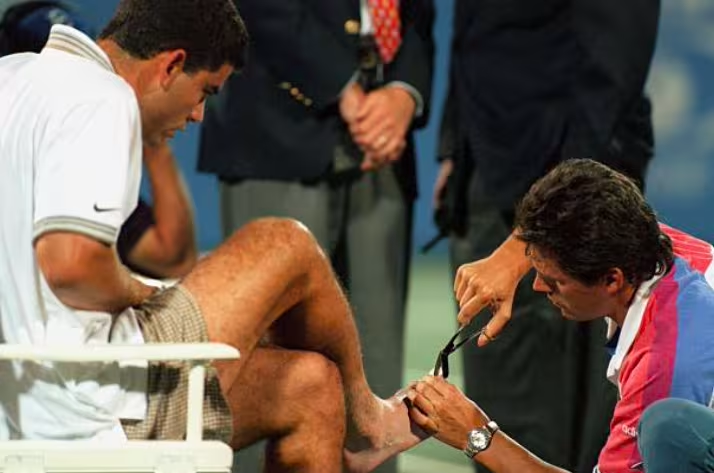
After a few days of moderate rest, the plan was to start the hard court tour at Washington, a tournament held in his hometown. You can imagine how excited he was to compete there, but his foot didn't allow it. Pete chose to give himself a little more time until his body was 100% ready. Weeks went by, watching the Montreal and Cincinnati tournaments from the comfort of his couch, hurriedly arriving at the US Open with no preparation whatsoever. Meanwhile, Nike was working against the clock to reinvent another model that would fit the champion's feet, a perfect model to debut at the American Grand Slam. Question for the veterans: Do you remember what happened at that tournament?
Sampras managed to advance through three rounds, achieving three victories against opponents outside the top 50 where he only dropped one set. This led him to the round of 16, where the Peruvian Jaime Yzaga, ranked 23rd at the time, awaited him. He was a slight guy, with good touch and agile feet, a classic underdog who clung to the slightest hope, one who would grab your arm if you showed them a finger. It was a very hot and humid afternoon, conditions that became torturous as they reached the fifth set. It was evident that Pete was not at his best, breaks occurred on both sides, but the most worrisome was seeing the American with so little fuel left in the tank. The thought of throwing in the towel crossed his mind several times, but then he remembered the pact he had made with himself years ago, not to leave a tennis court without fighting until the last ball.
As expected, the crowd rallied behind him, lifting him up to the finish line, appreciating the effort he was putting in to stay in the match. Unfortunately for the crowd, all that dedication wasn't enough. In addition to the defeat (3-6, 6-3, 4-6, 7-6, 7-5), the Washington native suffered severe dizziness in the final stretch of the match, highlighting the physical deficit he brought to the tournament. His fearless character didn't yield results but served to captivate the audience and star in the most fascinating duel of that edition, leaving some moments to remember for those present. For statistics lovers, that would be the only US Open between 1990 and 1996 where Sampras would fall before the quarterfinals, an opportunity that Andre Agassi took to claim the throne at Flushing Meadows for the first time.
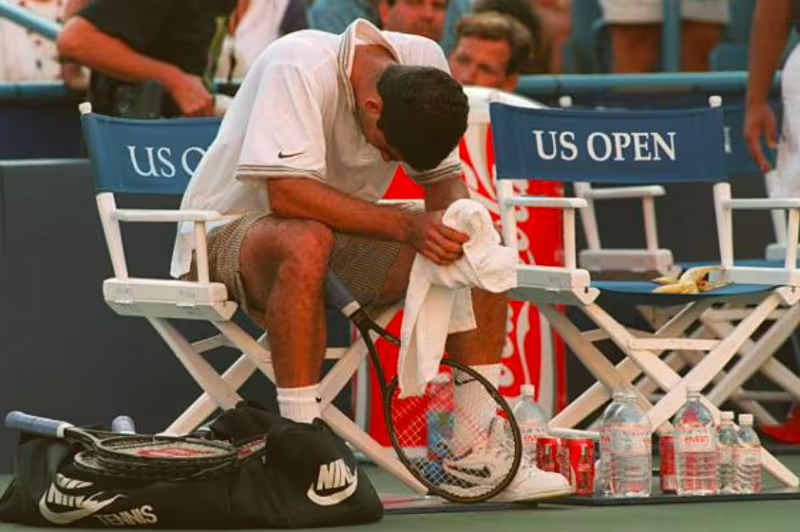
A change of sponsor, a new shoe model, the obligation to play with them at Wimbledon, the decision to skip the entire North American tour, and the toll taken at the US Open. This concludes today's anecdote, but it's worth extending it with a couple more paragraphs.
THE FINAL SCENE
As soon as that match against Yzaga ended, tournament officials took Pete to the referee's office, located on the other side of the tunnel connecting to Louis Armstrong Stadium. What seemed like simple exhaustion had turned into something much more serious. The assistants undressed him and set up intravenous drip bags, a rather distressing experience if you've never been through it. This bag contains mineral waters to prevent dehydration. Being intravenous, the effect is instant, so in just a few seconds, they saw Sampras' face transition from that of a zombie to regaining the sparkle in his eyes. After 'resuscitating' from that ordeal, the American recalls that the first thing he saw was Vitas Gerulaitis in that room. But why was his compatriot there?
Retired since 1986, the former world No. 3 and winner of the 1977 Australian Open ran down from the commentary booth to check on Pete and assist him if necessary. He volunteered to take him to the dressing room and look after his personal belongings. He waited there until Pete recovered, helped him out of the venue, and even carried his rackets. When they left the complex, hundreds of journalists and photographers eagerly awaited them for an exclusive, but Sampras refused to speak to anyone, claiming he needed rest. It was Vitas who dealt with the press, giving them some of the narrative they longed for. The next day, they all crafted their stories around a common theme: that duel had been an epic from which 'Pistol' emerged with honor and admiration.

“I didn't know at the time, but that was the last time I would see my friend Vitas,” writes the winner of 14 Grand Slams in his memoirs. Gerulaitis would die weeks later at just 40 years old in a tragic incident from carbon monoxide poisoning while sleeping at a friend's house in the Hamptons of New York. A terribly sad news, the farewell of a person beloved by everyone, the loss of a great individual and friend. There will be time to tell his story in the future.
This is an automatic translation. You can read the original news, ¿Puede una zapatilla hacerte perder un Grand Slam?