

"Crystal generation? What we are facing is the worst generation of parents"
We interviewed Pancho Campo to analyze current society and present his new project, which aims to boost mental strength in tennis players.

The problem with talking to Pancho Campo is that one doesn't know what to ask. He has experienced so many things, overcome so many experiences, that it's inevitable to go off script. Here the intention is to talk about tennis, but I can't promise anything.
Right now, I don't remember how I came across him, I just know that the interview I did with him during the pandemic was registered as one of the best conversations the profession has given me. Pancho Campo (Santiago, Chile, 1961) is one of those people who has the authority to speak from experience about practically any subject, especially tennis, a sport he played and that caused one of his greatest frustrations. His poor mindset prevented him from becoming a professional, so he had to seek revenge through other means.
The SMILE project – which in 2025 also took the form of a book – is an essential work for anyone who feels that fear or stress is blocking their life. However, Pancho has wanted to refine the aim a bit more and adapt this program exclusively to the world of tennis and all those involved, especially the players. Few know better than him what it feels like to be mentally suffocated on the court, which is why his goal is to help prevent anyone from going through something similar.
When did you start being interested in the topic of psychology?
The day I retired. After participating in many Challengers and Satellites, I realized that I couldn't control my nerves and emotions, which is why I never surpassed that level. Despite having a good physique and height, I was a disaster in other aspects, my mental game was off. That feeling was so unpleasant that I then got deeply involved in being a coach, giving players what I couldn't apply to myself.
How did you train?
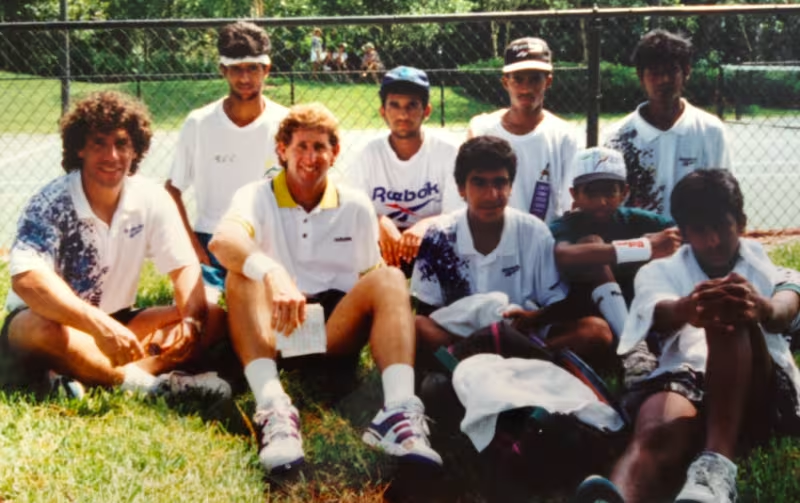
I went to the Nick Bolletieri Academy in the United States. I also took courses with James Loehr. It went very well for me. The first group of players I coached included Tomàs Carbonell, Juan Carlos Báguena, and Borja Uribe, among others. For example, Borja was ranked #700 and ended up winning the ATP Rookie of the Year award. In six months, he was almost in the top 100.
How did you work?
Our approach wasn't much different from what Pato Álvarez used at his time, although perhaps we paid a bit more attention to nutrition and physical preparation, but we focused heavily on mental training. Today, with great satisfaction, I can say that it worked.
Now you are traveling the world presenting your latest project: SMILE. Where did this idea originate?
We launched the SMILE program in 2016, almost a decade has passed. It was a very broad idea, aiming to help people manage fear and control emotions. To perform better, basically. Over time, I realized that society was starting to change, so I teamed up with a doctor, a psychologist, a nutritionist, and a physical trainer to delve deeper into the method, which took us almost two years [...] When I decided to return to tennis, that's when I saw the state of mental training, I realized it was still in its infancy, still the pending subject for all tennis players and athletes in general.
And that motivated you even more.
Look, if I have 15 years left to perform at the highest professional level, I want to end up doing something I truly enjoy. My great passion has always been tennis, so I can't think of a better role than helping the player perform better, both on and off the court.
Looking at the program, I see there are different courses.
We have three versions. One is corporate, requested by many companies to address the issue of employees who end up suffering from stress or anxiety. That's how we started, and then I adapted the entire program to the world of tennis, with many practical exercises and several hours on the court. It's important to note that this is not a coaching program that anyone can use; it's specifically for tennis. And then we also released the version for skydiving, where I mainly draw from my experience with jumps.
If you had had this program in your hands during your playing days...
... I'd have ranked in the top 200 for sure. Of course, I would have needed to know what I know now because back then, I was a mess (laughs).
Have you learned that much?
I've learned so much that I wouldn't know where to begin. Nowadays, people focus a lot on watching tennis, but I find it super interesting to observe other disciplines and then apply them to tennis. For example, I learned meditation thanks to Sting, with whom I did several music events. That meditation later served me when I got lost skydiving or when I swam among sharks. In the tennis world, they teach you to breathe when you have the racket back, you should exhale then, but what happens when you get nervous? Only the mentally strong survive.

Just technique is not enough.
Visualization, assertiveness, promoting positive thinking, etc. There is another fundamental thing that always holds true: if your life is not in order off the court, you'll never be able to perform well on it. All your personal affairs will have an impact when competing, but some coaches forget about that connection.
The program only lasts for two days, one weekend.
This is a program designed for coaches, players over 16 years old, and parents. We are trying to tour different Autonomous Communities, which lasts two days because you can't ask people to be there for a week. It's quite intense; we start at 08:00 in the morning and finish at 18:00, constantly engaging in activities.
Can you change a person's life in two days?
The goal is to plant the seed. It's like a doctor; they can give you the prescription, but then the patient has to go to the pharmacy, buy the medication, and take it. The key is not to interrupt the treatment.
Do you think the mind is trained as much as it should be nowadays, compared to technique, tactics, and physical training?
Serena Williams stated that 90% of a professional tennis player's success lies in their mind. Ultimately, these individuals have the best nutritionists, physical trainers, and coaches. The difference between Sinner and Alcaraz is minimal; both are incredible athletes. When one wins and the other loses, it's because something happened in their mind, not due to their shots.
That's why both of them work a lot on the mental aspect.
In my time, it was taboo; if you went to a psychologist, they would say you had a personality problem, until I met Jim Loehr and completely changed my perspective. After working with him in the United States, I brought him to Spain to offer different talks, and that's when people began to change their mindset. They no longer said 'I am going to the psychologist,' now they said 'I have a mental coach.' Even today, there are still people who fail to recognize the importance of this issue, but beyond the technical or physical aspects, in mental work it is crucial to start conducting sessions from a young age so that children are already familiar with the concepts.

In your time, did no player work on mentality?
Ivan Lendl went through a period where he was the eternal finalist. He contacted several psychology experts and discovered that, beyond the playing surfaces, the issue in his head was that he thought of himself as a runner-up. They told him that a tennis player relies on four legs, but if one is weaker than the others, you must reinforce the other three to the maximum. That's when Lendl became a machine, focusing on exquisite nutrition. Physically and tennis-wise, he was a beast. He gained so much confidence with that reinforcement that he ended up enhancing his mental performance. For a player, confidence is everything; it's impossible to win a match without it.
What current example comes to mind of a player greatly improved thanks to psychological work?
Roger Federer, for instance. In his junior days, he was very scandalous, almost rude; there is a video on YouTube where they point out the seven changes he made to leave that stage behind. Well, those seven changes were all mental: changes in attitude, entering the court, behavior, how he saw the game, and so on. This is how he transformed into a gentleman, an example for everyone.
What about Rafa? Do you think he worked a lot on this aspect?
Speaking with Toni (Nadal) many times, he would say to me: 'I always prioritized turning Rafa into a good human being, a good person, and a great competitor, rather than a player with perfect shots.' That's why he is the only player who has never broken a racket.
A special player and an equally special coach.
With the way he approached each training session, Toni had a mental coaching aspect within him, in addition to being a coach. Mental strength is worked on, of course, but some people are more predisposed than others; here we are talking about genetics, individuals more resilient to stress or pain. It has always been said that Federer was talent and Rafa was work... Forgive me, but Roger worked as hard as Rafa, just that one had more natural abilities to become a good tennis player. Rafa was a tremendous competitor, so what he had to work on more were the shots.
Of the current top 10, who would you like to help?
Sascha Zverev generates a lot of curiosity for me. He has the physique, the height, the shots... but he doesn't win Grand Slams! Whenever he plays against the big names, he loses. I don't know what's happening; for a player, family is always a very important point, but sometimes parents are the biggest enemies. A father can be the best support when used well, but can also ruin your career. Look at Jennifer Capriati! They didn't make amends until the day she entered the Hall of Fame. I don't know Zverev's case as well, but I think his father should take a step back and let someone else manage his son's career.

They talk about today's society as a generation of glass, do you agree?
Totally, this is a problem that is becoming more pressing every day, and I know it well because I have experienced it up close. My wife owns a school where there are students from 14 years old to the second year of university, so I have often given lectures on fear management and bullying prevention. What I see is that today's young people are overprotected, which is why anxiety problems arise so often.
Give me an example.
Well, you see, we made sure that the kids couldn't use their phones in the classrooms until the parents came to raise hell about it. Luckily, a law from the Junta de Andalucía protected us. It may seem like a silly example, but everything becomes harder if you don't have the right attitude from your parents. In fact, in my classes from years ago, it was strictly forbidden for parents to be on the court with the kids to prevent them from interfering with any shout or warning. Today, I think it would be impossible to enforce this; society has become very fragile.
Maybe we are facing the worst generation of parents.
It is indeed the worst generation of parents. We know that we are leaving a society to our children where things are not easy; every day there is more unemployment, the poverty rate keeps rising, and the middle class has disappeared. If geopolitics and the socio-cultural environment are already tough, what we can't do as parents is make it even more complicated. There's a saying that I really like: 'Difficult times create strong men, strong men create easy times, easy times create weak men'.
Tell me about fear, how do you face it?
First of all, each person must answer this question: what are you afraid of? In my case, when I skydived, I was afraid of the lack of oxygen at altitude, the speed at which I would fall, and the -40ºC I would have to deal with. After studying each case and finding a solution, that fear turned into nervousness, but it's the kind of nerves that are cool. I did some breathing exercises before the jump, and from that moment on, I enjoyed it like crazy. The same thing happens on the tennis court.
Nerves are necessary.
A player who doesn't get nervous before a match doesn't interest me. That means they have no kind of motivation. What needs to be taught is how to modify and handle that fear well. Let me tell you, I've even vomited before stepping onto a tennis court. I had to work a lot in this regard; I couldn't deal with the nerves. Many times, I couldn't stop bouncing the ball because I didn't feel prepared to serve. No one taught me at that time what I should do.

Tennis, what a challenge for the mind.
I've come to the conclusion that tennis is the most mentally demanding sport. In skydiving, you may feel fear, okay, but it's fear of a life-threatening danger. In tennis, there's no risk of anything happening to you, beyond an occasional sprain, but it involves traveling every week, sleeping in hotels, being alone inside the court... it's quite an ungrateful sport. Roger Federer, throughout his career, won 56% of the points he played... and he's the best tennis player in history! Just imagine the rest of us, we are all losers (laughs).
This is an automatic translation. You can read the original news, “¿Generación de cristal? Lo que estamos es ante la peor generación de padres”