

The greatest comeback in the history of Grand Slams
Fifty years ago, Manuel Orantes signed it, overturning an impossible score against Guillermo Vilas in the US Open semifinals: "When I didn't like someone, I focused more on the match".

If I ask you about a Grand Slam comeback that you will never forget, which one comes to mind?
I suppose most of you will think of the Nadalada at the 2022 Australian Open, that final against Daniil Medvedev. Or the final of the last Roland Garros, between Sinner and Alcaraz. It feels like it was just yesterday. However, if you have renewed your ID card more than six times, I bet your memory will uncover a more ancient file, the one from the semifinals of the 1975 US Open, where Manuel Orantes performed one of those miracles that will forever remain in the tennis history books. He did it against Guillermo Vilas, turning around the following scoreline: 6-4, 6-1, 3-6, 5-0, and 15-40. If you don’t know what I'm talking about, stay to discover it. If you watched it live, I know you will accompany me until the last line.
Let me first give you some context. Born in Granada but raised in Barcelona, the tennis world discovered Orantes' talent in the late sixties, although his definitive breakthrough would not come until Roland Garros 1974, his first major final, the one where he went from having victory against a very young Björn Borg to ending up falling dramatically due to a back injury (2-6, 6-7, 6-0, 6-1, 6-1). That cursed back, causing him so many career troubles. The scoreboard doesn't lie, the Spaniard stayed at zero, watching as his first Grand Slam title, in reality, ended up being Borg's. Would he ever have another chance as clear as that? At 25 years old, it was normal to think so, although his subsequent experiences made him doubt it.
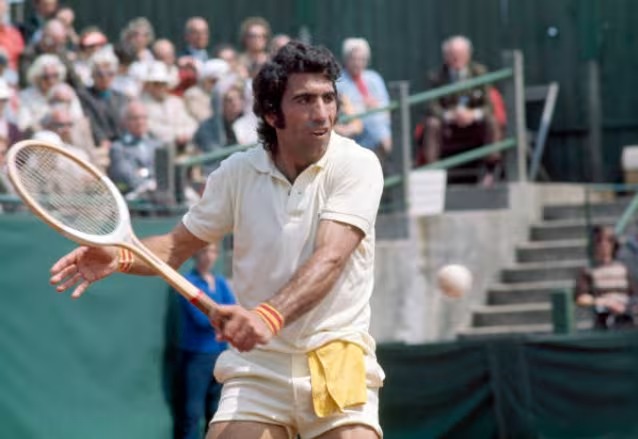
In the following season, he decided to skip the Australian Open again – he only played it once, in 1968, reaching the quarterfinals – and focus solely on clay, competing in all possible tournaments to arrive in Paris well-prepared. And he did just that! He prepared so well that he arrived exhausted, losing in the first round to the Italian Antonio Zugarelli in a clear defeat (6-3, 6-0). His hopes of reaching the Roland Garros final once more vanished at the first hurdle, but there was still a glimmer of hope ahead. After a lifetime of the event being held on grass, the US Open made the decision to switch its courts to clay that year, an experiment that not everyone approved. They would use the famous green clay (Hard-Tru), slightly faster than European red clay, although it wouldn't be seen in color on television until two years later. Manuel, an expert in the field, started dreaming of New York for months, thinking that there he might find the cure for the wound suffered in the French capital.
A DIFFERENT SURFACE
His record in the Big Apple was 10-5, with his best result being the 1971 quarterfinals. A decent statistic considering it was on grass, but the surface change would drastically alter his expectations. Out of the 15 titles he held at that time, 14 had been on clay, seven of them that season. Suddenly, his name started to gain strength for the event, climbing in the odds, and he confirmed it during the initial rounds, until facing Ilie Nastase in the quarterfinals. The Romanian was already a big deal, a double Grand Slam champion and the first ATP ranking No. 1 in history, although all these facts didn't help him. "One of the best matches of my career," Orantes would claim years later after his victory in four sets (6-2, 6-4, 3-6, 6-3), a glorious afternoon that allowed him to reach the semifinals filled with confidence and not much wear. And who was waiting for him in the penultimate round? Here is where the fun begins.
Guillermo Vilas was many things at that time. In the rankings, he was No. 3. On the court, he was the second favorite. On the street, he was one of Orantes' best friends. Sorry, did I say friend? They were in 1974 when they started playing doubles together, with the Spaniard mentoring a diamond in the rough who could absorb his experience in every match. The Argentine hadn't fully emerged yet, but the title at the Masters at the end of that season changed everything. It is said that the one from Mar del Plata changed his character, became reserved, somewhat conceited, overwhelmed by all the expectations he aroused, and idolized by a country that treated him as if he were a king. This caused the relationship between them to cool off after several snubs from Vilas, who reached breaking point in a press conference where he stated that the partner he truly wanted to form was with Borg. Those words hurt, they stuck in the guts of Orantes, who understood that that Guillermo was no longer his Guillermo.
In the 1975 US Open, the roles had reversed. Now Vilas was the main figure, the top contender for the title only behind Jimmy Connors. The South American was on an upward trend after reaching the last final of Roland Garros, where once again Borg would leave his mark on the Philippe Chatrier. The head-to-head between the Argentine and the Spaniard showed a 6-5 advantage for the latter, who had started to beat him more often ever since their personal relationship went up in flames. "That year I began to defeat Vilas quite easily. I had always beaten him in semifinals, both in England and in Rome and Indianapolis, the last time just three weeks before the US Open. That year we had played three matches and I hadn't lost a set, meaning he was the one who initially had it worse," recognizes the Spaniard in his autobiography, a tool without which it would have been impossible to write this piece.

Their only Grand Slam encounter had taken place precisely a year ago, at Roland Garros, where the Granada native came back from two sets down (3-6, 3-6, 7-6, 6-3, 6-2) to reach the round of 16. What were the chances of the same film playing out again in Forest Hills? Very few, practically none, but destiny had it that both would once again star in a sci-fi thriller, where Orantes dressed up for the second time as the very Houdini.
A COMEBACK FROM THE HEART
"I started quite badly," analyzes Orantes in the book written by Félix Sentmenat. "The first set was very evenly matched and he managed to win it by a narrow margin, but things didn't improve in the second. He got confident being ahead, and I couldn't keep up in the game. Vilas came in very focused, and I couldn't control the match as I used to, I couldn't set my pace. He enjoyed playing from the baseline, engaging in long rallies, whereas I, just like with Borg, tried to push him towards the net, forcing him to make overhead shots to disrupt his game," explains the former World No. 2 tactically.
Vilas wasn't a profile that overwhelmed you, that crushed you with aggression. It was even worse. The Argentine was a tennis bureaucrat, a 'professional' in capital letters. "He was like Borg, but with less game, at a lower level," Orantes sums up. They were the two players of the era who most contributed to that shift in mentality, the first ones to play differently, showing more physical and mental strength. The first ones to take this sport as the most important thing in their lives. History taught you to play tennis by attacking, until Borg and Vilas arrived to inject an update, to provoke a mutation. Between the two of them, they showed how valuable it was to also have a good defense, building bridges toward a more complete game.
That's how 'Willy' wore down his opponent, winning the first two sets, losing the third, and coming oh so close to winning the fourth. Up to five match points presented themselves to him! Five occasions where Orantes peered into the abyss, unaware that on that September 6th he would experience one of the most satisfying emotions as an athlete. The feeling of overcoming the impossible, of defying destiny, of surpassing oneself. Ultimately, of surviving when the lion already has your head inside its mouth.

"The first two match points, with the score at 6-4, 6-1, 2-6, 5-0, and 15-40, were two very good points. I remember that in the first one, I surprised him by approaching the net on the second serve, and since he didn't expect it, I was able to finish the point with a simple volley. In the second match point, I also ended the point at the net. He still had another one in that 5-0 game, which I saved with a smash. In the next game, he had two more match points on his serve. I won one with a drop shot and the other with an approach shot to the line. Most of the five match points were highly contested points, and I played them very well, taking risks and being brave. I won them, which encouraged me to tell myself: 'I'm going to make you work'. And indeed, I came back in that fourth set from 0-5 to 7-5," recounts the champion of 34 individual titles, who ended up turning the scoreboard around to 4-6, 1-6, 6-2, 7-5, and 6-4.
THE END OF A FRIENDSHIP
Our Manuel had reached such a level of irritation that he forgot about the score, preferring to focus solely on enjoying, on savoring the few minutes that could remain in the match. He could have thrown in the towel, gone to the locker room, and thought about the flight back home, but that last effort might be worth it. On the other hand, Vilas faded with each passing game until he was completely eclipsed. He collapsed emotionally, feeling overwhelmed as darkness fell upon him in the face of the helplessness of shaking hands with the Spaniard across the net. He, too, forgot about the score, about being so close to the goal of his first final in New York, but that night psychology was not on his side. Considering how ungraciously the South American had publicly belittled the Granadine, that comeback promised to be doubly sweet.
"Empezó a hacer cosas que a mí no me gustaron," Orantes recounts how that enmity was forged months ago. In 1975, when we met again, the relationship was already different, more distant. Everything that had happened made me want to beat him more on the court. That's why, in the semifinal, when I was down 5-0 in the fourth set, I kept fighting. Maybe if it had been against someone else, I would have given up, but not against him. Since then, every match I played against Guillermo was very intense for me. When I didn't like a person, I would cling more to the match. In contrast, losing to a friend, as happened to me once in Rome with Nastase, didn't bother me as much," the lefty adds.
In the meantime, Jimmy Connors had defeated Björn Borg in the first semifinal (7-5, 7-5, 7-5) to extend the peak of his career. The American was not only the defending champion of the tournament; he had reached the final of the last six Grand Slams played. He was so confident that he had once dismissed participating in Roland Garros, focusing mainly on London and New York. Everyone was certain who the favorite was on Sunday; nevertheless, the stadium was packed during the second semifinal, if only to solve the mystery of who would be defeated by Jimbo the following day.
It was nearly four hours of battle, ending well past midnight, benefiting from the fact that just that year, night lights were introduced allowing for night matches, although they couldn't do anything about the rain that showed up at the end of the fourth set. This break caused more than a few to throw in the towel and head home. The evening ended so late that many media outlets already announced the winner, confirming the Connors-Vilas final for the next day. That's how things worked before social media; if only we could turn back time. The next day, you can imagine the surprise on many faces when they entered the stadium and found Don Manuel there, who was barely Argentinean.
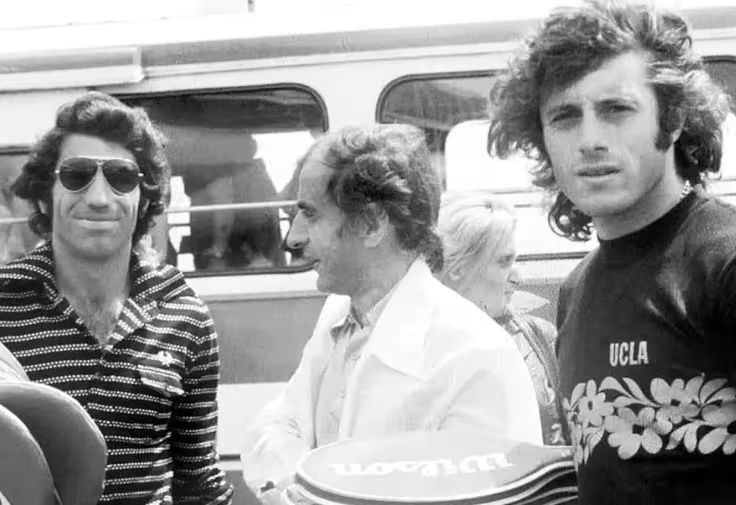
"The match was considered the best comeback or turnaround up to that moment," emphasizes Orantes, the proud protagonist of a story he never tires of remembering. "It was shown in tennis schools in the United States to teach children an example of faith and fighting spirit in the face of adversity, especially considering that it happened in such an important stage as the semifinals of the US Open," acknowledges the Spaniard, who would never step into a Grand Slam semifinal again in his career.
THE OTHER SIDE OF THE STORY
An article like this could not ignore the other version of events, which also existed. "Midway through the third set, I stepped wrong and tore a muscle, but I kept playing," Guillermo surprised with his post-match statements. "Orantes was playing drop shots and lobs, while I was constantly running back and forth as much as I could. What I couldn't do was move my left leg sideways, so he started making me do it, which made the tear worse. I got to 5-0, where I had a very good shot that I hit on the wrong side. I hit another shot, continued the point, but lost it. That was the only chance I had to be close to victory. After that, at 5-1, 5-2, 5-3, or 5-4, the most I remember is being 30-15 in a game, but the reality is I was already beaten."
The crowd in the stadium did not fit at all with this version of the player from Mar del Plata, who felt the weight of falling in that way in front of his former teammate. It was all too recent, a rivalry fueled from the outside, two friends who were no longer friends, fighting to reach the final of a Grand Slam. Whom do we believe? We hear Orantes' reply to these last words: “I know he made statements saying he had broken down on the court, he was entitled to say he was injured, rightly so, but only if he had lost the last set 6-0 or 6-1 [...] However, it was 6-4. Wasn't he so injured?”, he sarcastically threw. Vilas could have chosen nobility over pride, accepted that catastrophic defeat, but as the Spanish explained, he was just beginning an era when the Argentine suffered when he wasn’t in the middle of the photograph.

Guillermo would still have to wait a couple more seasons to lift his first major, while Orantes settled that matter in 24 hours, defeating Connors in straight sets (6-4, 6-3, 6-3) to become, ten years after Manolo Santana, the second Spanish tennis player to be crowned champion of the US Open. His first and only Grand Slam arrived on clay – of course – by knocking down the world number one who, besides playing at home, was the defending champion. You couldn't ask for more.
Well yes, a text like this so that, 50 years later, we continue to pay tribute to the great Manuel Orantes for an achievement that, possibly, we may never see again.
This is an automatic translation. You can read the original news, La mayor remontada de la historia de los Grand Slams