

Can a Spaniard Win on Grass?
It is the question that was never heard on the circuit until Manolo Santana proved it was worth asking. It has been 60 years since his feat at Wimbledon.

In the Spanish tennis annals, few pages more glorious than the one written by Manolo Santana at Wimbledon, a date where the Madrid-born tennis player opened a door of infinite dimensions for all his future compatriots.
Sixty years have passed. It is increasingly difficult to talk to people who experienced that live, which is why it is increasingly important to remember what happened. We must refresh the memory of the younger ones so that they understand the importance that the pioneer figure holds in sports. And what is a pioneer? 'A person or group that takes the first steps in an activity, discovers new fields, or initiates the exploration and colonization of territories', according to the RAE. Within the chapter of Spanish tennis, the synthesis boils down to two words: Manolo Santana. The first great mass champion who crossed borders showing that being a 'Spaniard' was not incompatible with being an international star.
Born in Madrid in May 1938, this ball boy from Club de Tenis Velázquez would not turn professional until he was 20. Soon, it became evident that the talent he possessed was different from others; the way he improvised every time he stepped on the court was that of an artist born for this. His projection would take shape with titles at Roland Garros (1961, 1964) and the US Open (1965), but this résumé was still missing an important piece. Manolo arrived at the 1966 Wimbledon completely obsessed, with the firm goal of leaving his mark there forever. Seasons earlier, he had reached the semifinals, a barrier that needed breaking. At 28, Santana had no choice but to devise the perfect plan to conquer the All England Club.

His strategy began by sacrificing the most sacred: Roland Garros. Knowing that grass required extra time for adaptation, his immense will led him to skip the Parisian event and use those weeks to gain experience on grass. If he had aimed to win the Australian Open, he would have undoubtedly achieved it, but he never had an interest in competing there. Where he wanted to reign was in London, so he appeared there as the fourth seed in the singles draw. According to rankings, there were only three more favored: Roy Emerson (current two-time champion), Tony Roche (Roland Garros champion the previous month), and Fred Stolle (Wimbledon finalist for the last three years). The level of difficulty was not small, but the desire for glory was much greater.
“My obsession with grass reached the point of sacrificing Roland Garros, a tournament where my tennis could always have a chance to win. In 1965 and 1966, I did not play in Paris to properly prepare my grass game, and the truth is that it worked out well. My victory at Forest Hills (US Open) was the first step, but Wimbledon would mean the ultimate confirmation,” describes Santana in his memoirs, hinting at what would unfold in the UK.
His journey to the later rounds found a turning point in the quarterfinals against the Australian Ken Fletcher, who had just beaten the great John Newcombe. The Australian managed to reach 5-4 with service in the fifth set, but that's when the competitive spirit of the Spaniard surfaced, turning the score around to 7-5 and securing a spot in the semis. That morale boost would play a critical role in the subsequent two matches. In the semifinals, it was expected he would face Emerson, but it was the surprising Owen Davidson (also Australian) who showed up. There, Manolo suffered once more, pushed to a fifth set, yet coming out victorious at 7-5. The title was now just one step away.
Dennis Ralston would be his partner on that Sunday, July 1, 1966, ranked sixth but the number one American player. Fortunately for Santana, this time, he did not face much distress. His greater experience in finals was evident, allowing him to breeze through with only minor hurdles in the second set (6-4, 11-9, 6-4). With that last backhand volley, the Spanish tennis pioneer put the final touch to his masterpiece. A legendary embrace followed with the American, who couldn't have fathomed at that moment that he would never step into another Grand Slam final again.

We cannot overlook the remarkable anecdote that shines as we delve into the memories. Yes, friends, it is not a fake; Manolo Santana won Wimbledon with the Real Madrid crest embroidered on his shirt. Perhaps this explains his determination in the finals (a nod to all the Madridistas). “I don't know if there is another football club in the world that can boast about one of its players winning Wimbledon,” quipped the champion afterward, who even had a 'contract' in the club's now-defunct tennis section. This success led him to earn a million pesetas a year from the coffers of the white club, each one well-deserved.
The second noteworthy anecdote came minutes later when a lack of protocol knowledge led to a humorous scene with royalty. “As is tradition at Wimbledon, the Duchess of Kent was preparing to hand me the trophy, and amidst joy and emotion, when the lady was about to shake my hand, I leaned to kiss it. Apparently, that custom is prohibited in the British royalty (laughs). The Duchess of Kent, very discreet but firm, withdrew her hand as if on a spring and, without losing her smile, continued with the ceremony and handed me Wimbledon's trophy.”
Six decades later, the feeling remains that it hasn't been that long since that first Spanish flag was planted on the Centre Court, making me think we still hold it very close. We had to wait 42 years for Rafa Nadal to prove that passing the baton was possible, although Conchita Martínez paved the way in the nineties. Santana had conquered other arenas, other continents, but it was his feat at Wimbledon that truly opened the doors to the field, changing our mindset forever. The man who, besides popularizing this sport nationally, gathered the courage to win Grand Slams on three different surfaces, urging the rest of the Spaniards to soar beyond the beloved clay courts.
“When I lifted that trophy above my head, I felt that I had achieved all my dreams, dreams I had been pursuing since 1959, right when I first stepped onto the grass courts of the tennis cathedral. I always thought that becoming a good grass player was an absolutely fundamental goal for me. First, to become a better tennis player and gain total recognition in the tennis world, and then to achieve the cachet and level that American or Australian players had and, ultimately, earn more money through my profession. There was no choice but to adapt to the grass,” the legend reflects in his autobiography.
How much money did Manolo Santana earn for conquering Wimbledon?
This afternoon, when the Wimbledon final concludes, Jannik Sinner or Alexander Zverev will pocket the prize money for the champion: €3,600,000. The runner-up will also not leave empty-handed: €1,800,000. Do you know how much Santana earned sixty years ago reaching the same pinnacle?
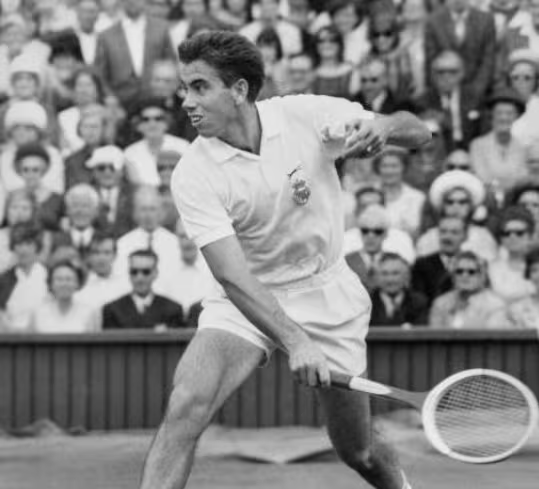
“With the figures being handled today in the tennis world, it may seem incomprehensible, but for me, winning Wimbledon cost me money,” Manolo humorously pointed out in a 2016 interview. “Covering all the expenses from my pocket, my wife, and I spent a month living, playing, and training in England to adapt to the grass courts. After emerging as champion, I only received Wimbledon's official allowances, which I recall were no more than 10 pounds a day,” recalled the Madrid-born player, who also received a watch for winning.
We loved hearing these anecdotes from him, even though we couldn't stop asking, as it was always a delight to listen to his tales. Almost five years have passed since Manolo left, yet he left behind his story, his legacy, and the tremendous affection he evoked within the locker room and beyond. More than a thousand years may pass, and that Wimbledon of 1966 will remain crucial to understanding our narrative, that of every child dreaming of wielding a racket on the world's biggest stages. If you agree, let's conclude the article with the master's final remarks.
“I have always considered the Wimbledon tournament the most important of all. Personally, always, and even today, I prefer playing at Roland Garros for many reasons, among them because Paris is a city I love. But I still believe that Wimbledon is number one. That tournament has something special, not easily explained. It's a blend of tradition, prestige, and entering the history of tennis. If I had to choose only one of my titles, without a single doubt, I would choose the Wimbledon title.”

This is an automatic translation. You can read the original news, ¿Un español ganando en hierba?