

Kuznetsova: "I never announced my retirement because I don't know if I will come back"
We interviewed the former World No. 2 almost five years after her last match. Will she ever return to the circuit? "There is a small possibility, but it is very small."

Almost five years after her last official match, Svetlana Kuznetsova still hasn't announced her professional retirement. Why? Quite simple: because she hasn't retired. In this exclusive interview, the Russian explains the reasons to us.
Having turned 40 this past summer and with a gap in activity since June 2021, it would be normal for Svetlana Kuznetsova (Saint Petersburg, 1985) to never compete again in a professional tournament. However, she is not so sure. The former world No. 2 knows that with each passing day, a comeback becomes more difficult, but she doesn't shut the door. At Punto de Break, we had the pleasure of speaking with the Russian to delve deeply into this matter, but also to reflect on the most relevant moments of a memorable career.
What is Svetlana Kuznetsova currently doing?
Phew! Well, many things, nothing to do with the years as a player. I do a lot of activities; it may seem a bit chaotic, but I love it. When I stopped playing, I was clear that I wanted to try different projects, so the first thing I did was to design some clothing models, which I then showed to BOSCO, the leading textile company in Russia. They have always dressed the Russian Olympic team, have large stores, and are a giant company that did not have a tennis sportswear line, so it was a pleasure to connect and start a collaboration with them.
Sounds good.
On the other hand, I have a colleague who is a showrunner, dedicated to creating television series. At one point, she offered to produce a series about my career, so for four years, I was preparing to improve my speech, in addition to taking some acting classes. It was a very nice experience, although the script wasn't entirely focused on my journey, it was about a father pushing his daughter to play tennis. It was released last year and turned out very well, called 'Trigger'.
I definitely didn't expect that.
And wait, there's more! I also work with the Moscow Transport Department to build new sports centers to encourage people to move, take care of themselves, and have more options to practice sports. I focus a lot on tennis, paddle tennis, and squash, where I link my roles by bringing in trainers and teaching them the training method.
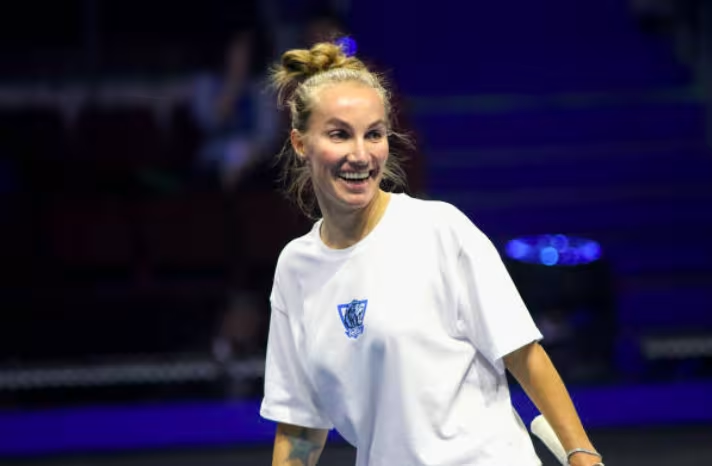
You work more now than when you were playing!
(Laughter) I thought the day I stopped playing, I would just travel, but I'm working much more than I expected. I'm lucky, fortunate to do all these things; for me, it means evolving and growing in other areas. I was a very good athlete in tennis, but I'm interested in trying new projects to see what else I like.
What I don't remember is reading an announcement about your retirement.
I did not do it, people ask me about it a lot. I did not want to announce my retirement because, honestly, I did not know if I would come back later on […] In fact, to this day, I do not know if I will return. At that time, I was unsure if I would get tired of the other life, and now we have Venus Williams playing at 45 years old. What if injuries respected me? What if I felt like trying again? I was not sure, so I did not say goodbye. I chose to leave it open in case I felt like returning later.
As of today, is there any possibility in your mind of returning to the circuit?
Yes, but it is very small, getting smaller every year. I do think about having a farewell gesture, for example, but it would have to be something nice.
Your last recorded match was at Wimbledon 2021, first round against Lesley Kerkhove. Did you know then that it was the last one?
You do not think about that at the moment, you are in the moment, thinking about each point. What I was clear about during that time is that I could not play more tournaments, I did not want to, I was completely worn out, exhausted. Months prior, I spoke with a psychologist and confessed my intention to stop, but he told me to give myself a margin of 2-3 more months playing to see how I responded. I lasted three more months, and after Wimbledon, I stopped.
How were those last months?
Very tough, both physically and psychologically. Many injuries, many breaks, the issue of COVID… It was getting harder for me to travel.

I see you've kept training, in case you ever decide to make a comeback.
I've always enjoyed taking care of myself. Dementieva asked me at the time: Why do you train so much? I like to feel good, I need it, it helps me in my daily life. Right now, the doubt is whether my body would allow me to compete again, but I doubt it [...] For example, I injured my hamstring while skateboarding some time ago, I also have a lot of pain in my knee, I don't know to what extent it would be worth forcing my body for a comeback. But I don't dwell on it, to be honest.
This year you were nominated to enter the Hall of Fame, how did you feel about this news?
With the numbers in hand, you must be very satisfied with your career. If you don't return to the circuit in the end, there's also nothing to prove to anyone.
I have been without the need to prove anything to anyone for a long time; no opinion will change my daily life. Today, I work on being a better person, improving physically, and contributing something different to the world. I also track young players who are starting out, select two of them each month, and try to help them, answer their questions, and guide them so they can fulfill their dreams. I enjoy helping; tennis has given me so much, so now I have to give back.
Is it common for retired Russian tennis players to do this? I mean, to help the next generations.
Sadly, no. This practice is not very common; only those who truly enjoy it do it, those who retire and feel the pleasure of helping. I would like to see more of this happening, for several players to come together to support the next generations, for the Russian Federation to invest in providing jobs to all those who brought great success to our country. I have always been communicative, and with more success, I receive more offers, but I know players who have ended their careers and have no jobs. They are lost athletes, so it would be very wise to utilize them, hire them, and benefit from all their knowledge. I hope we have a much more structured training system.
Imagine that one day you write a book about your career. If we were to list all your achievements, what would be on the first line?
[…] I would have to think about it; maybe it won't fit in one line (laughs). I always liked the idea of writing a book; I will end up doing it in the future. But beyond that first line, what I really need to consider is: what message do I want to convey to people? Above all achievements, I want to include a message that reaches people.
And what would that be?
That to achieve something, you have to believe in it first. If you don't believe in yourself, nobody else will either. You need to have that confidence and then work for many years. Until you believe it yourself, you can keep fighting and playing because you love it, it's alright, but give it your all. The important thing is for your confidence to develop during that process.
Has anyone ever told you that you weren't cut out for this?
At home, they did! In St. Petersburg, just before going to Spain. They told me, and it stuck with me, but at that moment, I didn't believe it myself. I had no choice but to accept it, but I knew that with work, I could fix it.
Would you change any decision from the past?
This question is very difficult. I think all the decisions I made were because I thought they were the best at that moment. Now, it cannot be changed. Well, maybe I would change the training system a bit because the way of working in Russia has nothing to do with Spain's. I would exchange training hours for quality time, something much more specific.
And why didn't you change it?
I thought about it many times, but changing a tactical aspect always involves much
Fear, it is complicated to change something that is ingrained in you and that you have been executing for several years. When you are successful and things are going well, it is normal to have a little fear of touching some piece.
Do you follow the current circuit?
I follow it a bit because I have a channel on Telegram in Russia and I am very connected to the circuit and its stories. There I follow the results, share my opinions, and talk about my tennis career. I have also traveled to some Grand Slam finals in these years, although I have also commented on many of them from here.
And what do you think? Is this tennis better than it was ten years ago?
When I was playing, I never watched tennis because if I saw them on TV, they all seemed excellent, I thought it was impossible to win against them. Then on the court, it was different, there I could play with them. Now everything is much more physical, Sabalenka and Rybakina are very strong, but I would like to see tennis with less power and more finesse, not just strength. I would like to see more variety, but of course, what to do against Aryna's power?

What do you think of men's tennis?
Jannik and Carlos are on another level; right now, they have a very interesting rivalry to watch. I like both circuits; in both, you can find interesting matches, the trick is to find those players you like, the ones that make you turn on the TV.
Name a current player that reminds you of yourself.
Perhaps Karolina Muchova has something, although she has a different structure. She is much taller, with long arms, and serves much better. She plays much flatter than I used to.
You had a 22-year career, would you be able to pinpoint when your prime was?
When I felt best on the court was during the 2009 clay court swing: I won Stuttgart, made the final in Rome, and then won Roland Garros. I also felt very good in Cincinnati 2019, when I reached the final with Madison Keys; that's when I started working with Carlos Martínez again. At that age, you think more, you have everything much clearer.
If that version of Sveta were active now, would she be in the top 10?
That's a very difficult question; it's not the same to watch them play as it is to face them. For me, all the current top 10 players are in tremendous form, all play very well, and I think it would be very difficult for me to beat them.
In my mind, it's a matter of time before you share a project with Carlos Martínez. Perhaps he spends more weeks off-court and you bring the on-court experience. Can you imagine that?
I usually refer players to Carlos for him to observe them, so he can work with them in the future. Several girls have been proposed to me for training, some even involving travel, but I assure you it would be easier for me to return to playing than to travel to train someone. Right now, I have other much more interesting projects, even if they don't bring in as much money. In the future, we'll see. All the girls want you to travel a lot, and that's normal, I understand them, but it would be hard for me. Hopefully, someday we can share a joint project with Carlos, although he would do more weeks than I, that's true (laughs).
While that moment arrives, let's move on to the quick round.
Let's go!
Your family is coming over tomorrow and asks you to put on a match for them. Which one do you choose?
Against Barty, semifinals of Cincinnati 2019.
Tell me a match you would erase.
Final of Indian Wells 2017, against Elena Vesnina. I was winning 4-1 in the third set and ended up losing.
A scoreline you would change.
Against Justine Henin at Roland Garros 2005, I lost with a match point in my favor.
A match you would have liked to play.
There was a time, playing against Dementieva in Moscow, that if I won, I would become world No. 1. My father recently reminded me of this, I didn't even know. I don't know if it's true, but it would have been nice to make it through one more round that week.
A rival you enjoyed facing.
Elena Dementieva, at the beginning I lost many times, until I found the formula. They were always very good matches, I loved them.
Your toughest rival.
An unbearable rival.
Arina Rodionova.
A friend on the circuit.
Arantxa Sánchez Vicario.
A match that made you cry.
When we won the Fed Cup, I cried very happily there.
A perfect match for you.
2009 Roland Garros final, against Safina. It wasn't perfect, but things went very well.

A terrible match where nothing went your way.
I don't remember the match, but there was a time when I stepped off the court and Ricardo Sánchez told me, 'You played a match where the ball wouldn't go in the stadium'. I'll never forget that comment, although I don't know which match it was (laughs).
What do you think was your greatest strength?
Continuing to play throughout the match.
And your weakness?
That I played further back than I should have, sometimes I should have played more aggressively.
Favorite tournament.
Any of the ones I won. I used to really like Roland Garros, although I felt a lot of stress[…] I would say the US Open.
A coach who left a mark on you.
Many coaches have left a mark on me: Antonio Hernández, Juan Antonio Pino, Stefan Ortega, Emilio Sánchez, Olga Morózova… Of course, I can't forget Carlos Martínez, with whom I always had a more comfortable and family-like environment. I was very lucky to have him by my side for so many years.
What is the difference between the player Sveta and the one off the court?
In normal life, I am quite calm, but tennis made me a different person. There, I was very competitive, aggressive, mentally strong. I picked up many things from tennis, but I was always relaxed off the court. I never tried to separate it; on the court, I did what helped me win, while off the court, I tried to stay calm and not harm anyone.
What grade do you give to your career?
An 8 or 9.
You won two Grand Slams, if I force you to keep just one? I'll take the other.
This is like choosing between two children, I won't give you either (laughs).
Based on feelings...
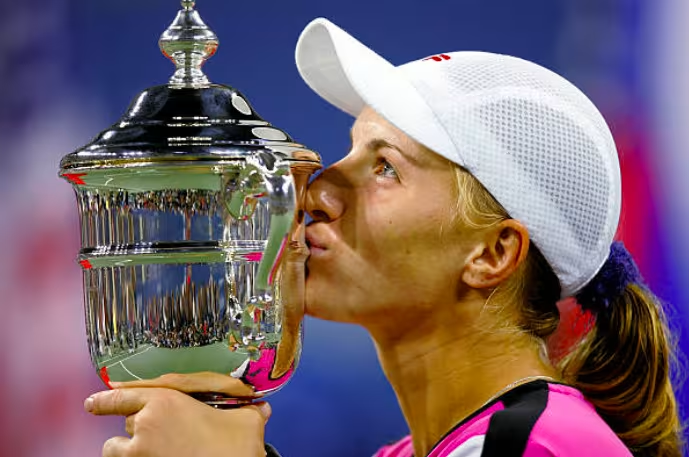
The US Open, of course. Because it was the first one and it gave me a lot of confidence to think that I could win more. But winning Roland Garros at 25, being more mature, was like confirmation. If you haven't won a Grand Slam, people criticize you. If you've won only one, people will say you've only won one. When you have two, they don't talk as much, but very few remember that I have another two Grand Slams in doubles.
Where do you keep them?
I have them at home, but in the third room, so that no one sees them (laughs).

Would you exchange one of your Grand Slams for an Olympic medal?
Yes, I would exchange it for the medal. It would be good to have both a medal and a Grand Slam, even though ideally winning both would have been best. In my case, Grand Slams have always sparked more passion in me than the Olympic Games.
And for having been World No. 1? You missed it by one position.
It's not just one position, sometimes it's just a couple of matches. It would have been good to have had it all, including the No. 1 spot, but it wouldn't have changed my life.
And the last one, keep the first image that comes to your mind. Tell me about your happiest moment on a tennis court.
[...] I go back to Cincinnati 2019, I have never moved as well in my life as in that day of the semifinals, I never played so well. At that moment, I was already older, understood everything better, saw things very clearly, and valued every situation more. That feeling is incredible.
And you had a great rival in front of you.
That match with Barty is very valuable; Carlos helped me a lot. She was World No. 1, but I felt very comfortable. I remember leaving the court, and Carlos said to me: 'Where she studies, you are the teacher' (laughs). We had a very similar tennis style, but I found it very comfortable to play against her.
This is an automatic translation. You can read the original news, Kuznetsova: “Nunca anuncié mi retirada porque no sé si voy a volver”