|
28 Jun 2026 | 22.06
|
28 Jun 2026 | 22.06






Joao Fonseca carries the distinction of being one of the standout names to follow in this Wimbledon 2026. His performance at Roland Garros was a revitalizing starting point in a career where many had begun to lose faith in him in recent months, falling behind in the kind of 'race' in which youngsters immerse themselves to reach Alcaraz and Sinner. The Brazilian's main goal is to turn that performance into a catalyst to climb several steps and approach the absolute elite... and the upcoming Grand Slam offers him a wonderful opportunity to move in that direction.
However, the grass court season has left more doubts than certainties: a defeat in his debut in Halle and absence in Eastbourne due to shoulder discomfort, two factors that have significantly dampened the hopes placed on Joao. For him, as he admitted in the press conference before the tournament, this is not a problem: he acknowledges that doubles (where he reached the final in Halle) has prepared him sufficiently for this tournament, makes it clear that he withdrew from the British tournament merely as a precaution, and demonstrates his maturity by recalling the figures of Djokovic, Nadal, and Federer as sources of inspiration. There is no doubt: Joao is fully committed to London.
Fonseca reflects on Nadal's influence and offers an inspiring view on how it changed his career
- Adapting to grass before a new Wimbledon, especially after a tour with more doubles matches than singles
"In my first year as a junior and my early years as a professional, it was challenging for me to adapt, but each year I improve more, acclimatizing faster. This year, in Halle, the adaptation came a little after the first match I lost, which was my first grass match of the year. Then I played doubles, and that helped me a lot to feel the grass more. It greatly assisted me with my serve, especially. Unfortunately, I couldn't play in Eastbourne, but I feel good on grass, playing a little better every day.
It is true that the surfaces are different. Halle is faster, Eastbourne a bit slower, and here the grass is slower. You have to adapt to each tournament, but I always look forward to Wimbledon."
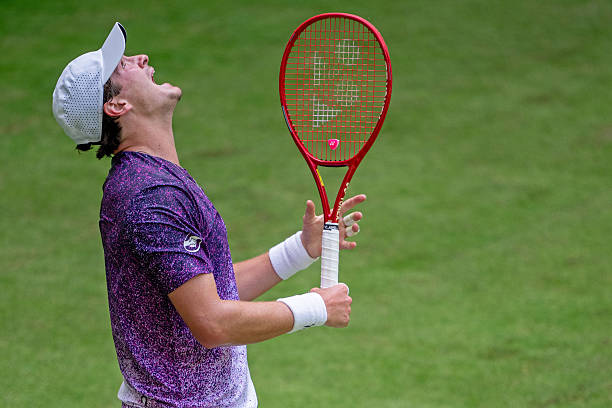
- What his performance at Roland Garros meant to him, did he prove something to himself?
"The result in Paris was significant for many reasons. Firstly, it proved to myself that I can win matches when I'm two sets down, that I can rely on my physical and mental strength. When I arrived in Paris, as I've said many times, I wasn't feeling very confident and wasn't playing good tennis. I didn't know if I would play even at 100% because I felt something in my wrist. Then I improved every day, felt better each day: it was a tournament where I had no expectations, and I had incredible results. The match against Djokovic will be a memory for a lifetime. It was significant for me in many ways, and now I just want to give more of myself to reach more objectives."
- How he feels physically after withdrawing from Eastbourne due to a shoulder injury
"It wasn't serious. It was a decision purely as a precaution to be able to play here at 100%. It's clear that the main objective was always to play Wimbledon at 100%, so we didn't want to risk by adding Eastbourne. I already feel this way, I'm at my best. The training is going great. It's incredible to be here; every match feels like an opportunity. I will debut on Court 18, I've been told it's an awesome court, I've never played there, so I hope to perform great against a tough opponent. I'll focus on my debut and take it match by match, nothing more."
- How he has improved over the past year in understanding his body and handling physical loads
"It has helped me understand how much my body can handle, that's for sure. To understand that sometimes training or playing too much can harm you. I have also realized that my mental health is crucial. The clay court season was quite long; I left Rio the week before Montecarlo and returned after Roland Garros, two months away from home. I needed to go back home and spend a week in Rio, rest, reset mentally. It was important for me to understand how to structure those weeks, feel that I needed to return. I'm still learning, gaining experience, understanding my body and mind more. I hope that in the next 15 years, I can find the best possible balance in that adaptation."
- Which aspects of his tennis shine more on grass, or he feels should shine more
"I would say the serve and the return. On grass, those are the most important things. Also, the adaptation in terms of mobility, as the ball always stays lower, you have to play more low balls. Jannik, for example, has exquisite mobility in this regard: he can slide, not many players slide on grass as well. Those are the most important things because on grass... you can only place the ball... in Portuguese, there is a saying, I can't express it in English (laughs). If the ball eats you up, you can't... that ball doesn't generate power. You always have to anticipate and get to the ball first. That's what I'm trying to learn on grass. Each year, I adapt better. If you don't go for the ball, the ball will eat you up, and you'll barely be able to apply power."
- What he has learned from the best, including the Big Three and even Alcaraz and Sinner
"I believe what inspired me first was observing how talent combined with hard work. I'm a fan of Federer, always watched him, but now I can say more about Nadal. Nadal is a person with a lot of talent, but people sometimes only notice his hard work, how he fights, how he gives everything. Yes, but you have to combine both. That always inspired me. When I was younger, I wasn't the most hardworking type. At 13 or 14 years old, I understood that by combining the two, I would achieve my goals faster."
That was the first thing that clicked for me. They have inspired me... with how they express themselves, how humble they are, how they always stayed grounded. When you have 24 Grand Slams, for example, you have nothing more to win, and yet you continue in the game purely out of love for this sport. I also enjoy playing this sport out of love and when I connect with such great people, they are an inspiration."
This news is an automatic translation. You can read the original news, Fonseca desvela la característica de Nadal que le inspiró a cambiar su carrera
-
 28 Jun 2026 | 11:00Ruud admits that Sinner and Alcaraz made him change his mind: "I was wrong"
 -
 28 Jun 2026 | 18:00Raducanu, for now, confirms her presence at Wimbledon: "The plan is to play"
 -
 28 Jun 2026 | 23:00OFFICIAL: Raducanu finally withdraws from Wimbledon due to injury
 -
 28 Jun 2026 | 15:00The moment everyone was waiting for: Alcaraz already trains with his right hand
 -
 28 Jun 2026 | 13:00These are all the players arriving at Wimbledon injured or with some discomfort
 -
 28 Jun 2026 | 12:00Zverev surprises before Wimbledon: "I have a grass allergy"