|
4 Jun 2026 | 16.56
|
4 Jun 2026 | 16.56





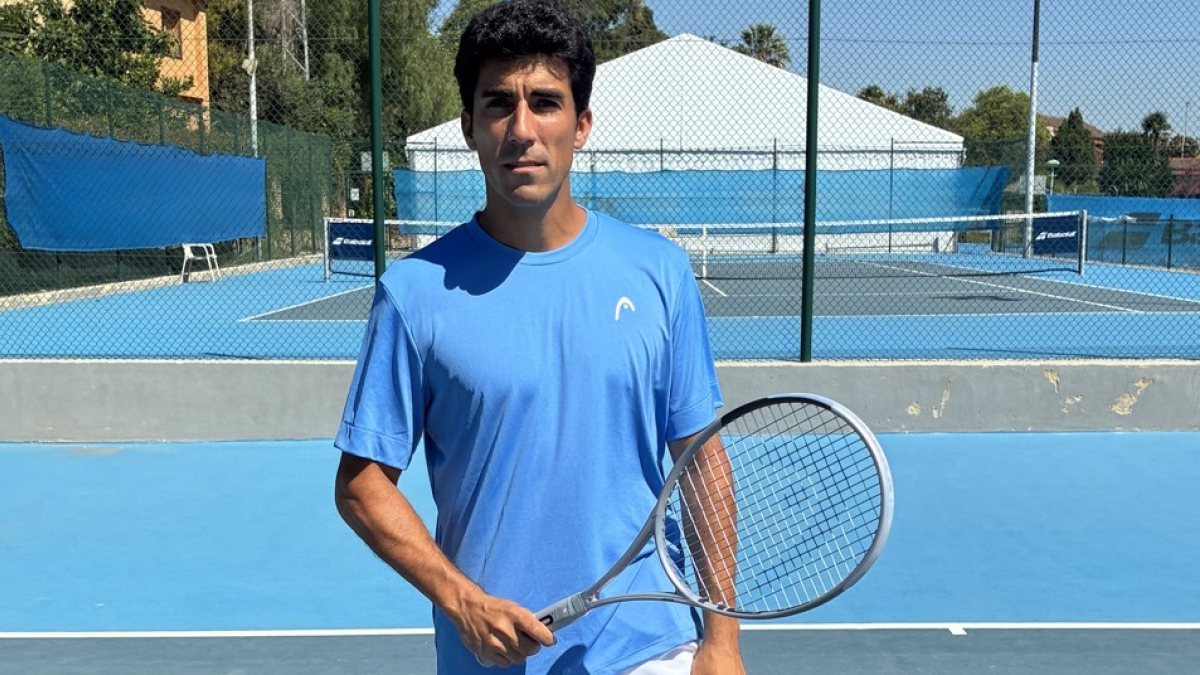


There is a question that tennis players have been asking themselves for years without saying it out loud: why is it that when a racket has power, the arm suffers, and when it takes care of the arm, you lack punch? HEAD has been working on that answer for some time. With the Squared², they believe they have found it. And after putting it to the test on the court, there are reasons to believe them.
Design: what seems still, moves
The Squared² doesn't catch your eye in a conventional way. Its holographic gray finish oscillates between magenta and bluish-green depending on how the light hits it: one of those things you don't notice until you do, and then you can't stop seeing it. Some details in black and the heart of the racket in shiny silver gray complete an aesthetic that seems discreet in hand and has a hypnotic quality in motion. No aggressive logos or screaming colors. It fits perfectly with what it is: precise, modern, and quietly impossible to ignore.
Specifications and technology: a construction like no other
The specs: 100 square inch head, 295 grams unstrung, 29.5 cm balance unstrung, stiffness of 60, and string pattern of 16x18. On paper, a racket with very low balance. On the court, the lightest-headed racket that HEAD has ever manufactured.
But what's most striking is not the numbers but how it's built. The Squared² incorporates two tubes within the same frame: the outer one made of Torayca™ T800S carbon fiber by Toray, providing stability and speed in the strike; the inner one, filled with foam and running from the grip to the main strings, dedicated to absorbing what the arm shouldn't have to endure. It's not a filtering technology. It's a separation of functions within the same structure, and that conceptual difference translates into something noticeable from the first rally.
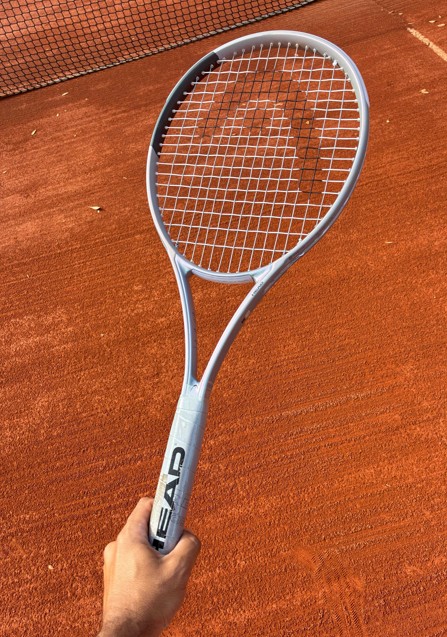
And the large holes in the string pattern are not a minor detail: they directly contribute to the ball coming off with more power than the 295 grams might suggest.
From the baseline: control and power without overexertion
From the baseline, the Squared² surprises with how easy it is to play well with it. The low balance towards the handle makes it extremely maneuverable in exchanges, with a swing speed achieved without straining the motion. And what might seem like it would diminish power, it doesn't.
It doesn't matter if your game is more about hitting with a lot of spin or flatter. It doesn't matter if you have precise timing that day or if it's a bit rusty. The Squared² provides you with tools to make the outcome positive in both scenarios. That adaptability is not something to be taken for granted.
If I had to place it in the HEAD lineup, I would say it's between the Extreme and the Radical, although clearly closer to the latter. It shares with the Radical that balance between control, handling, and feel, without leaning towards pure power or pinpoint control extremes.
At the net: appreciated agility
At the net, the head's lightness becomes a very tangible advantage. Quick reaction situations, where there's no time to think and the motion has to be instinctive, are handled with a fluidity that simply doesn't exist in other more balanced rackets or ones with more weight in the head. Volleys feel solid and controlled, and moving the racket from side to side in net exchanges almost happens on its own. For those who enjoy coming to the net or find themselves in volley situations frequently, the Squared² is a very viable option.
On serve: hand speed and gesture security
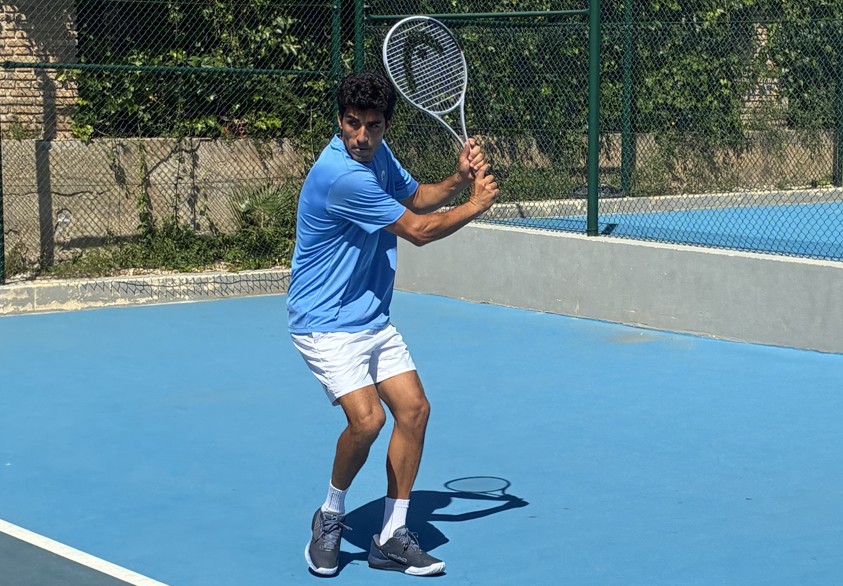
When serving, maneuverability takes the spotlight again. Accelerating the hand is easy, the motion doesn't demand extra effort, and seeking effect—slice or topspin—feels natural. It's not a racket that turns the serve into a destructive weapon, but one that provides consistency and direction very reliably. And in a long match, that counts for a lot more than it may seem initially.
In the return game: for those who need to react, not just attack
The return game is perhaps where the philosophy of the Squared² is best understood. It's not just for those who want to hit hard from the first shot; it's for those who need to take their hands out when the ball comes fast, close or with a lot of spin. The low balance turns challenging situations into manageable ones, and that—in the context of a real match, with pressure and crucial points—is exactly what makes the difference between holding on to the point or giving it away.
Who is it for?
The name that immediately comes to mind is Taylor Fritz. A complete player, solid in all aspects of the game, not relying on a single pattern to win points, and valuing having a racket that feels comfortable both from the baseline, at the net, or on serve. That versatility is exactly what the Squared² embodies.
But what's interesting is that HEAD has designed it for players of all levels and ages, and on the court, this is confirmed. It doesn't require a specific type of tennis or a minimum level of technical skill to benefit from it. However, if your game involves significant skill, maneuverability, and point construction with variations, you will find in this racket a partner that understands precisely what you're looking for.
Conclusion: breaking the usual logic
The HEAD Squared² isn't a racket that adds nuances to the catalog. It proposes a different way of building the game: with less effort, more confidence, and without having to give up anything in the process. Manageable without being soft, powerful without being heavy, comfortable without losing feel.
If you've been searching for a racket that adapts to you instead of requiring you to adapt to it, the Squared² deserves a chance. You probably won't regret it.
This news is an automatic translation. You can read the original news, HEAD Squared²: la raqueta que no te pide que elijas
-
 04 Jun 2026 | 09:00Jódar assesses Roland Garros and sets goals for the rest of the season
 -
 04 Jun 2026 | 18:00Kostyuk points out the reason that made her lose against Andreeva
 -
 04 Jun 2026 | 21:00Analysis of the Roland Garros semifinals: Everyone against Zverev
 -
 03 Jun 2026 | 20:00Injuries once again sink Berrettini, and Arnaldi moves on to Roland Garros semis
 -
 04 Jun 2026 | 15:00Andreeva crushes Kostyuk to reach the final of Roland Garros
 -
 03 Jun 2026 | 23:00Berrettini, after another withdrawal at Roland Garros: "I am fed up"
 -
 04 Jun 2026 | 19:00Chwalinska and her 'vintage' tennis reach the Roland Garros final
 -
 03 Jun 2026 | 23:00Is Arnaldi prepared to win Roland Garros?: "I still have energy left"
 -
 04 Jun 2026 | 21:00Chwalinska: "When I started playing tennis, everything revolved around Federer"
 -
 04 Jun 2026 | 16:00HEAD Squared²: the racket that doesn't ask you to choose
 -
 04 Jun 2026 | 15:00Arnaldi's feat: from world No. 104 to Roland Garros semifinals
 -
 04 Jun 2026 | 19:00Andreeva is ready: "Now I am more mature, I face the matches in a different way"