

The day Djokovic helped create the 'Monstruo Jannik Sinner'
Darren Cahill, current coach of the Italian, deeply recalls one of the episodes that has marked Jannik's sports career. The protagonist? A certain Novak Djokovic.

In the process of cooking and evolving a player, experiences of all kinds intersect. Positive, negative; of learning, of failures; that generate a lasting impact or that become merely fleeting. How to extract a learning from all of them ends up shaping the character of a player and their ability to overcome stages, something in which Jannik Sinner has become an expert over time, completing a journey that leads him to be at Roland Garros 2026 as an indisputable candidate to complete the Career Grand Slam.
One of the main reasons for his rapid rise is Darren Cahill, an expert star maker and tennis father of San Candido's own. His arrival at the 'Team Sinner', forming a lethal duo with Simone Vagnozzi, marked the beginning of the most glorious pages of the Italian's album, although the epics and epic tales were preceded, of course, by moments of suffering, of instances where the horizon also showed dark clouds.
Before becoming the Grand Slam champion Jannik, there were certain episodes in the Italian's career that served as turning points. Throughout the year 2023, the transalpine gradually improved his game, adding new variations to his tennis, but still struggling physically... and, why not say it, in the pressure moments of the match, where if his opponent entered a perfect communion with the public, it seemed that Sinner diminished. Few experiences provided as many lessons as his defeat against Novak Djokovic at Wimbledon 2023, a match in which he led by two sets to zero... and which would ultimately become, according to Cahill himself, a central episode for his development.
The day Djokovic laid the first bricks to build the current Sinner
After that match, which left a devastating internal wound in the Italian, Darren Cahill was very clear about whom to turn to. No one more suited to offer his vision of Jannik's growth than the very person who had just defeated them, giving them a class on time management, endurance, and mental strength. Few minds are more extraordinary at dissecting opponents than Novak Djokovic's, but the timing was somewhat strange: after all, he had just shattered Jannik's dreams... would that aspect hold him back? As Darren revealed a few hours ago in a conversation with Brad Gilbert, that talk with the Belgrade native laid the foundation for the Sinner we know today, a narrative piece that would eventually intertwine their stories time later.
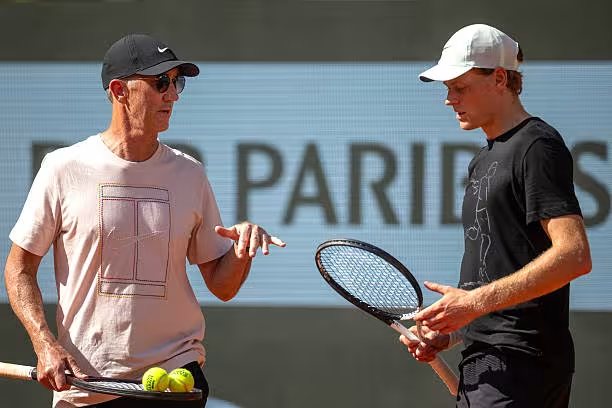
"There were a couple of matches that helped Jannik a lot in his growth. Losing to Novak after leading by two sets to zero... then they faced each other again the following year, and I think, despite losing in straight sets, Jannik played at a higher level. Yes, I remember grabbing Novak after he finished his interview and told him: 'Look, I'm starting with Jannik, I don't want you to overdo it, you can be respectful, of course, and you don't need to tell me anything, but is there anything about him that catches your attention that could help me start working with him?'
He doesn't remember this, by the way (smiles), but he gave me a talk of around 10 or 15 minutes in which he analyzed his game down to the millimeter. He spoke about the variety or lack of variety in his game, about how you get used to the weight and depth of his ball, about how you're not afraid when he comes to the net, as you know it's something he doesn't like, about how he doesn't use the drop shot or how his serve was relatively easy to read. Many of these things we already knew, although not all, but we were able to return to Jannik together and emphasize that we had to keep doing what we were doing, that Novak had said these things, and that it meant a lot that Novak provided us with all this information. He immediately said it was time to get back to work," Cahill states unabashedly, even pointing to that conversation as the beginning of all the work in recent seasons on the unpredictability and variety of the Italian's tennis.
"All of that is what we work on every day to create variety in Jannik's tennis, to create the ability to finish points, as many juniors struggle in their transition to professionalism for one reason: everyone hits the ball so well from the baseline that, against the best on the planet, how are you going to finish points? How do you complete them? To do that against the best, you need either a definitive shot, either a great serve or a great forehand, or have a very good transition game to the net, or attract your opponent to the net, or create angles on the court. Variety is key in today's tennis, and over the last three or four years, Simone and I have spent a lot of time, especially Simone, creating more skills to finish points in Jannik's game," he affirms with the calmness of someone who has done a great job.
"We haven't seen the best Sinner yet"
Perhaps what is most striking when listening to Cahill is his conviction in affirming that Sinner is not yet a rounded product, a perfect machine with all updates downloaded: there are still more add-ons to include, more aspects to develop, in a project that is far from having its end. "Jannik is not afraid to try new things. Firstly, that seems very brave to me, but I think it stems from his mindset, his eagerness to continually improve, always thinking about being better. He knows he's not playing, yet, his best tennis. He believes, and I also believe, that he will play his best tennis when he's 27, 28, 29, or 30 years old, so there's no reason to stop experimenting with your tennis."
All of this explains very well the increase in the drop shot we have seen in recent times from San Candido's player, his ability to take more risks with the serve or to rely less on his ball power from the baseline. The goal is to continue lubricating the pieces of a machine that has not tasted defeat since February... but that is still, according to Darren, far from finding its final version. Let the rest of the circuit get ready.
This is an automatic translation. You can read the original news, El día en el que Djokovic ayudó a crear el "Monstruo Jannik Sinner"