

"Sinner and Alcaraz have a lot to prove to say they are better than the Big3"
The Faulconbridge Cup gives us a final interview with one of the most celebrated coaches in our tennis. Javier Piles recalls some experiences with David Ferrer, analyzes the current circuit, and confesses why he has turned down some offers.

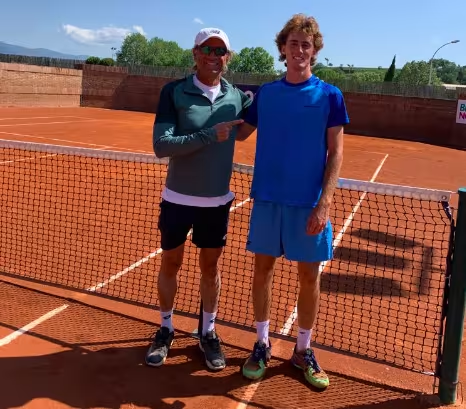
The preliminary phase of the 2026 Faulconbridge Cup begins, and on Court 4, Alejandro Juan Mano steps in to play. He is a 21-year-old from Valencia, currently ranked #735. In the stands, his coach, Javier Piles, gets ready to take note of every detail.
The match against Henri Squire (25 years old, #258 ATP) ends in a defeat with a double 6-3 score, a new experience to learn from on the challenging path towards the elite. For those who may not know him, Javier Piles (Valencia, 1968) is a tennis person, he loves talking about this sport. Minutes after the match, as I run into him at the Valencia Tennis Club, a simple greeting is enough for him to quickly analyze the missing keys that would have led to a more favorable score.
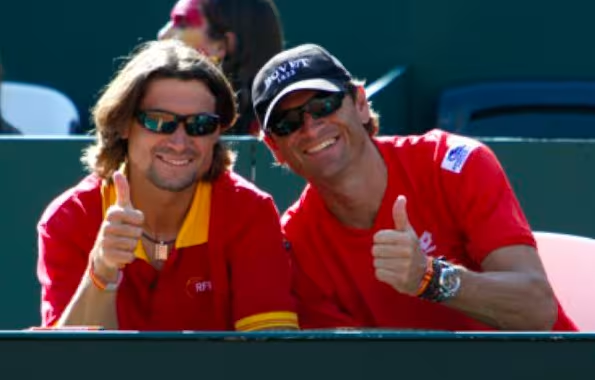
Talking with Javi is a pleasure, and at some point in our conversation, it's also a way to revisit his best years, those 17 seasons where he shaped, accompanied, and guided David Ferrer from the ground up to the top 3 of the world rankings. Life granted him a unique experience but also left a toll: no stone on the path would be the same. After trying with several players, the coach has spent two years laying the foundation for Alejandro Juan, ready once again to mold a champion. As the process unfolds, an interview to pass the time is most welcome.
Alejandro Juan Mano, what can you tell me about him?
He is a young player with a lot of enthusiasm, technically quite correct, and very physical. He has ball acceleration and quick arm movement, but he is at a stage where he needs to improve many things.
Above all…?
Above all, knowing how to act depending on the score. If you are 0-30, you have to act in one way, but if you are 30-0, you have to act differently. You have to be very clever on the court to make a sensible and logical chess move. He is in that training phase, to stop making mistakes. If he succeeds, he could be someone we see at the top.
The player usually wants to rush to the top, does the coach as well?
It can happen, but experience and comparison lead you to be more confident in what you say and do. If I didn't have experience, I would keep quiet and let him play, let him do what he wants on the court. I think there has to be a specific point between player and coach so we always row in the same direction. Can the coach be in a rush? Surely, many times we make mistakes, hence the player may get upset when things don't go well.
Alejandro must have something special for you to have been working with him for over two years.
Of course, one has to hold on to that motivation. I see this kid with a ball rhythm like the top players, even if it's just for 20 minutes. The challenge is to extend it to 30 minutes within a week, 40 minutes next month, gradually maintaining that ball rhythm. We also have certain deficiencies in some situations, so we will have to improve them if we want to reach the place we aim for.
Injuries haven't allowed you to run either.
He had a back injury that lasted nine months, in addition to some elbow overload. Nowadays, many players at all levels are getting injured; in the end, the ball moves very fast and the average level is very high, but sometimes the body is not prepared. There are young people who start hitting the ball very hard, creating an imbalance between ball speed and physical condition that ends up taking its toll.
Have you received offers from the circuit in recent years?
Yes, a few. I didn't jump at any because I have other aspirations at the moment. I've always liked this phrase: 'The player can leave the coach, but the coach cannot abandon the player'. I want to remain true to that principle.
You don't want to start a project you might regret later.
Sure, I don't want to abandon a player that I've brought up; I don't want to build trust with the player and then step aside. For instance, when you take on a player who is already developed, to accompany them to tournaments and contribute as much as you can, you might find that things are not going the way you want. That's why I prefer to train them during their youth when they make fixable mistakes. This motivates me more than supporting players who are already established but don't share my tennis vision. In the end, this leads to constant clashes, a daily battle.
You know you will never find another David.
I know, I know. David Ferrer was a needle in a haystack. The way that boy evolved and improved his way of thinking to reach #3 in the world was incredible; I would have never thought that possible in my life. All the titles he won, all the finals... but well, one must have hope to continue in life after so many years. For now, I don't want to think about retirement (laughs).
Afterward, you worked with other players: Bautista, Raonic, Ymer, Shapovalov, Kuznetsova... Did any of them charm you in the same way?
It was incomparable. With David, it was like both of us coming out of our shells, throwing ourselves into the world to seek our fortune. That whole process of evolving and gaining experience together is incomparable to anything else. For me, David was like a son; we functioned 24 hours a day, overcoming many obstacles. When you have a player who is already formed, with no needs and financially secure, then the player is in charge above all. You may even feel like you're not contributing anything to the team.
I think of someone who had a very attractive girlfriend. The day they break up, they may not want another girlfriend because they know they won't find another like her.
Because she was pretty or because I was very in love, it could be... It was a pity the way everything ended, but one has to be prepared for these things. Then when you travel with a Raonic or a Shapovalov, you know that it has a duration, so you are already prepared for the moment when the relationship breaks. It could be comparable to a girlfriend of many years, yes.
Why don't you feel like traveling? What holds you back?
Personal matters pile up, now I have a son in the United States and a daughter in Dubai. Leaving my wife alone also weighs on me, I spent many years traveling where she had to put up with a lot. This holds me back from diving into the project... I would really have to be convinced by the project... For example, if (Corentin) Moutet calls you, well, it's very complicated. A player who goes on court with headphones while the coach is talking to him.
(Laughs)
It's great, and I love watching him play, I would pay for a ticket, but it has to be a project that suits me and has continuity.
Like who?
Any complete player. A Tsitsipas, for example.
It wouldn't be easy.
It would be very difficult, but there are players who are very closed-minded, that's why it's complicated.
Give me one that would be irresistible.
I don't know... Who wouldn't want to have a Musetti? A Sinner? Disciplined players, with patience and dedication. Some have been suggested to me, but it hasn't worked out due to my personal affairs.
Can you imagine yourself with Alcaraz?
Alcaraz is well managed by his team. People criticized him when Juan Carlos left, but that discipline and dedication have been maintained with Samuel López. If he loses a couple of matches, it's no problem; we have to let him work. It's not a coaching issue. Now, it's true that the injury he has is serious, it may be more complicated than it seems...

Are you attracted to this circuit dominated by Sinner and Alcaraz?
I believe that people don't like everything revolving around two players. It's always nice when new talents emerge to compete with them, but right now the feeling is that they are two steps ahead of the rest. Zverev cannot seem to gain confidence, and while Musetti plays very well, when it really matters, he lacks ambition.
How do we solve that?
David said that this situation should drive you to raise your level. Without Federer and Rafa, would he have been World No. 1? Well, I don't know, but they helped him raise his level, push himself more, gain confidence, and dedication to beat players like Tsonga, Berdych, or Wawrinka in the second tier. Let's hope things change, and people start raising their level; everyone says that the average level has increased a lot.
How do you notice it?
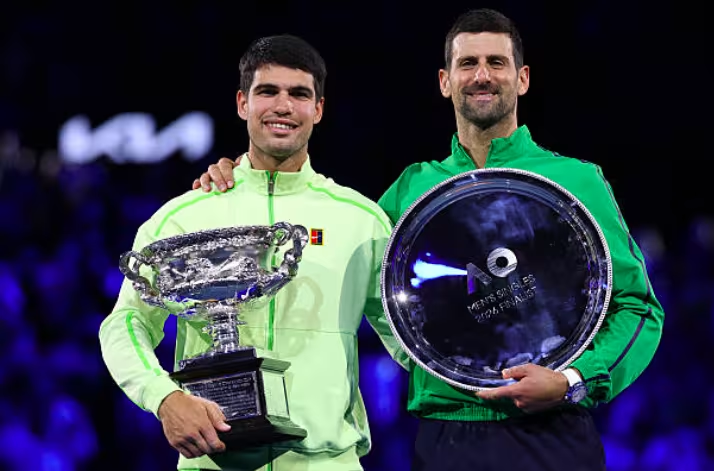
In the first shots, mainly. Most hit very hard, they have a lot of power, they are all very good with the first ball. Right now, it's difficult to save a serve and first shot situation. It's hard to appreciate it on television, but I understand that Sinner and Alcaraz are at the level of the best in history...
At the level of the Big3?
I think Federer was better [...] And a Djokovic was better. And a Rafa Nadal, of course, was better.
People forget quickly.
I don't forget, they used to save impossible situations, balls that were beyond logic and physics, always winning at critical moments. I dare say that era was superior to the current one, they still have a lot to prove to say they are better than the Big3.
The best David, would he have beaten Sinner and Alcaraz?
Is it easier to beat Alcaraz?
What I believe is that Alcaraz gives you more opportunities, he can leave the door open more often. He is very aggressive and has more variations, but overconfidence can lead you to make mistakes. Sinner is more German, more cerebral, more consistent.
What do you think of Zverev? Your profile would fit well within his team, why hasn't he called you?
Because there are two thousand coaches ahead of me (laughs).
Will he win a Grand Slam or not?
Tell me which player you see causing problems for Sinner and Alcaraz.
We have to wait and see, Zverev and Medvedev seem to lack motivation to push themselves in their daily routines. I don't know, maybe Medvedev lacks motivation, maybe to be the best Russian in history? Rafa Nadal wanted to be the best player in history, that's why he never settled for just winning Grand Slams.
These players don't aim that high.
There is a lack of commitment when they have already achieved everything and have no financial need. Here, you can't lose focus if you want to excel every week; many even get comfortable with injuries: 'No, I'm injured...' Why did Djokovic never get injured? Why did Federer never get injured? Why did David never get injured? Because they were prepared and focused on physical conditioning all the time. I might be wrong, but if you want to face such a demanding and tough circuit, you must be physically prepared.

Sergi Bruguera told me the same thing, there are players in the top 20 without motivation.
They lack ambition and have too much money. Now they earn three times the money from David's time. Where now they earn five million, before it was one and a half million, which was already a lot! Tennis is a very complicated sport; it's not like football where you sign a contract and have that security. Here, you get injured, and things go downhill fast. It may be that there is a lack of motivation in many players, especially in those expected to do much more. You have to struggle in training, especially physically; you have to be prepared to suffer on the court. That's how Rafa and David always did it; they were players who suffered a lot on the court.
There is a lot of emphasis on the soft player and less on the coach. What if coaches nowadays don't push as hard as before?
There, I can't tell you because I'm not involved in the day-to-day of the teams. I know very good coaches, for example, the Argentinians are hard workers, they put in the hours necessary.
But do they press like before? I'm not just talking about the physical aspect, but also personally.
Well, I don't know, that's why I say it's more interesting to develop a player, because during those stages they have certain tennis and physical obligations, and if they don't go through that, it's very difficult to reach the top. When you are with a top player, what he asks of you is the perfect word at the exact moment. Every coach knows what they have to do, there will be players that you can push harder and others less, although many will go with the handbrake on for fear of damaging the relationship.
Locking the player in the broom closet is no longer the trend.
(Laughs)
That was universal.
No way, no way. If I could go back, I would change many things.
That anecdote went around a lot...
Sure, it must have been written in all languages and on all continents.
What exactly happened? I don't think I ever asked you in an interview.
We were training in Dénia, it was 9:05 in the morning and David didn't want to train anymore. He was still very young, but it wasn't the first time this had happened.
- ‘This is shit!’
- ‘I don't know what the hell I'm doing playing tennis!’
- ‘I don't like this at all!’
- ‘I don't want to travel!’
- ‘I don't want to play!’
By the third or fourth time he did it, I grabbed him by the ear, put him in the ballroom, and locked him in from 9:00 a.m. to 12:00 p.m. That was his training schedule, so I didn't return until 12:00 p.m. to ask him if he wanted to do physical training [...] And if he didn't want to, he could go home.
What did David do?
- ‘Open up, open up!’
I went to the window and between the bars I left him a bottle of water and a piece of bread so he could eat something and wouldn't get dehydrated. Then he started calling the other coaches:
- ‘Open up, that son of a bitch Piles has locked me in the little room!’
Did no one help him out?
They knew that if they opened it, they'd be out on the street (laughs) [...] No, when I got mad... well, those are things I would change if I could go back.
But that forges the player.
Yes, but then they give you lessons, they correct things that you could have changed or approached differently. I do not pride myself on that chapter or other things that have happened.
Can you imagine something like that in 2026…?
You go out on the street in the first minute (laughs).
This is an automatic translation. You can read the original news, “Sinner y Alcaraz tienen mucho que demostrar para decir que son mejores que el Big3”