

Bublik: "Doubles is not tennis. It is very simple"
Bublik speaks out candidly about tennis, social media, money, and delivers a devastating blow to doubles: "That is not tennis."

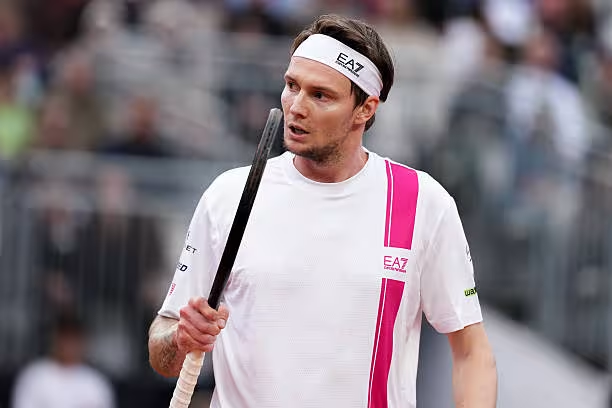
Alexander Bublik has never been a conventional tennis player. On the court, his unpredictable and creative style has made him one of the most difficult players to decipher on the circuit. Off the court, his frankness—often uncomfortable—has earned him as many admirers as detractors. The Kazakh has once again made headlines in an extensive interview granted to The Guardian, where he spoke candidly about tennis, social media, money, and doubles players.
Just a year ago, Bublik was going through one of the most delicate moments of his career, falling outside the top-80 and even forced to compete in Challenger tournaments. However, he managed to reinvent himself to reach his first Grand Slam quarterfinals at Roland Garros, lift five titles in the last twelve months, and break into the top-10 for the first time. But his personality remains unchanged.
"I think all social media is fake"
Often known for his outbursts or eccentricities on the court, Bublik did not hold back in addressing it. “Emotions are emotions. I think we live in a world where everyone tries to pretend. I don't think there's anything wrong with releasing your emotions occasionally. This is a very stressful sport. We travel a lot, play a lot, and there's a lot at stake.” The Kazakh went even further when asked if he believes that players present a less authentic image publicly. “I think all social media is fake. People pretend to be someone they're not. Everything seems fake,” he concluded.
Perhaps the most controversial statement came when discussing doubles specialists, a discipline that Bublik does not consider comparable to individual tennis. “Doubles is not tennis. It's half tennis. If you can't play singles, you play doubles. If you can't play doubles, you play paddle. Very simple.”
Bublik explains his major mental shift
Bublik also recalled the toughest moment of his recent career when he fell out of the top-50 for the first time in seven years and had to compete on the Challenger circuit. “Nobody wants to be the 80th in the world. It was the first time in seven years that I dropped out of the top-50. It was a blow for me.” A situation that forced him to rethink many things about his career and professionalism. “I understood that success meant seeing my career as a job and applying myself every day. I started to really enjoy tennis,” he commented.
As clear as ever, 'Sasha' also did not shy away from the topic of money. “You quickly realize, when you start making money playing tennis, that this is a big business. It's great to win trophies and play in big stadiums, but at the end of the day you have to pay yourself. That was my first motivation when I turned pro.”
At 28 years old and with his career relaunched, Bublik's great challenge will now be to sustain the level and prove that his breakthrough was not temporary.
This is an automatic translation. You can read the original news, Bublik: "El dobles no es tenis. Es muy simple"