

INTERVIEW | Daniel Vallejo: "I will never be World No. 1, but I dream of the top 10"
We spoke with the best Paraguayan tennis player of the moment about how his arrival to the top100 has been, his work alongside 'Gringo' Schneiter, and his upcoming challenges to fulfill.

At 22 years old, Daniel Vallejo is experiencing the best moment of his sports career, now inside the top 100 and alongside a coach who has found the right formula. This week, the Copa Faulconbridge allows us to sit with him and learn more about the process.
Walking around the Club de Tenis Valencia these days, more than one may have come across this scene: Daniel Vallejo (Paraguay, 2004) playing cards with his team on the club's terrace. He appears calm, confident, but grounded. The player from Asunción values having been the former Junior World No. 1, but is aware of his current position. With Andrés Schneiter by his side, he has managed to showcase his true potential, confirming the significance of the coach's role. Just a few weeks away from his Grand Slam debut, Punto de Break sits down with the Paraguayan to tell his story.
First time in Valencia?
Second time. I came for a week to train at the G Tennis Academy, right after leaving the Rafa Nadal Academy. I wanted to try it out to see if I would stay here in Spain, but in the end, I didn't.
Why?
The truth is that I already had it quite decided, it's just that my dad wanted me to give it a try. My intention was to move to Argentina, much closer to my home and South America, so I ended up making the decision even before coming here. I only came because I was in Spain, took the test, but I already had made up my mind.
How is it going in Argentina?
I've been there for a couple of years now, working privately with 'Gringo' Schneiter in Buenos Aires.

Was there no option to stay at the Rafa Nadal Academy?
That was a cycle, ultimately it's an Academy. As one grows, it's natural to seek something more personal. It was a very nice experience, I was there for almost a year, and I enjoyed it a lot. Us South Americans really like Spain for the treatment and food, so I enjoyed it.
What did you learn from that experience?
Many things, a new culture completely different from mine. I met very important people like Rafa Nadal or Toni Nadal, shared great moments with Dani Rincón or Abdullah Shelbayh. There were many experiences; living in Europe is very different from living in South America, a beautiful memory that I will always cherish.
In nine months with the 'Gringo,' you went from #250 to #80. What contributed to such a leap?
It is not the first time he has done it; he has something special. Since we started in September, things have gone very well. I am the type of person who may argue with many things at the beginning if I don't agree, but I always end up following your advice. That's the most important thing, listening to your coach and trusting him; the rest of the work was up to him.
This is not the first time 'Gringo' has produced a top 100 player.
That's right, many players have done this work with him and have also achieved success quickly. He is a great coach. The difference before and after is that I was very disorganized on the court, it was like solving a puzzle. I was doing many things at once, and none of them were working. When we started with 'Gringo' and also with Ramón Delgado, who helps me in Paraguay, we talked a lot about tactics, about how I should play on the court. That's how we began to piece together the puzzle. When you start to understand what you are playing for, you no longer get frustrated with some decisions because you already know if they are right or wrong.
Up to that point, was the process long?
Certainly, it was very difficult. If I think about everything I went through... the journey felt endless. Even when you are winning tournaments, there is a lot of stress in your daily life, a lot of mental and physical wear and tear. There were weeks where I was on the verge of collapsing, but in the end, I overcame it... This year, for example, I made it to the third round in the Australian Qualy, it was a tough blow, but the following week I became the champion at the Itajai Challenger. The next week, I won again at the Concepción Challenger. In the latter, I was very sick, with a fever, pushing myself every day. That's how tough the journey is. If I had to go through it all again, it would be very difficult, so I hope to stay here for a long time.
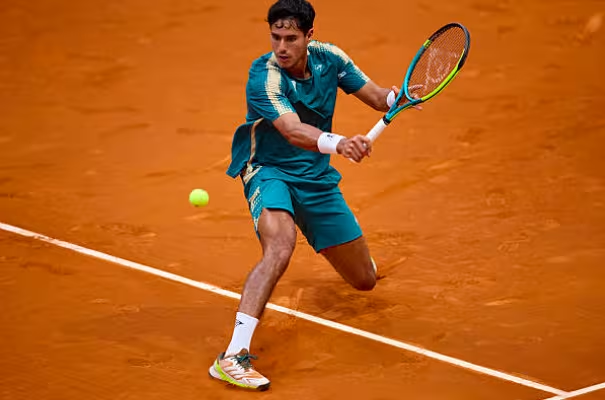
Until one morning you wake up and see your name in the top100. Did you feel it was so special?
Of course, I felt like a cycle was completed, in the end, it's the dream of a lifetime. When you start in tennis, the first thing you dream of is being top100; from there, you can set new goals, but the first step is reaching the top100. It was my goal; I never said I wanted to be top50 or a Grand Slam champion. The only thing I said as a child was that I wanted to be top100. Once you achieve it, you need to take some time and set new goals to avoid getting stuck; now I am full of motivation.
What are your new goals?
I am very young; I always knew that being top100 was the first step, so now I would like to be top50. I think I can achieve it; it's something very reachable throughout my career. I have always dreamed of having a long career and staying in the top100 for several years.
Where do you see yourself in the ranking?
Maybe moving between the top80 and top20, I don't know, but staying among the top hundred for a long time. I know it's very difficult to do, but I believe I have the qualities to achieve it. Right now, I am #80 in the world and don't defend any points until the US Open.
You were No. 1 in your junior stage; can't you imagine being No. 1 again?
ATP number one? That doesn't make sense (laughter). I will never be ATP number one...
Why?
You have to be realistic; I will not be the world No. 1, but I would like to dream of reaching the top 10. It takes a lot of effort, a lot of luck, and a lot of work. Touching the top 10 would already be crazy, but I never dreamed of being ATP No. 1, I never said it because I see it as something impossible. Others did, but we are talking about a goal that is only within reach of a few privileged ones; I do not have that talent.
What talent do you lack?
I lack many things (laughter).
Can those things be worked on?
No, they can't. To be number one is not for me, maybe to be among the top ten. Being number one is something unique; you have to be born with a privileged mind, a different talent, different strokes. Sinner, for example, is a robot, he doesn't do anything wrong. I don't have that like Sinner, nor the talent that Alcaraz has, or the discipline that Djokovic has. Out of a thousand players, one is born like that.
Tell me something you do have.
Clearly, there must be something I have; I am the third Paraguayan in history to break into the top 100. Out of thousands and thousands of Paraguayans, three in history were able to be in the top 100, so I must have good things on the court.
Tell me one.
I don't have a super standout shot, but at times, I can be a player without weak points, without gaps. I open up the court very well, I have good angles, and I change directions correctly. I can come to the net to close points, but I have to improve my serve a lot, although I usually vary it well. There is nothing I do particularly well, but there is also nothing I do very poorly. Obviously, I have to fight like a dog to win every match, otherwise, I don't beat anyone.
How do you see yourself mentally?
I still have to work on it, although I also don't know how opponents see me. Some days I can mentally falter a lot, but nowadays, opponents must see me as a very tough opponent. I have been showing week after week that I am very strong mentally, they know I will run for every ball, that I will fight until the end, you have to be very mentally prepared to do this.
When was the last time you threw away a match?
I have improved this aspect immensely since I started working with the 'Gringo.' Before, out of every ten matches, I would say I mentally faltered in 5-6. Now, out of every ten matches, I only falter in 1-2. Against Cobolli in Madrid, for example, I was not mentally sharp, but I think it was because I was already content with what I had done. I had gone through the qualifier, was in the third round, facing the world number 12. You tend to settle, like it or not, although I also felt overwhelmed. It is an aspect where there is always room for improvement, but now I feel good.
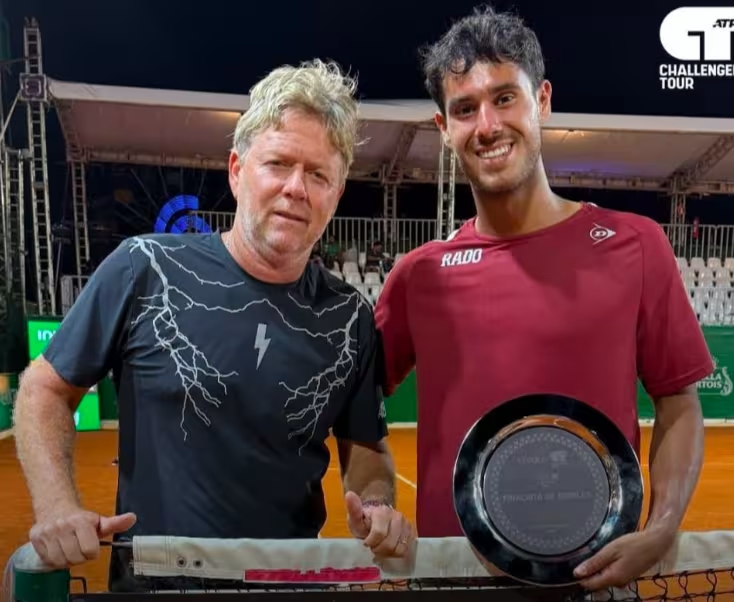
You may not remember, but I already interviewed you in December 2022.
I know, I read a lot of Punto de Break, I love the website.
Pay attention to the headline you gave me: "I believe I am the best, whether I am or not."
Very daring (laughs).
I liked it, without confidence, it's impossible to go out there.
If I had to play against Sinner tomorrow, I believe I have a chance to beat him. Otherwise, I wouldn't play the match, I wouldn't step onto the court. I know I would enjoy playing against someone like that, that's the key. Of course, there would be a high chance of losing to Sinner, but I would enjoy the experience, there lies the big difference.
With both cases being very difficult, people think it is more likely to beat Carlitos than Sinner.
I also believe that. Alcaraz is very talented, he can do many things, he's like Roger (Federer). However, there are games where he may not care if he hits three forehands out or does a drop shot, he plays for the show. If you ask ten players who they like more, Alcaraz or Sinner, eight will say Alcaraz.
I also say Alcaraz.
It's more enjoyable to watch, I prefer Alcaraz. Who could you beat out of the two? I would say Alcaraz because he may have that day where he doesn't feel like playing, there Sinner is more robotic.
Can you imagine playing against them?
I would like to play more with Sinner, I feel that he is a bit like me, but at a much higher speed. Apart from the 800 steps of difference I have with Sinner, I think I could play like him, but I would have to do it at a much faster speed and play much better.
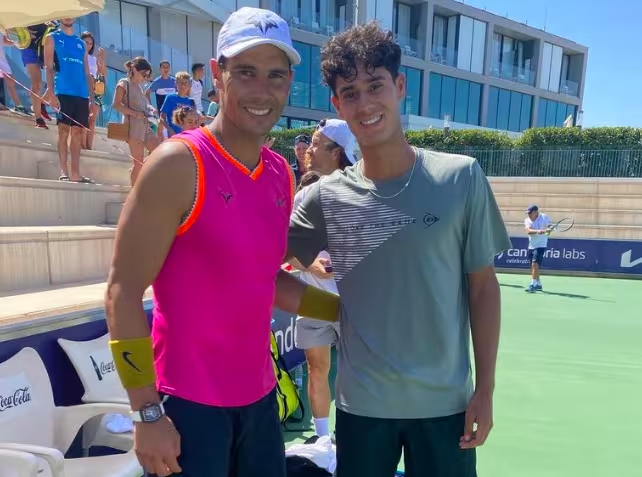
Let's talk about Paraguay, about your roots. When you step on the court, do you feel like you are playing for a whole country?
Absolutely, 100%. I have always loved becoming part of Paraguayan tennis history. What I am doing, if I were Spanish, I would just be one more player, but being Paraguayan already makes me the third best player in the history of my country. That gives you extra motivation; it's very nice that so many people follow you. I am fortunate to have a lot of support; it's an absolute pride. Hopefully, over the years, I can continue to grow and end up being the best athlete in the history of Paraguay.
That would be unbeatable.
I know it's extremely difficult, I have great respect for what Victor Pecci achieved, reaching the final at Roland Garros in 1979 and the semifinals again in 1981, in addition to being World No. 9. This is very tough to accomplish, especially what he did at Roland Garros, but I would like to enter that debate in time. Victor did not have such a long career; I don't know how many years he stayed in the top 100 or how long he was in the top 10, so I would like to have a much longer trajectory. Hopefully, I might reach the top 10 or top 20 to enter the debate. Now, final or semifinal in Paris? This will be very difficult to match.
Which tour or tournament do you see yourself breaking through in?
At Roland Garros, if I have a good draw, I can be more dangerous than on hard courts. In Madrid, for example, I beat Learner Tien. I believe that my level doesn't drop as much on hard courts, but Learner's level drops considerably on clay. The conditions in Madrid favored me a lot, so I might play Geneva next week, where I might be able to go through the Qualifying and advance a few rounds.
You never like to aim too high.
I am very realistic. In Geneva, the goal is to get through the qualifying rounds, and then whatever happens, happens. Similarly, at Roland Garros, I don't dream of making quarterfinals; reaching the third round would be the best-case scenario. The same here in Valencia, I won't say the plan is to become champion; this is a very tough tournament. If I have to dream about a tournament, I would like to reach the third round at Roland Garros... and go up from there.
Have you always had your feet on the ground?
I have always been very realistic, always set goals that I could achieve. To be in the top 50? I believe I can achieve it, even this year if the results are right. I am someone who plays well, but I am not a talent of the era. I don't know if I can reach Roland Garros in my first year as a professional and make it to the quarterfinals; very few achieve this. Rafa Jódar was #800 in the ranking a year ago and is now in the top 30 in the world, but this is not the reality for everyone. My reality is that Madrid was my first Masters 1000, where I went through qualifying and reached the third round, which is crazy to me.
You're going to cause a stir in Paris, I see it coming.
It would be great! I see it as achievable if I have a good draw and play well, but I am aware that this is my first year as a professional. Roland Garros will be my first Grand Slam main draw, so I have low expectations. I have a long career ahead; there's time to make an impact one year and reach the quarterfinals at Roland Garros.
This is an automatic translation. You can read the original news, ENTREVISTA | Daniel Vallejo: “Nunca voy a ser Nº1 del mundo, pero sueño con el top10”