

Alexander Zverev, in the hands of a Valencian
We interviewed Ramón Punzano, a prestigious physiotherapist within the professional circuit who has been working privately with the German player since last March.

They say that good things abound, that's why there are so many Spaniards within the tennis circuit. When we can't find them on the court, we will find them in his team, just ask Alexander Zverev, someone who tends to always surround himself with some of ours.
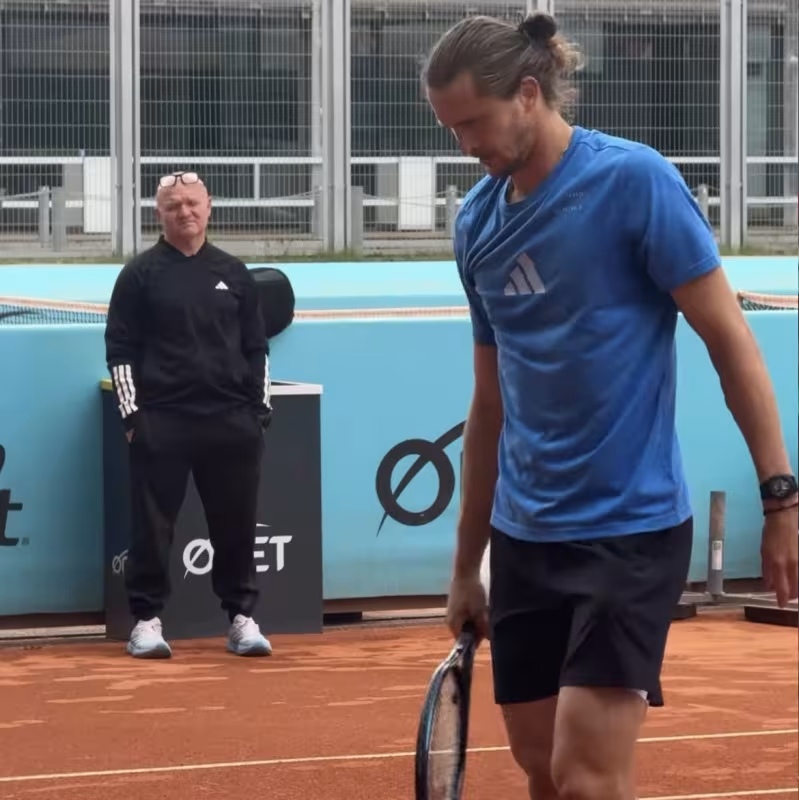
The German's latest addition is Ramón Punzano (Valencia, 1974), a physiotherapist whom we have been seeing on TV all these days whenever the camera pointed to his box. A man who has been gaining experiences within the tour in the last ten years, don't they remember him from his time with Matteo Berrettini? Today, the hands of the Valencian are responsible for taking care and protecting the Nº3 world's body, whom he has been accompanying since the last Miami tournament. A very ambitious project where his skills will be crucial for Alexander Zverev to aim for the top. An interview a bit more technical to expand our knowledge before the grand final of this Mutua Madrid Open.
How did you join Zverev's team?
By chance. It's already 20 years in the tennis world, and although it seems like a very big world, it's not that much. In the end, colleagues end up asking when they need someone, consulting with other doctors or physiotherapists on the circuit, looking for that person with a profile that might fit them. In this case, Sascha's team ended up contacting me and asking about my work situation. They needed one more person for certain weeks of the year, we tried for a while, and here we are.
What was your situation?
In 2025, I was working with Qinwen Zheng, but at the end of the season, we parted ways. I have my own practice in Valencia, but I had free time to dedicate certain weeks per year to a professional athlete.
Can you reveal who recommended you?
Certainly. Hugo Gravil, who was a ATP physiotherapist and later a private physiotherapist for many years for Sascha. They contacted him and asked if he knew someone to recommend. Coincidentally, he knew about my situation after parting ways with Qinwen, so we got in touch in February and started working in Miami.

How was the experience during these weeks?
When you start a new project, you always face the uncertainty of understanding your role, what it entails, and what you need to do. You have a new patient, who in this case you have greeted many times, but you don't know them personally. It's a strange feeling because you have to demonstrate all your professional knowledge, show them that you can truly help, that they can trust you [...] It's like actors performing for the first time, starting from scratch with that nervousness in the initial situations. Fortunately, I have been in that situation several times, which gives me a certain peace of mind.
I imagine that first time having the player at the table and starting to treat them. How do you break the ice?
In general medicine, there is a very important concept called the 'therapeutic alliance.' If a certain bond beyond treatment with the person is not formed, it becomes more difficult to help them. You have to create that bond, that connection to quickly earn the player's trust. With Sascha, what I did was study his medical history, see what preferences he has, what he likes, and what he doesn't like. This helps so that my proposals later receive a good response.
What is Zverev like physically? Anything that has surprised you?
He has a high pain tolerance, tolerates certain discomfort very well. Players I have met throughout my career would step back from minor discomforts, start thinking it was a significant problem. This then leads to not wanting to train or play [ ... ] This does not happen with Sascha. He has a fairly high pain tolerance, which allows for deep treatments and with a certain intensity that he will have no problem accepting. Normally, when a person is somewhat enduring in high performance, it tends to be more of an advantage than a disadvantage.
Does he have any disadvantages?
Yes, he has one. When the player conveys to you that they have a problem, you have to start thinking that the problem is indeed serious. You already know that with trivial issues, there is never any complaint; the player overlooks them and continues competing. That's why the therapist quickly needs to understand the player's threshold, preferably in the early days. Sascha is someone who knows how to endure, which is positive at times, although the physiotherapist must take this into serious consideration.
Is he fine now?
He's doing quite well now. He had a very serious ankle injury in 2022, but has had very few impactful injuries; that may have been the only one. Also, as I mentioned, he has a higher pain tolerance than other players I've worked with and tends to downplay certain discomforts.

That ankle injury was brutal. Do you specially care for that area?
You always check how mobility is, you know there was an injury there, there was surgery. Mechanically, there is the possibility that something is not functioning quite well in that ankle, it can happen. Both I and the rest of the professionals who work with Sascha emphasize those structures where the clinical history has been more affected. We continue working daily on ankle mobility, but without affecting other areas such as the hip or lumbar region. Right now, the player is in an optimal state for high performance, not thinking if that area might fail during a match.
Genetics will also play a role.
Indeed, genetics influence. There are players with spectacular genetics, tissues that withstand loads very well, there is the lucky factor of having very good genetics. On the other hand, the player has to be aware of self-care. As his body is his tool, the player knows that he must take care of that tool, or it won't last long. Based on the average I have encountered on the circuit, Sascha is a player who perfectly understands the need to undergo all these treatments; it is the only way to last many years in high performance.
Why do you like having Spanish presence on the team so much?
He is very hardworking, he likes to surround himself with people with a hard-worker mentality. He then applies this to his training; he is a player who trains more than average, speaking of hours. He likes that philosophy. I am aware that he has worked with Ferrero, Ferrer, Bruguera... mainly with coaches, and with me, perhaps, it may be his first experience with a Spanish physiotherapist. That mentality is very characteristic of Spanish players and coaches: a lot of sacrifice, a lot of dedication, the focus on high-intensity training to then approach competition. It is a hallmark of ours that perhaps other countries do not have, a style that resonates strongly with Sascha's philosophy.
I understand that the big danger here is that none know how to stop. Being Sascha so tolerant to pain, if you demand that he gives one more point, it is because you know he will deliver it.
This is where experience is valued, not only of a physiotherapist but of any professional in their field. We are making decisions all the time. Here the physiotherapist is the one who must decide when to take it easy so as not to affect other areas of performance. The fitness trainer aims to enhance performance, the coach seeks to improve performance, the player wants to enhance performance... and then there is the medical aspect, the physiotherapist who often travels with the player.
The counterpart in the equation.
Of course, we must know when not to push harder, when to step on the brakes, because it is very easy to get caught up in that environment where the whole team wants more, more, and more. However, our job is to bring a bit of balance. Of course, we want to improve the player's performance, but I have to ensure the player's health. It is important to have that voice to impose your opinion, although for that, it is vital to have experience. It's not easy what you're saying, but sometimes you can prevent an injury by making the right decision in time.

Perhaps it's normal after two weeks without a break in Madrid to skip Rome... but of course, try telling a top 3 player in the world to skip a Masters 1000.
That's where the physiotherapist needs to have earned the player's trust and the rest of the staff. Years ago, it was harder for me to make those decisions, but if they are not made, the problem will be greater later on. When you have already experienced a similar situation, you prefer to have an uncomfortable moment rather than a month-and-a-half injury.
Do you remember how your first trips were?
I have been doing tournaments for ten years without traveling privately with any player. At the same time, privately, I started with Juan Carlos Ferrero. He was the first player who proposed that I travel on the tour, although at that time, I preferred to finish my studies and complete my training in osteopathy and physiotherapy.
You rejected the offer?!
I had to say no. Years later, when I felt ready to do it, I started traveling with Pablo Andújar.
While we're at it, give me the complete list.
Specifically, the first one was Juan Carlos Ferrero. Then came Pablo Andújar. Next was David Ferrer, with whom I was in his final professional years. Later, I traveled with Matteo Berrettini between 2019 and 2023. Last season, I was with Qinwen Zheng, and now I am with Sascha Zverev.
Has the profession changed a lot in the last decade?
And have you changed?
I have changed in terms of managing a problem or injury, in anticipating to take care of the player's health. Experience is very important here; at the beginning, you lack the mileage to anticipate those problems, you don't know the possible consequences. With years, you can foresee how the problem will develop, even a slight discomfort, you know it will become more serious if you don't stop it immediately.
It's curious that you can do your job perfectly and the player doesn't win matches. Why would a tennis player change physiotherapist?
The physiotherapist is not the one hitting the ball, that's true (laughs). Well, I don't know about other cases, but I can tell you about mine. I stopped working with David (Ferrer) because he retired, that's clear. With Matteo (Berrettini), it was because after four intense years with many travels, it becomes tough to spend so much time away from home. It generates a very high personal wear and tear. Maybe at 20, it doesn't weigh as much, but when you've been on the circuit for a long time, it's vital to have disconnection moments from the tour. For example, in 2024, I decided to step back from the tour because I needed a break, even though I had offers.
Did you ever imagine that the figure of a physio would have such an important role on the circuit?
I never dreamed of working with these types of players, nor did I ever dream of seeing physiotherapy gaining such relevance in sports in general, and especially in tennis. Personally, I lean more towards the field of medicine than tennis, in my life, medicine holds more weight. I have worked in various sports, and it's true that tennis is the one I know the most, a sport I like. But 30 years ago, when I finished my studies, I never imagined that physiotherapy would end up having such an important place in high performance.
I don't know to what extent this is good news, it means we are pushing the human body to its limits.
This is a problem, and those who suffer the most are the players, physically and even mentally. In my opinion, rest periods should be interspersed. It's true that tennis has evolved towards a much more physical era, so now if you're not a true athlete, it's very difficult to reach high performance. This means that the physical demands on the player are much higher, both physically and mentally. Is this good? It's hard to answer, but what we must be clear about is that behind each player there is a person. All areas that make up health should take this into account.
This is an automatic translation. You can read the original news, Alexander Zverev, en manos de un valenciano