|
4 Mar 2026 | 16.30
|
4 Mar 2026 | 16.30






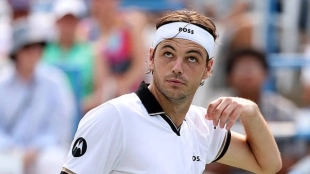
He is one of the tennis players who speaks most clearly about what he feels, and in a deep interview for a Russian media outlet, before competing in Indian Wells 2026, he has done it again. Stefanos Tsitsipas offers statements full of sensitivity in which he analyzes his rivals, talks about his ordeal with injuries, life on the ATP circuit, and his renewed ambitions.
The Greek is not going through just any moment in his career. After the toughest year he can remember, Stefanos Tsitsipas has returned to the circuit with more than just victories: a deeper insight into his profession, his body, and his mind. In an interview with Anna Chakvetadze, former tennis player, for the Russian media First&Red, Tsitsipas moves away from the standard discourse of elite athletes and puts words to a reconstruction process marked by physical pain, emotional fragility, and resilience.
A more intimate Tsitsipas: identity, roots, and the need for balance
Away from the court, Tsitsipas claims an identity that goes beyond ranking and results. In the family environment, he is not always "Stéfanos." "My mother sometimes calls me Stepkin. It's a more affectionate, simpler way," he explains. An apparently minor detail but revealing of his need to preserve a version of himself apart from the constant pressure of the circuit.
This quest for balance is also reflected in his way of disconnecting. During the preseason, he chose Namibia, an unusual destination for tennis players. "The Maldives are too predictable for any player. And the last thing I want is to do something banal," he confessed. For Tsitsipas, traveling is part of his personal growth: "Africa is a destination that has taught me a lot," although he admits that it is not always compatible with a demanding professional career: "I want to be everywhere, but I also have a tennis career," he said.
Back injury and its impact on mental health
The central theme of the conversation revolves around his back injury, an ailment that affected his season and emotional stability. Tsitsipas clearly explains the direct relationship between body and mind: "When your body is not well, your confidence crumbles." For months, he lived with a constant sense of insecurity: "Not being able to have a healthy body ultimately leads to an unhealthy mind."

The most critical point came after his elimination at the US Open. The physical pain was so intense that he began to question his continuation. "I asked myself, ‘What am I doing here? What do I do with my career?’" It was the first time that thought appeared, an unmistakable sign of the accumulated mental fatigue after months of competing without being at one hundred percent.
Resilience and commitment: persisting even when the body doesn't respond
Nevertheless, Tsitsipas did not allow himself to stop completely. He trained every day and even returned early to play the Davis Cup, driven more by collective commitment than a logical decision. "I thought more about the team than about myself," he acknowledged. His restless character also hindered rest: "I am a very hyperactive person, I don't like sitting still doing nothing."
This drive to continue, even under adverse conditions, is part of a resilience that Tsitsipas himself has had to learn to manage. "Bad things happen, but they must be faced with courage," he reflects, explaining that he tries not to react impulsively when situations get complicated.
Müller-Wohlfahrt, the key figure in his recovery
The definitive recovery came with the help of Dr. Hans-Wilhelm Müller-Wohlfahrt, a legendary figure in elite sports. Tsitsipas had no doubts about turning to him: "I have only heard good things about him." At a critical moment, he sought out the doctor who had been trusted by some of the world's best athletes.
The result, he claims, has been decisive: "I am completely fine and feel no discomfort. I owe him a lot." Beyond the physical relief, he highlights the emotional impact of the process: "It helped me win matches again and feel like myself once more." A statement that summarizes the importance of feeling healthy to compete—and live—normally.
Alcaraz, Sinner, and the fight for Grand Slams
With health restored, Tsitsipas looks to the future with ambition. He does not agree with the notion that only Carlos Alcaraz and Jannik Sinner can win Grand Slams. "I believe many players are capable," he states. Among them, he mentions Alexander Zverev, who has been "very close several times," and he highlights the growth of Andrey Rublev, whom he considers "one of the toughest rivals when he is in form."
Regarding Daniil Medvedev, he emphasizes his mental strength: "His ability not to give up is impressive." And he concludes with a conviction that explains why he keeps going, despite everything: "If I didn't believe I could win a Grand Slam, I would have already stopped playing." A statement that defines a more aware, more battered, but also more prepared Tsitsipas to try again.
This news is an automatic translation. You can read the original news, Tsitsipas: "Si no creyera que puedo ganar un Grand Slam, dejaría el tenis"
-
 27 Jul 2026 | 12:00Schedule and where to watch Rafa Jódar's debut in Washington, against Fils
 -
 27 Jul 2026 | 15:00Vagnozzi recalls Sinner's collapse at Roland Garros and explains the cause
 -
 27 Jul 2026 | 16:00Osaka: "I don't want to be famous"
 -
 28 Jul 2026 | 15:00Zverev has a real opportunity to be world number 1