

"In my time, there were no managers that controlled us, we spoke with whomever we pleased"
We interviewed Joan Gisbert from the Conde de Godó, one of the great pioneers of Spanish tennis: "Whether Alcaraz reaches the Big3 will depend on injuries."

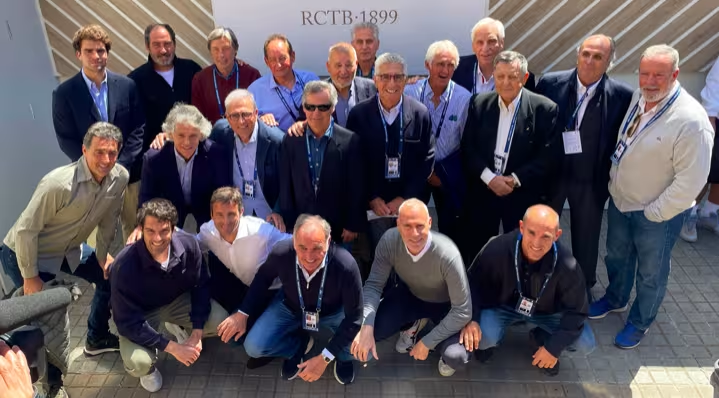
One of the great moments of each Trofeo Conde de Godó is the gathering of former Davis Cup players. On that day, at the clubhouse of RCTB 1899, one can encounter a piece of our tennis history. The most exciting part is that you never know who will come each year. Who would have told me that in 2025 I would sit down to chat about tennis with Pepe Higueras? A sense of privilege that I felt again this week when I saw the figure of Juan Gisbert (Barcelona, 1942) walking through the door.
At almost 84 years old, Gisbert's mind remains sharp to recall every detail of his extensive career. He was in those Davis Cup finals for Spain. He was in the last amateur Grand Slam final. He experienced firsthand the arrival of the Open Era. He occupies a fundamental page in the history of Spanish tennis, an interview that had not yet been read on Punto de Break.
How nice to see you here, Joan.
I am very happy to be here, grateful for the invitation. I hadn't been here since before COVID, there were two years when I couldn't come. Then my wife fell ill until, sadly, she passed away a year ago. After going through all this, the time has come to be here again.
How long have you been living in the United States?
I have been in the United States for many years... 48 years! I used to come here much more before, when my mother was alive, I used to do Miami-Barcelona about four times a year to see all my brothers and the rest of the family.
How has that reunion with your former teammates been?
It has been a very emotional moment with all the Davis Cup teammates. Pepe Higueras also came from California, so we were able to share some stories.
Which one have you shared?
Today I had to share the one that happened to Manolo Orantes and me when we won a doubles tournament in India, against the Armitraj brothers, in New Delhi. After the final, we had to go play the Masters, so the president of India took us in his private plane, which was a Russian Tupolev, where you were strapped in with belts. They didn't even let us shower! (laughs).
How the world has changed…
In those times, there were fewer means of communication, everything was different, things were passed on through words, conversations, situations, etc. Today, the Media surrounds and solves everything, now in the United States, there are people in love with their own chat, talking to artificial intelligence (laughs).
We have lost that closeness, that naturalness.
It's all a set-up business, as in all sports. Everything has become highly professionalized; it's all about managers and money, but back then, we played the Davis Cup for 400 pesetas a day… and if you won, they gave you 800!
Anything else?
That's it, they would shake your hand and thank you very much.
Would you have preferred to play in this era?
I prefer my era, but of course... I would love to play in this era too, it would mean having 50 years less (laughs).
Of all the things that have been lost, what would you say is the most relevant?
One very important thing: we were all friends before. I remember all of us going out for beers, with Rod Laver and Roy Emerson, with the entire Australian team, the Americans, the French, etc. Today, each player has a manager, two coaches, a physiotherapist, a doctor, a cook, a barber... but what is this? (Laughs) This in our era would have been very difficult to understand, we didn't have managers controlling us, we could talk to whoever we wanted. Before, there weren't so many economic interests.

You were the pioneers, with all the difficulty that entails.
We had nothing, no cars, no money, absolutely nothing. Santana, Orantes, Arilla... all of us were the pioneers of our era. Until we managed to beat the Americans in the Davis Cup in 1965, there were 700 licenses in the whole of Spain, about a thousand players. From that point on, tennis exploded and started to grow tremendously.
Was Rod Laver really that good?
He won the Grand Slam twice, up to that point only Donald Budge had done it in 1938... and if he didn't win it again, it was because World War II started after he had already won the first three. Rod Laver was incredible; I remember he beat me in the final of Tokyo in 1974, and then we flew back together. On the plane, he told me: 'Joan, I'm very happy because this year I'm going to win $150,000'. Nowadays, $150,000 is earned by posting a couple of silly things on social media.
The question of how many more titles he would have won will always remain.
He was lucky that three Grand Slams were played on grass and one on clay. If the Australians won the clay one, imagine the others! They were masters, always playing on grass. Now everything has changed; there is only one major grass tournament.
Who has been, for you, the greatest of all time?
(Thinking) Rod Laver was impressive; I played with him twice. Here in Barcelona, he beat me in 1970 in five sets, after being two sets up, 2-1 and 40-15. The next day I was exhausted, and Manolo Santana finished him off. Roy Emerson was also excellent. Manolo Orantes is the player with the most victories in history on clay; I have to mention him because I admire him a lot.
Can we compare Laver and Federer? Borg and Nadal?
It's difficult because rackets are metallic now, whereas before they were made of wood. It's like in golf, comparing the yards made with old clubs to the ones made with modern ones.
You're not taking sides, Joan.
Now it is played on similar surfaces, before the conditions were more distinct. We should make a list and say who is the best on clay, who is the best on grass, and who is the best on fast courts. On clay, we know it's Rafael Nadal, winning Roland Garros 14 times is an extraordinary achievement. Among those I played with... I would choose Emerson and Laver.
Can you imagine Nadal playing against them?
He would have made them go crazy, they would have quit tennis (laughs).
Nadal and Alcaraz almost at the same time, how lucky we are.
And this morning I was having breakfast next to Rafa Jódar, although I had already seen him play some matches there in the United States. It's incredible what Spanish tennis does and how it produces players. Years ago, we were talking about the need for someone to emerge after Nadal to keep tennis going, and then came Carlitos, a phenomenon. Thanks to him, tennis continues on an upward trend, so we have to thank him. Jódar also plays very well, we talked a lot about him during lunch, it's surprising how calmly he plays. We need more figures like him to win the Davis Cup again.
A competition that is not going through its best moment.
The situation shifted with the Laver Cup, the tournament that Federer created.
Due to the competition?
Because it occupied the most appropriate date to play the Davis Cup quarterfinals. There all the top players could play, but it was removed from the calendar to give it to Federer, ruining the Davis Cup and those ties that used to fill stadiums to capacity. Exhibitions bring in a lot of money, but they can never compare to a Roland Garros or a Wimbledon.
How did you experience the arrival of professionalism?
I couldn't play professional tennis until I was 23 years old; my father made me finish my law degree in Barcelona. When I finished, that's when I started playing, and eight months later, I won the Conde de Godó in 1965. That season, we also reached the Davis Cup final for the first time, against Australia. That year, we set the record for the most ties played: Spain played eight ties, a world record. Meanwhile, Australia went straight to the final.
And against that Australia, there wasn't much to do.
The team was impressive: Roy Emerson with 12 Grand Slams, Fred Stolle with 4, John Necombe with another 4, and Tony Roche with 2. In total, 22... but in doubles, they had 56 Grand Slams!! They made us play on grass, so we did the best we could. What could a lawyer do against professionals?

Did you feel disappointed for not winning those two finals?
Some stress always remains, even with the 1968 Australian Open final. I played the last Grand Slam final in the amateur era, and from then on, the Open Era began. I remember that the first open tournament was held in Bournemouth, a moment when all the rules changed.
For the better?
I was very happy; I went from being a lawyer to starting to play tennis at 23 years old - it was a miracle.
How was your retirement?
In the last few years, I played thanks to Manolo Orantes; we won many doubles tournaments, including the first Masters in history in 1975. That same year, we saw Manolo win the US Open, one of his great successes, but years later, he would win the individual Masters in Houston.
You witnessed the transition from Santana to Orantes, the link between them.
It was fantastic; Orantes started training with us when he was 18 years old. I remember in 1978 we were punished with a two-month stay in Australia to learn to play on grass. Manolo didn't speak English or anything; it was very funny (laughs). We are great friends, and I am very grateful to him.
Don't you think Orantes should have more recognition?
Well, yes, really. Years ago at the club, they had a picture of Andrés Gimeno, an excellent player and a close friend. But what about Orantes? Manolo has won three times in Barcelona in seven finals, but he hasn't always been recognized.

I don't understand it either.
Seven years ago, the last time I was here, looking at the tournament's historical honors board, there was a photographer but he wasn't there. I had to discuss it with the director to demand his presence, which they corrected the following year.
And you, Joan? Because you deserve a good tribute too.
Well... for me, any gesture is welcome [...] I don't expect anything from the tennis world anymore; if someone invites me for a coffee and we start talking about some match, I am already happy.
I know you have an epic comeback in your résumé.
It was here, against Alex Metreveli. I was losing two sets to one, 5-1, and 40-0, at which point half of the audience left the stadium. I was playing very poorly, but in the end, I turned it around. The next morning, the newspapers read: Spain 1-1 Russia. They had to correct it; it was Spain 2-0 Russia.
Was that your best victory?
No, the most memorable was when we defeated the Americans; there I beat Denis Ralston, who was the best in the world at that time.
Did you stay involved in tennis after retiring?
Nothing at all, I dedicated myself to business in the United States. We organized some celebrity tournaments to raise funds and then help disabled children and fight against cancer. Many actors and people from Hollywood, as well as multiple sports champions, came to play with them. It was a beautiful show that helped raise money for charitable causes.
Are you still playing?
Now I can't run or jump too much, although my knees are fine, but it's better not to force it (laughs). I try to walk fast to keep up the pace, but I'm already 84 years old.
When was the last time you played?
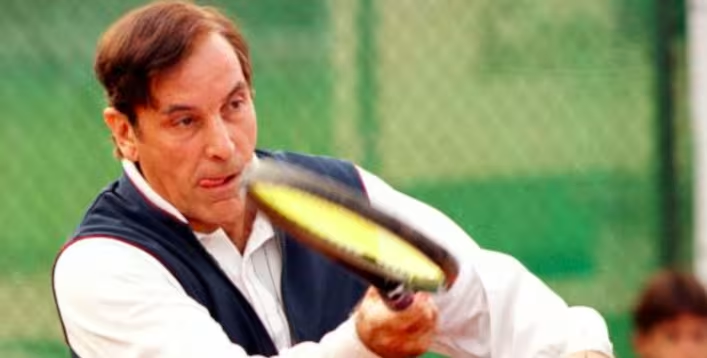
With Pepe Higueras in a tournament in California, Pancho Segura was also there. It was eight or ten years ago, with many people from Hollywood.
You must have played with quite a few legends.
So many! I played a lot with Chuck Norris in Montecarlo, John Forsythe, Linda Evans, Anthony Edwards, Sylvester Stallone, Tony Bennett, Christopher Reeve...
Can you imagine what your life would have been like without tennis?
It was another time, the situation was very different. I won the Orange Bowl, and there I was offered a scholarship to study in the United States. Artur Ashe, Charlie Pasarell, and Clark Graebner were there, so they signed me up to join them. I already had the ticket booked, but in those days it took 24 hours to Miami and 14 hours to Los Angeles... in a luxury plane! The day before leaving, my mother said to me, 'I didn't raise you to go to California, if you go, we won't see you anymore.'
A very clear turning point.
In the end, I stayed and studied at the University of Barcelona, in the law faculty, until at 23 years old, I had to choose between playing tennis or doing something else.
Interesting that you ended up living in the United States after all.
My wife was American, I fell in love, we got married, and we moved to the United States because there I had many more opportunities than here.
Joan, how do you envision tennis in the next five years?
With robots (laughter).
I'm worried.
Me too.
This modern tennis doesn't connect the same as before.
It's not as human, now it's all much more mechanical. As I said before, there are many economic interests today, when a champion emerges, 20 people immediately come out to protect him and take care of everything.
Do you usually watch tennis?
On television, I watch some.
Which player?
Rafa Jódar, for example. He plays very well, he has shown that he can go far after all the matches he has won.
And Carlitos? Will he reach the levels of the Big3?
Almost certainly, but it depends... You know what? Injuries. This is never known, I saw great players who looked like they were going to be legends and then they got stuck halfway due to too many injuries.
This is an automatic translation. You can read the original news, “En mi época no había managers que nos controlaran, hablábamos con quien nos daba la gana”