

Draper: "I aspire to return to being Top 5 in the world before the end of 2027"
Jack Draper reflects on the ordeal of his injury, the lessons it brought him during the pause, and his undiminished ambition to return to the elite.

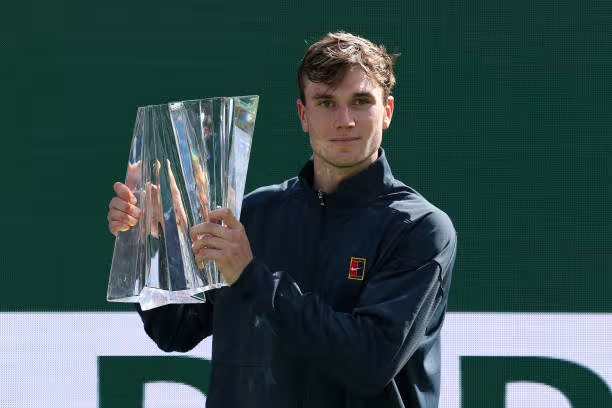
It has been a long year for Jack Draper. Very long. Twelve months after conquering Indian Wells, his first and only Masters 1000 title, and positioning himself as a real threat to the duopoly of Carlos Alcaraz and Jannik Sinner—he reached World No. 4 after that title—the Brit is back in the Californian desert. After months away due to a bone bruise in his elbow, Draper looks back with perspective: "A lot has happened in my life since then."
The halt was abrupt. After Wimbledon and a failed attempt to compete at the US Open, Draper had to accept the physical reality. "It was extremely exhausting; pain is tiring," he admitted about a process that lasted longer than expected. There were weeks without clear progress, days when frustration outweighed patience, but now, in an interview with The Athletic, he conveys the feeling of having left that ordeal behind.
What injuries don't show
Beyond the pain, the toughest part was the lack of competition. "You are used to the adrenaline of playing in front of people, and suddenly that disappears, and you go from 90 to 20 kilometers per hour. It's an adjustment. And it can be quite lonely because it's an individual sport, and you give it your all. During my time off, that was probably the hardest part: getting used to being more isolated and thinking beyond my life as a tennis player."
Far from hiding, Draper decided to showcase that process in a docuseries during his rehabilitation. His approach was clear: "I try to see the positive. What can I do? Sit and cry about it or try to work on my game?" The Brit acknowledges that the injury forced him to rethink everything: "Injuries always happen for a reason and made me analyze the work I do, how I recover, how I eat, and how I sleep."
Draper took advantage of the break not only to recover physically but also to evolve tactically in his game. "I've worked a lot on my transitional game, my volleys," he explained. "And I've served more than ever because I did it at 20%, 30%, 40%, and so on. The precision and the change in posture in the serve to help my arm take time, but you get more reps because you practice it more."

An unwavering ambition to challenge the dominance of Alcaraz and Sinner
The goal was not simply to return but to "progress to become the player I want to be." Draper returns with a new coach, Jamie Delgado, service adjustments, and a more strategic view of his schedule. He emphasizes Delgado's experience not only with Murray or Dimitrov but that he "is someone without much ego, whom I get along with extremely well, in whom I trust, and with whom I hope to achieve great things."
If there's one thing that hasn't changed for the Brit, it's his ambition. "I want to have a great year, but honestly, after what I've been through, I just want to compete again and play consistently. There's no reason why I can't do really well because I feel I am a better player than I was 12 months ago."
"My aspirations are to be back in the Top 5 in the world by the end of 2027 and be competing for Grand Slams. That could happen sooner, but it's easy to say that I want everything now. I have to be realistic," he acknowledged.
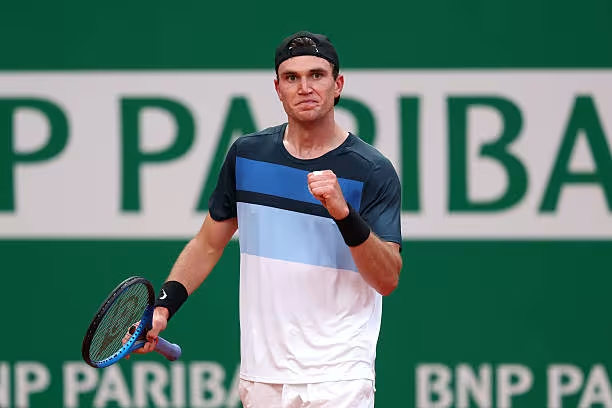
With 24 years and after eight months of uncertainty, Draper now speaks from the awareness of how fragile everything can be. "My perspective and gratitude for simply being healthy and able to do what I love have changed a lot in the last year. It can be taken away from you very quickly, and you have to truly value life and results because that's what you work so hard for. I'm proud of everything I've overcome in these last eight months to be in the position I'm in," he concluded.
His talent was never in doubt. Now, with perspective and a more rational ambition, his return could be even more dangerous than his breakthrough.
This is an automatic translation. You can read the original news, Draper: “Aspiro a volver a ser Top 5 del mundo antes de finales de 2027”