

The man who prevented the 'Rafa Slam'
Back in 2011, after winning in Paris, London, and New York, Rafa Nadal lands in Melbourne with a unique opportunity. Until a good friend snatched it away.

Rafa Nadal retired with 22 Grand Slams in his bag. He conquered the four major venues, even repeating victories in all of them. In his pursuit of excellence, he only missed chaining together the four majors consecutively. He didn't achieve it, but he came close.
To tell this story properly, we must go back to the spring of 2009 when Rafa Nadal handed over the keys of the Philippe Chatrier after 31 consecutive victories. Nothing lasts forever, not even for the clay court gladiator, who bent for the first time on the Parisian clay against a superb Robin Soderling. The dream of winning Roland Garros for the fifth time vanished on May 31, casting reasonable doubt on his upcoming commitments. How would he recover from that blow? Would it take him a long time to bounce back?
It took him a year. Twelve months of struggle, patience, and failed attempts until he returned to the French capital to reconquer the territory that belonged to him. Roland Garros 2010 extended a helping hand, finally allowing him to right the wrong by lifting the Musketeers' Cup and defeating his last vanquisher in the final. A sweet revenge that propelled the Manacor native toward a springboard of confidence that swiftly covered the lean period. After leaving Paris without dropping a single set (Mina, Zeballos, Hewitt, Bellucci, Almagro, Melzer, Soderling), the Spaniard headed to Wimbledon, where an injury had prevented him from defending his crown the previous summer.

Everything was as usual there, so Rafa returned to the grass court to claim his second trophy at the All England Club. His triumphs over Nishikori, Haase, Petzschner, Mathieu, Soderling, Murray, and Berdych remind us that the king of clay also knows how to transition to grass in record time, repeating the 'Channel Slam' he had achieved in 2008. What more could be asked of him? […] Well, once in the groove, the urge arose to go to New York and capture the US Open, the only major trophy missing from his collection. Would he have the strength for it?
He had more than enough. With victories over Gabashvili, Istomin, Simon, Feliciano, Verdasco, Youzhny, and Djokovic, the tennis world bowed before a Rafa Nadal who had already become a legend in the sport, becoming the youngest player of the Open Era (24 years old) to complete the Career Grand Slam. Three majors under his belt consecutively, a supreme form, and a level of confidence that indicated the party was far from over. The idea of maintaining this momentum in Oceania started to take shape in the Balearic's mind.
Australian Open 2011, the possibility to complete the circle
As almost always, Nadal's 2011 began in Doha, where he collected three victories before falling in the semifinals to Davydenko, one of his toughest opponents. That stumble didn't disrupt his journey in Melbourne, where he reached the quarterfinals without dropping a set after defeating Daniel, Sweeting, Tomic, and Cilic. He had racked up 25 successive wins in Grand Slam tournaments, just three steps away from sealing an unparalleled achievement. He was familiar with his next opponent, having faced him 14 times and emerged victorious on eleven occasions. They were also good friends, making it a match that Rafa looked forward to. The name of his opponent? David Ferrer.

Of the three victories Ferru had secured over Nadal before January 26, 2011, one had come at the US Open in 2007. That is, in a hard-court Grand Slam tournament. Could the man from Alicante repeat that feat? His streak of seven consecutive defeats against his compatriot didn't bode well for optimism, but as one knows, in this sport, each match is a different story. Rafa was the world No. 1, while David was No. 7. He had just lifted the trophy in Auckland two weeks earlier, so that Thursday, he entered Rod Laver Arena as an undefeated player in the current season.
The outcome of the match is likely etched in the community's memory: a straight-sets victory for Ferrer (6-4, 6-2, 6-3). The Jávea native broke the champion's 25-0 streak in Grand Slam events, advancing for the second time in his career to the semifinals of such a prestigious tournament. Before crossing paths with Andy Murray, he had to face the media, where everything was discussed except the significance of his conquest. Apparently, the focus was not on David's triumph but on Nadal's injury.
“I can't say anything about the injury; I prefer not to talk about it much. Right now, I don't know anything,” the Mallorcan replied as soon as he took his seat. “Out of respect for the winner, for a friend, I prefer to talk only about the match. He played at a very high level; I congratulate him and wish him the best for the semifinal. He's having a fantastic tournament. I'm sure he'll have a good chance if he keeps playing like this,” Rafa sharply assessed. That shield seemed impenetrable, although the press's persistence ended up breaking it down.
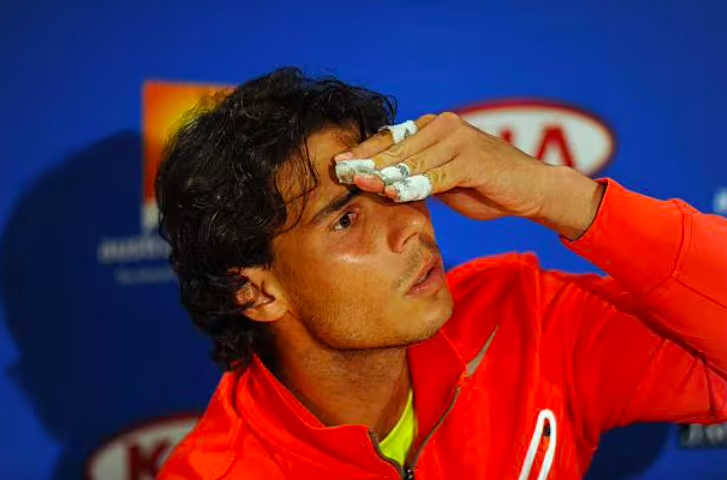
“I did my best all the time, but it's obvious that I wasn't at my best. I had a problem during the match, from the start, so it was already too late. That's all I can say […] It's hard for me to come here and talk about it; I wasn't healthy in Doha already, but now I have another problem. It seems that I always have issues when I lose, and I don't want to give that impression. Therefore, I prefer not to discuss it. It would be much more pleasant for me if you could respect this,” concluded the world's number one.
David Ferrer's take on his best victory over Nadal
Minutes later, it was Ferru's turn to speak. “It wasn't an easy match; perhaps Rafa had a physical problem, but I focused on my game. I was very consistent for three sets, remained completely focused on my tennis. To beat someone like Rafa, I need to be very aggressive; he defends incredibly, although a bit of luck is always necessary, as today. I feel very confident; I haven't lost in 2011 yet, so now I want to enjoy this moment,” he responded calmly.
At this point of the article, I could have been satisfied with what happened fifteen years ago, with the responses from those press conferences, but I am too restless. It's much better to contact the David Ferrer of 2026 to explain how he experienced that match, what such a victory meant, and of course, the million-dollar question. To what extent did Rafa's injury determine the outcome?

“In that tournament, I felt very good both in terms of tennis and physically; I was in great shape, the ball was at my mercy,” explains the former world No. 3 with his focus on 2011. “I had won the previous tournament, which made that Australian Open the best I ever played in my career. During that match, I felt like hitting easy winners, dominating all the time, it was lightning fast,” David recalls.
“Most times I had faced Rafa, I ended up overwhelmed by his serve and forehand placement, but this time I didn't have that feeling. I was so physically well that it even surprised me; I didn't step back from the baseline, which made me dominate and not have to defend as much as other times. Ultimately, that's the only way to beat Rafa in three sets without encountering much difficulty […] Do you know the feeling of playing without thinking? I felt that everything flowed; the ball was moving swiftly; I felt great even though the match was played at night,” adds the man from Alicante.
Did Nadal play injured at the Australian Open 2011?
Considering the result, the head-to-head record, the conference statements, and certain images from the match, Ferrer couldn't leave without addressing the burning question. To what extent does it hurt that, after a tremendous victory, people only talk about the opponent's injury? Doesn't he deserve full credit for his performance?
“It's logical; in the end, I beat him in three sets, and it's true that there was a moment where he suffered a strain... not a tear,” specifies the Jávea native. “It's okay; it didn't affect me at all; I was very pleased with my game. I care a lot about Rafa as a friend; we have always had a great mutual respect, and by then, we knew each other very well. I never had the ego to be the protagonist; I fully understand why they asked him about this matter. Ultimately, we all play with pain, but the players who are that good beat 95% of opponents even when they are injured. I don't take credit away from myself; I know perfectly well how I felt that day on the court,” he states with complete harmony.

But then, was Nadal injured or not? “He certainly had some discomfort,” Ferru asserts. “Moreover, coming off a streak of winning the last three Grand Slams, he had reached the quarterfinals in great shape. I'm sure today we could sit down and discuss that calmly; we have always been very close, and we still maintain a great relationship. I know he always wanted the best for me... except when he had to face me, of course.”
Without actively contemplating it, David Ferrer went down in history as the man who thwarted the 'Rafa Slam'. Nadal wouldn't be pleased to lose that night, although David laughs when asked to reflect. “Sure, but if we look at it from that perspective, he was also responsible for me losing many Masters 1000 events and even a Roland Garros final. If we weigh everything, I assure you he'll be happier than I am” (laughter).
This is an automatic translation. You can read the original news, El hombre que impidió el ‘Rafa Slam’