

Swiatek: "I grew up watching Nadal, so long exchanges feel more natural to me"
The Pole reached the quarterfinals of Australia after defeating Inglis, but she ensures that "now there is a much broader group of players competing at a higher level than ten years ago."

Iga Swiatek found no opposition against one of the surprises of the tournament, Maddison Inglis. Inglis, ranked 168th in the WTA, had been progressing in the 2026 Australian Open, with her latest advancement due to Naomi Osaka's retirement, becoming Australia's great hope. However, the Polish player brought her back to reality with a convincing 6-0, 6-3 victory.
Nevertheless, Swiatek didn't want to diminish the level of her opponent and affirmed that today's tennis in the WTA is much more level than it was years ago. This was confirmed during the press conference after her win, where she once again mentioned her admiration for Rafa Nadal and highlighted the tough challenge she will face in the quarterfinals against Elena Rybakina.
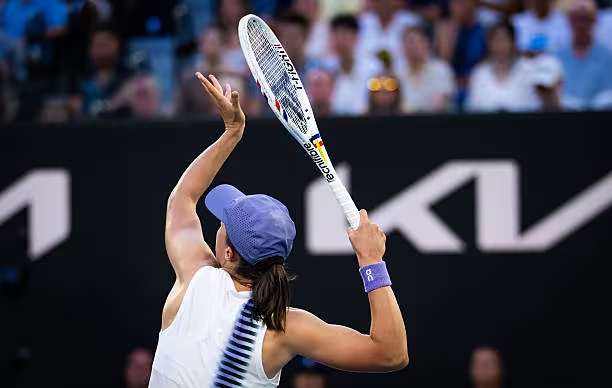
Iga Swiatek emphasized the equality in today's WTA circuit
"Before a match, I usually am aware of my strong points and know that I have to be present on the court and utilize them, regardless of the opponent's ranking. Overall, I would say now there's a much wider group of players competing at a very high level compared to, for example, ten years ago. Even though I didn't play back then, I also hear it from experienced people: the level is much more even. It's no longer a case where having skill advantage means you just go out, play, and win. It doesn't work that way."
Maintaining her match-to-match philosophy
"You have to be prepared for every match, be very aware, and not take anything for granted. It's not valid to think that just because I'm second in the rankings or because I'm playing well I will win again. There are surprises, and that's precisely why the level is more balanced. That's why you have to focus on yourself, be professional, and not look at the ranking or such things."
"Each match is not only a physical effort but also mental, and the question is how you recover in that aspect to feel fresh again. There is quite a bit of time between matches here, so the best recovery is, in a way, to disconnect from the tournament for a while, relax, and take advantage of being in a pleasant place. Spend time off the court, enjoy it in some way, have other thoughts or memories."
The importance of good preparation during the two weeks of competition
"But the reality is we're here for two weeks to win matches and work hard. That's always the main goal and is always at the back of your mind during those days. So, it's not simple, because even in the waiting moments, you have to organize well to arrive in the best conditions for the match. I think it was a good match, and from the start, I felt quite secure. I just played my tennis, that's all."
Her love for long, heavily spun points since childhood watching Rafa Nadal
"I guess, since I also play like that, I understand that type of tennis a bit better. Besides, I feel tennis makes more sense when players construct the point more. I don't know, it's a personal feeling. Maybe it's also because sometimes in women's tennis, points are decided very quickly. I grew up watching Nadal, so longer exchanges feel more natural to me. That's how I developed."
On the consistency of the favorites in this Australian Open
"I don't have a complicated reflection on that. It's positive for the fans because they can continue supporting the same players for a longer time. The top-ranking players usually have more followers, which is good for tennis. But every tournament is different, every Grand Slam is different. It's not something I think about too much."
Her upcoming opponent, Elena Rybakina
"I don't think head-to-head is important. Even when one of us has won more, the matches have always been very tight or, in some cases, clear for one or the other. It doesn't make sense to overanalyze the past. Each match is a new story. She has always been a tough opponent, plays very well, and I have to be at one hundred percent, use my experience, and what I've learned from the previous encounters."
The moment she realized she could become a professional tennis player
"Perhaps when I played my first junior Grand Slam and had a good result at Roland Garros, at 15 years old. That's when I started to believe that I wanted to dedicate myself to this for real and do everything possible to be a professional. I always loved the Grand Slams; they have a different atmosphere. I never thought I could win so many tournaments or reach number one. I've always been quite realistic. I just worked day by day. Everything happened very quickly, and then I felt I had to prove that I deserved to be there. I'm proud of it," stated Iga Swiatek, who, with Rafa Nadal as a role model, approaches the decisive phase of the 2026 Australian Open with the aim of achieving her career Grand Slam.
This is an automatic translation. You can read the original news, Swiatek: "Crecí viendo a Nadal, así que los intercambios largos me resultan más naturales"