

Zverev is Wrong: Current Tennis is Not Slower
The German claimed there was preferential treatment to Alcaraz and Sinner, slowing down the tennis for them to win. We verified that this is not true.

Those words of Alexander Zverev in Shanghai still resonate, complaining that ATP tournament directors deliberately altered playing conditions so that Alcaraz and Sinner would always reach the final. While this has been widely assumed, it would be advisable to thoroughly study everything to determine if this is true or not.
SPOILER: It's a lie.
In tennis so dominantly controlled by Jannik and Carlos, instead of accepting that they are better, end of story, it might be easier to find excuses and blame others to explain the difference between them and the rest. This is what happens with Sascha, who would be wise to consider the following data that will be explained below before making statements like the ones he made in China to avoid further embarrassment.
The ATP circuit is not slower
It is important to note that the speed of a tournament involves various factors such as the type of court surface installed by the tournament (here is where organizers intervene), as well as weather conditions and the ball used (elements beyond anyone's control). All these combined provide a CPI that helps understand the speed of a tournament.
We understand that the CPI may be confusing for fans. It is simply a number that does not provide information unless one knows what each value corresponds to. As far as we know at Punto de Break, efforts are being made to make the CPI values simpler for everyone to understand. However, while that is in progress, let's delve into explaining in detail what is happening in ATP tournaments in 2025.
To determine if a tournament is fast or slow, beyond the CPI, which gives a general idea, two specific data points should be considered: the ace percentage and the average number of shot exchanges in the tournament. These data will truly help us understand how fast this tournament is. By comparing these data with previous years in these events, we can ascertain whether tennis in 2025 has been slower as Zverev suggests compared to previous years.
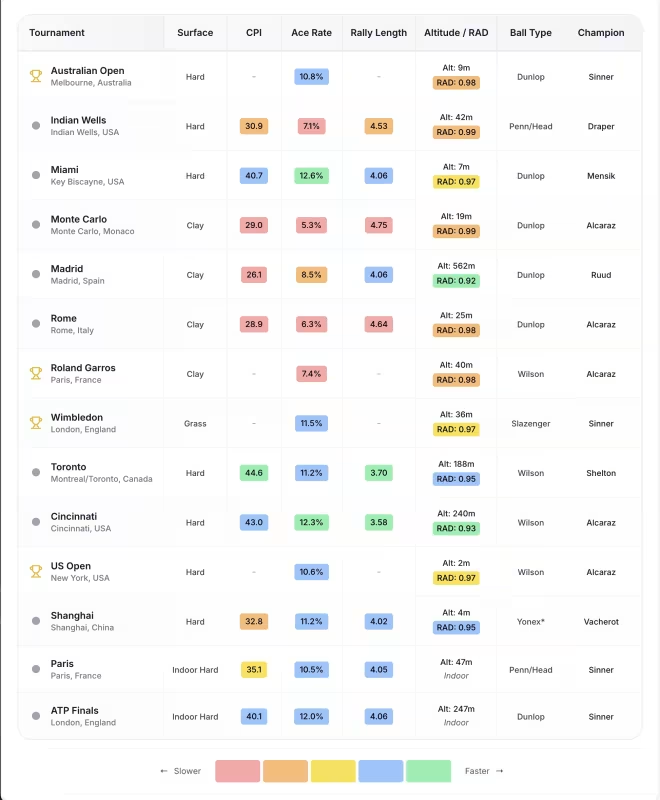
Source: Courtspeed.com
Based on this data, several observations can be made. Excluding clay court tournaments, which are unlikely to change significantly unless there is a week with rain and cold weather affecting the game's slowdown, the rest of the tournaments show a medium-fast to fast speed, except Indian Wells.
Compared to the previous year, Indian Wells has indeed slowed down in speed, as indicated by its decreased ace percentage and average shot exchanges. Although Shanghai has a medium-slow CPI and significantly lower than in 2024, its average number of aces and shot exchanges remains similar to usual, suggesting they might have decided to slow down the court due to a lively ball to prevent it from becoming too fast-paced. Paris, another tournament with a lower CPI, also seems to have decreased in speed compared to the previous year.

The remaining tournaments have all increased in speed. Miami, Canada, Cincinnati, and ATP Finals have become faster. Hence, the circuit's trend is not towards being slower but rather, on the contrary, slightly faster than usual. Special mention to Canada and Cincinnati. Canada is the fastest tournament on the circuit in 2025, with an average of just 3.7 shot exchanges per match, although Cincinnati has more aces and even fewer exchanges, making it evidently faster than the Canadian tournament.
In another Insights data point, in 2025, there was an average of 4 shot exchanges per match in hard court M1000 tournaments. This is 0.3 less than in 2022, showing a slight increase in speed each year. The game is played in fewer shots, despite what Zverev claims.
Yearly average rally lengths for all elite hard court ATP events (Miami, Indian Wells, Canada, Cincinnati, Shanghai, Paris, ATP Finals)
— Matthew Willis (@mattracquet) November 19, 2025
2022: 4.3 shots
2023: 4.2 shots
2024: 4.1 shots
2025: 4.0 shots@tennis_insights data
Over 70% of points in modern tennis matches involve exchanges of 1-4 shots, leading to a very fast-paced style of play. Everything happens quickly, and while viewers may remember the occasional 30-shot rallies, the data shows that the game is not slow.
Some incorrectly claim that tennis in the 70s and 80s was much faster due to frequent net play. There is a misconception that net play equals a fast game, which is not accurate. In those years, points were won at the net because it was challenging to win them from the baseline. With wooden rackets and strings from that era, generating spin was limited, forcing players to approach the net to win points.
In fact, if you watch videos from the 80s, you will see that the game was slower compared to today, where everything happens at a staggering pace. The current game is played differently. Nowadays, the majority of play occurs from the baseline. It's not that the game was faster before and has now slowed down; it's simply played in a different manner.
Currently, the game is played at the highest speed ever seen. The advancements in materials and the physical abilities of players lead to an unprecedented pace of play. Forget about thinking tennis was faster 50 years ago due to Serve & Volley play. That's not how it works.
In fact, just look at how many times Alcaraz and Sinner approached the net in the Roland Garros final compared to Wimbledon or the US Open; even on a slower surface in Paris, they went to the net more frequently.
Why did this happen? Because faced with the difficulty of winning points from the baseline, they were compelled at times to approach the net more often, besides the fact that on clay courts, more strategic variations are possible. On faster surfaces, finding the right moment to approach without being passed is more challenging.
Zverev seeks excuses
To understand the difference between Alcaraz, Sinner, and the others, one must look at their playing styles. In modern tennis, where the majority play power baseline tennis or serve-return +1, the Spanish and Italian players find ways to reset points and excel from the baseline, providing more winning shot options compared to others.
While many have a game plan centered around serve and forehand, they have multiple paths to a winner or forcing a rival error. This leads to the conclusion that tournament directors are not doing anything illegal or that tennis is very slow, which is untrue; rather, Sinner and Alcaraz differ significantly from the rest, possessing more resources and being more complete players.
But, as mentioned before, it may be easier to blame the world than to acknowledge that others are better. Tennis is not slower; instead, two players are forcing others to improve on many levels, both technically and tactically, making everything seem very different from reality. Therefore, next time someone claims everything is arranged for Jannik and Carlos to reach finals, remind them that this is due to two reasons: either because these players are exceptionally good or because others lack the necessary tools to challenge them.
Darwin once said back in 1859 that one must adapt or die, explaining that species surviving are those that adapt to their environment. It's not about being the strongest but about adapting and developing a strategy to emerge victorious.
This is an automatic translation. You can read the original news, Zverev no tiene razón: el tenis actual no es más lento