

Who is that young man who has become No. 1?
Today marks 25 years since Marat Safin became the youngest No. 1 in history, thanks to his explosive talent in the 2000 season.

On November 20, 2000, after a scandalous season, Marat Safin woke up with an indescribable feeling. At just 20 years old, the Russian had become the youngest No. 1 in the history of tennis.
How did he do it? Quickly, for sure. Turning professional in 1997, it took the Russian just a season to break into the top 50, two seasons to crack the top 25, and three to rule them all. An emergence where potential and talent shook hands, paving the way for a power-based tennis to rise above other more vulnerable styles. Marat Safin was an execution machine: serve, backhand, forehand, and charisma that swept everyone off their feet. However, even he would not have thought that the year 2000 would bring him so much joy.
"The 2000 season had a pretty tough start for me; I began at #24 in the world, but then I fell to #48," recalls the Moscow native in an interview with ATP. "At that point, I needed some changes, and my representatives recommended me to change coaches. It was very tough for me; I had been working with Rafa Mensua for a long time, and to me, he was like a father or an older brother. I decided to start working with Andrei Chesnokov, and something clicked. I began to understand the philosophy of listening to someone else, and everything worked out quite well," he states, with hundreds of photographs in his mind.
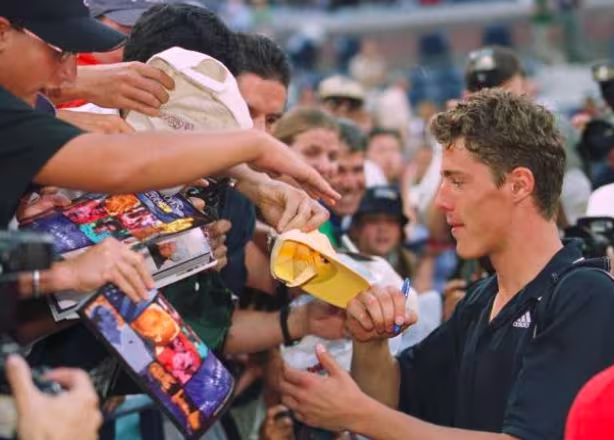
That's how his trophy case, which barely held one title in Boston the previous season, began to fill up massively. "It was the year I became the world No. 1, the year I won the US Open, and the year I lifted my first title in Barcelona [...] Due to my background and origins, becoming a professional tennis player was already pretty good, even being among the top hundred was quite a success. Then being among the top ten was an incredible achievement, but being the world No. 1 was a very impactful event," confesses Marat.
The calendar was too thrilling to summarize in one paragraph, but we can try. Safin reached nine finals that season, clinching a total of seven titles: Barcelona, Mallorca, Toronto, US Open, Tashkent, St. Petersburg, and Paris. I particularly pause at the last one, the Paris Masters, where he secured the dream of every child starting this journey. After defeating Àlex Corretja and Juan Carlos Ferrero, the final paired him with Mark Philippoussis, putting him a victory away from becoming the youngest No. 1 in history. He had to fight for it (3-6, 7-6, 6-4, 3-6, 7-6), but the goal was achieved. By the following Monday and after only three years on the circuit, Marat was already the best tennis player in the world.
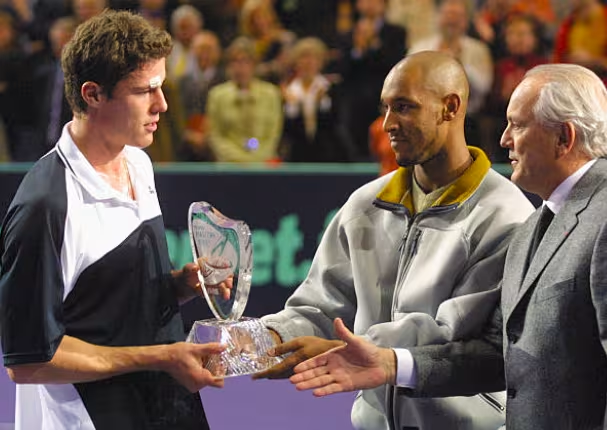
I wasn’t prepared to be No. 1, not at all," asserts the Russian, who played a total of 100 matches!! that season, competing in 30 different tournaments. The historical record is held by Yevgeny Kafelnikov, who played 101 matches that same year. "It was very tough, too much attention, too much of everything, I didn't know how to handle it all because I had never experienced anything like it... and I also didn't have anyone by my side to explain it to me. Honestly, I couldn't bear it," he admits with a hint of bitterness, the man who will soon blow out 46 candles.
Marat Safin and the hidden side of success
After winning the Paris Masters, the Muscovite faced the last event of the year with the obligation to defend his new status. He had to debut in his first Masters Cup, where he needed to go further than Gustavo Kuerten to end the season at the top. Unfortunately, Andre Agassi eliminated him in the semifinals, while the Brazilian would take the trophy, thus finishing the season at the top by a mere 75 points. It hurt, of course, but the fact of becoming the youngest No. 1 ever – a record now held by Carlos Alcaraz – was here to stay.
"People, from the outside, only see the runway, the nice part. They look at the tennis court, on TV, all that is amazing. However, during 90% of the time, it's not what you see on television; there are also the training sessions, the relationship with your coach, or the time with your girlfriend. Then you start making a lot of money, you have an agent managing your finances; becoming a millionaire at 20 is hard, you don't know which way to go," reveals the Russian with the same frankness he always had.

Marat does well in showing this side of success too, for people to understand that even the best in the world can feel pursued by the obligations and pressure of a never-ending circuit. "Your focus is always external, it’s 42 weeks a year, of which 35 you're traveling. You're constantly on the move, you have no home. People see the nice part, but in sports, there are many more facets; that’s why not everyone can reach the top. Simply, they can't handle everything hidden beneath the surface; it's too much. Then you learn from it, albeit a little later. It took me a few years to understand the process of my career; it was all too fast; I needed to understand who I was. At 20 years old, you have no life; you're on tour and only know about tennis; you don’t notice anything," he concludes.
Marat Safin would reclaim the world No. 1 spot in January 2001 and in April of that same year. In total, he spent weeks leading the rankings, much fewer than expected initially. His trophy case gathered 15 individual titles, two Grand Slam titles, much fewer than he promised. Everyone who saw him play will think that his accomplishments do not do justice to his talent. Fortunately, his mind is now clear, without the need for self-blame. "I'm proud of everything I did. Could I have done better? Surely yes, I should have won more Grand Slams, but I could have enjoyed more as well. That was it, in the end, this whole journey opened many doors for me afterward; I ended up learning more from mistakes than victories. It was a beautiful journey that, without a doubt, was worth it."
This is an automatic translation. You can read the original news, ‘¿Quién es ese joven que se ha convertido en Nº1?"