|
13 Oct 2024 | 07.52
|
13 Oct 2024 | 07.52






Nothing can be reproached to Carlos Alcaraz in this current season, having been able to add two new Grand Slam titles at just 21 years old and confirming the gestation of a legendary tennis player. The competition from Sinner and some inconsistency in his performance have prevented him from finishing the year as the world number 1, despite winning Roland Garros and Wimbledon. How many times has something like this happened in the history of tennis?
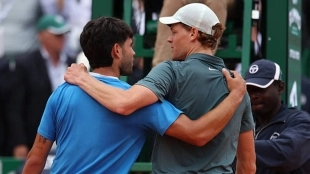
Looking back allows us to understand the present much better and to appreciate what we are witnessing. It is logical on the circuit to think that a winner of two Grand Slam tournaments would end the year at the top of the ATP ranking, but sports offer intricate scenarios. One of them is the very rare case of two players equally sharing the majors in the same season, as Carlos Alcaraz and Jannik Sinner have done this year, leading one of them to join a very limited list of tennis players who won two Grand Slam titles and did not finish as number 1 that season.
To find the first case, we have to go back to 1977, the year when Guillermo Vilas won at Roland Garros and the US Open. What's most curious is that the Argentine never even reached number 1 during any week, something recent research questions, stating that the ATP scoring system had inaccuracies at that time, depriving Vilas of a privilege he had earned on the court. It was Jimmy Connors who had the honor of leading the ranking at the end of the season.
The following year, a similar situation occurred again, in 1978, with one of the greatest players of all time, Björn Borg. The Swede achieved one of his famous doubles at Roland Garros and Wimbledon, but that was not enough to reach the top ranking at the end of the season, as the consistency of Jimmy Connors and his victory at the US Open allowed him to conquer the top spot and deny the Swede of a privilege he would miss on two occasions.
Four years passed before a similar situation arose again, in 1982, this time with Jimmy Connors as the protagonist. Poetic justice? The vanquisher of Vilas and Borg experienced the frustration he had caused in previous years, seeing that his titles at Wimbledon and the US Open were not enough to dethrone John McEnroe from the number 1 position, as McEnroe ended the season in that spot despite not winning a single Grand Slam in that campaign. However, winning five events and reaching the final stages of the most important tournaments was his credential to conquer the ranking summit.
Now, let's fast forward to 1989, the most glorious season of Boris Becker, that unique character with genuine talent who turned the circuit upside down with his distinctive playing style and who triumphed that year at both Wimbledon and the US Open. Despite this, he encountered the more consistent version of Ivan Lendl, who won ten tournaments that season, including the Australian Open. What's most intriguing is that the German never managed to finish a season as number 1.
- There have been eight other years where a situation similar to that of 2024 has occurred
Surprisingly, the next similar case can only be found in the 21st century. We arrive at 2016, during the golden era of the Big 3, and witness how the brilliant first half of the year by Novak Djokovic did not continue as desired towards the end of the year, giving rise to the emergence of Andy Murray. The Scotsman displayed the best tennis of his career after winning Wimbledon and had an impressive last few months, triumphing in Shanghai, Paris, and the ATP Finals, claiming a total of nine titles.
The most comparable case to this season is what happened in 2017, with Roger Federer sharing the glory with Rafael Nadal, marking a miraculous resurgence for the Swiss. Both capitalized on Djokovic's absence due to injury to revive those distant times between 2005 and 2007 when all the successes fell into the hands of one or the other. On this occasion, it was the Swiss who eventually succumbed to Rafa's greater consistency throughout the season.
Just two years later, in 2019, a similar scenario unfolded, but this time with Novak Djokovic in the spotlight. The Serb triumphed at the Australian Open and Wimbledon but saw Rafael Nadal's triumphs prevent him from ending the year at the top. One of the two had to yield and join this list since, as in 2017, both protagonists in that season won two Grand Slam titles each.
As the last precedent before the current year, we have the case of 2022, which appears both painful and easily interpretable. A phenomenal version of Rafael Nadal at the beginning of the year, arriving unbeaten at the Indian Wells final, seemed poised to dominate everything. However, a rib injury, subsequent foot issues, and an abdominal tear suffered in the Wimbledon quarterfinals against Fritz not only dashed his hopes of being number 1 at the end of that year but also ended his sports career. It was Carlos Alcaraz who, taking advantage of Djokovic's inability to compete in the United States, finished the year at the top of the ATP ranking.
In summary, what happened in this 2024, with Carlos Alcaraz being deprived of finishing the season as number 1, is not unique in the history of tennis but rather an uncommon situation. His rivalry with Jannik Sinner has been exciting, and it remains to be seen how a symbiotic rivalry develops for both of them, as well as whether another great competitor emerges between them who can aim in the short, medium, and long term for successes as significant as winning Grand Slam tournaments and finishing at the top of the ATP ranking in any given year.
This news is an automatic translation. You can read the original news, Alcaraz y el caso poco habitual de ganar dos Grand Slam en un año y no terminarlo como número 1
-
 27 Jul 2026 | 15:00Vagnozzi recalls Sinner's collapse at Roland Garros and explains the cause
 -
 27 Jul 2026 | 08:00If Alcaraz does not play in Cincinnati, he will not play the US Open
 -
 27 Jul 2026 | 12:00Schedule and where to watch Rafa Jódar's debut in Washington, against Fils
 -
 27 Jul 2026 | 16:00Osaka: "I don't want to be famous"