|
31 May 2026 | 07.37
|
31 May 2026 | 07.37






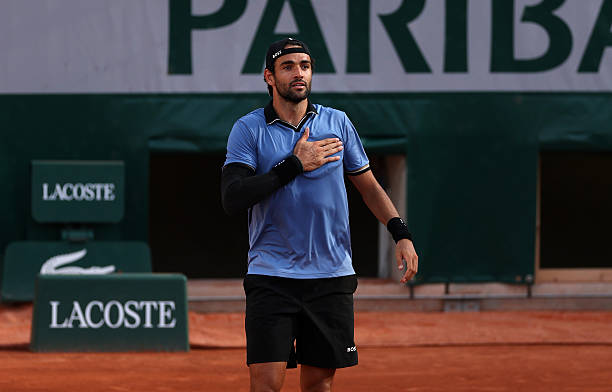
Matteo Berrettini continues to regain his sensations at Roland Garros 2026. The Italian defeated Francisco Comesaña in an epic battle lasting over five hours to advance to the round of 16 of the Parisian tournament, a result that goes beyond the purely sporting realm for a player who has spent the last few years fighting against injuries, setbacks, and doubts about his ability to return to competing at the highest level.
After the match, Matteo Berrettini shared some of the most heartfelt reflections of the entire season. The Wimbledon 2021 finalist admitted that he had thought he would never feel comfortable on a tennis court again, explained how he has rebuilt his confidence over the past months, and revealed the significance of Thomas Enqvist's arrival to his team during one of the most delicate moments of his career.
This is what Berrettini said after his epic triumph over Comesaña at Roland Garros 2026
A victory built on resilience
"I don't know exactly what made the difference. Perhaps the fact that I hadn't played in this tournament for five years and just wanted to enjoy one more match here. When everything is so tight, with match points on both sides, in the end, it's a matter of nerves and also a bit of luck."
"Normally, I remember absolutely everything that happens in my matches, but right now I struggle even to reconstruct what happened. I only recall a few specific points. What I do know is that I fought from the first point to the last and ended up feeling good physically and mentally. That makes me very happy."
The emotion of proving that he could still come back
"After the match point, many thoughts crossed my mind. Probably the most important one was realizing that over the last few months and even years, I doubted myself too much."
"Although my family, friends, and team never stopped telling me that I still had tennis inside me, I have to admit that there were moments when I thought I couldn't come back. I thought maybe I would never feel comfortable on a tennis court again. That's why I got so emotional. Because I proved to myself once again that I can still do it, that I can still compete, fight, and enjoy playing tennis."
When the body and mind stopped syncing
"This sport requires time. It requires confidence, rhythm, and many hours of work. For a long time, I felt that my body was ready but my mind wasn't. Then the opposite would happen: my mind was prepared, but my body didn't respond."
"That's the most complicated part. To play your best tennis, you need everything to work simultaneously. At the end of last year, during the Davis Cup, I already felt very good physically. I also had a great pre-season. However, I had abdominal problems again in Australia, and that's when the doubts resurfaced. You start to wonder if your body will hold up or if everything will repeat itself."
"I have worked extremely hard to get out of that mindset. Now I trust my body again. All the matches I've played this year, whether Challengers, Masters 1000, or any other tournament, have helped me build the confidence needed to get here."
The physical problems that tested his faith
"External doubts have always existed. Since I was 12, people said I was too thin, that I didn't have the physique to go far, and that I wasn't ready to compete at the highest level. I'm used to that."
"The hardest part was managing internal doubts. I never stopped believing in my tennis. What did happen is that there were moments when I stopped trusting that my body could endure with the necessary consistency to compete at the highest level. That's where the real fears appeared."
"When you're afraid of feeling pain, discomfort, or an injury again, it's very challenging to compete freely. That fear conditions you a lot. That's why I've worked so hard to develop mental tools that allow me to live with it when it arises."
The decisive role of Thomas Enqvist
"The most important thing Thomas has done is restore a confidence I had lost. Every day he reminds me that I'm still one of the strongest players in the world."
"He doesn't say it just because. He says it because he sees my tennis, he sees the quality of my game, and he knows the player I can be when I'm healthy. Constantly hearing that from someone like him has great value."
"Since we met at the Laver Cup, he has always conveyed incredible confidence in me. Even today, after losing the third set, he kept telling me that the fourth would be ours and that I should keep believing. That goes far beyond purely technical work. It's something personal."
"The combination of Thomas, Alessandro, and the rest of the team is working very well. Each of them brings something different to me, and together, they have made me comfortable again on a court."
How he managed the tensest moments of the match
"When nerves kick in, your heart races, breathing becomes harder, and everything gets tougher. It's a feeling I know since I started playing tennis."
"Many times when a player gets tense, they stop playing using their whole body and start relying only on the arm. You stiffen up, try to force things too much, and errors occur that you normally wouldn't make. I remember perfectly missing a forehand in the tie-break because I was nervous. It was an easy shot to build the point, and I missed it by a few centimeters."
"But that's part of this sport. After over five hours under the sun, it's impossible to expect to be completely clear-headed. The important thing is to accept that situation, keep being aggressive, and have the courage to continue seeking victory."
Confidence growing again in Paris
"I know what it takes to go far in a Grand Slam. Obviously, I hadn't reached these rounds for a while, so it was also important to find the balance and not rely solely on memories."
"I entered the tournament without the confidence I had a few years ago, but I feel like I've been building it gradually. Now I'm in the second week of Roland Garros, playing well, my weapons are working, and physically I feel prepared. All of this allows me to believe again."
Enjoying the big stages again
"My brother told me after the match that the atmosphere had been incredible. I heard the noise, felt the energy from the stands, but I was so focused that I barely understood what was happening around me."
"The only thing I kept repeating to myself was that I deserved to be there, fighting in that way. That's how I like to play tennis. Just a few weeks ago, playing a match like that seemed almost unthinkable to me. That's why I'm so happy to have fought until the end and even happier to have won."
The qualification of Matteo Berrettini for the round of 16 of Roland Garros 2026 represents much more than just a simple victory. After years marked by injuries, setbacks, and doubts about his future, the Italian once again feels competitive on the big stages and, more importantly, believes in himself again. Paris is confirming that the road back has been long, but the former Wimbledon finalist still has a lot to offer in the elite world of tennis.
Cette actualité est une traduction automatique. Vous pouvez lire la nouvelle originale Berrettini describe su calvario: "Pensé que jamás volvería a sentirme bien en una pista de tenis"
-
 30 May 2026 | 19:00Parry explique comment il combine les restes à une et deux mains
 -
 30 May 2026 | 20:00Landaluce reste aux portes de la gloire après une course de fond avec Cerúndolo
 -
 30 May 2026 | 19:00Énorme surprise : Potapova élimine Gauff de Roland Garros
 -
 30 May 2026 | 22:00Landaluce : "C'est l'une des défaites les plus difficiles de ma carrière"
 -
 30 May 2026 | 21:00Gauff se montre autocritique après sa défaite contre Potapova à Roland Garros