

Del Potro : "Je visualisais être numéro un après l'Open d'Australie de 2019"
L'Argentin avoue que se pousser jusqu'au sommet du classement lui a coûté cher et affirme qu'en 2009, le niveau sur le circuit était tel, qu'il était "le numéro un des mauvais".

Juan Martín del Potro was the last star that Argentine and South American tennis had in its possession. The giant from Tandil won the 2009 US Open in an epic final against Roger Federer, and his career seemed to be among the best for a long time, but his knee and wrist hindered a spectacular player, with one of the best forehands remembered on the circuit.
The Argentine retired in 2022, although he played one last exhibition in 2024 with his great friend Novak Djokovic. And now, a year after that moment when he definitively hung up his racket, he spoke in an interview with ESPN about his tennis career, from his breakthrough, his unforgettable 2009 US Open, his painful injuries, and how close he was to achieving the number one ranking in 2019.
Juan Martín del Potro reviewed a tennis career to be remembered, but marked by injuries
"I had to be infiltrated many times. Quite a few. Many times in the knee, in the wrist I had three surgeries, but perhaps because of having made some wrong decisions. Sport leads you to such pressure and to achieve things that it cannot stop. I didn't want to stop because I had to be in the top 5 or top 3. I didn't want to lose ranking and I would infiltrate myself. It was bread for today, hunger for tomorrow."
"The knee issue was another story. After my first surgery, things didn't work out, and with the second, they tried to fix it. So it was a series of events that ended up being what it was, took me off the court, I had to retire, and so on. Injuries in an athlete are something we live with."
He longs to end the wrist pain so much that he even asks Artificial Intelligence for help
"I can say that I had a bit of bad luck, but the truth is that I was the athlete I was because of the injuries. It's part of the movie in those more dramatic chapters. Now I ask artificial intelligence to give me a hand. I've talked so much with ChatGPT. I have all kinds of MRIs and X-rays. I go to clinics and they say, 'It's you again, we don't know what else to do to help you.'"
What winning a Grand Slam in tennis entails
"You win a Grand Slam and things change a lot. Even for contracts, sometimes you have to go and participate. The clothing sponsor calls you, the racket sponsor, and the ATP. It still moves me. Sometimes I watch that last game and say, 'let it end the same way.' That game was dramatic because I was down 5-2 and if I didn't break there, I would have had to serve later. Having to close the match, the final, against Federer, the first Grand Slam, with your serve, would have been a pressure; I don't know if manageable. So I put all my energy there, it was that moment or nothing. And well, it finally happened."
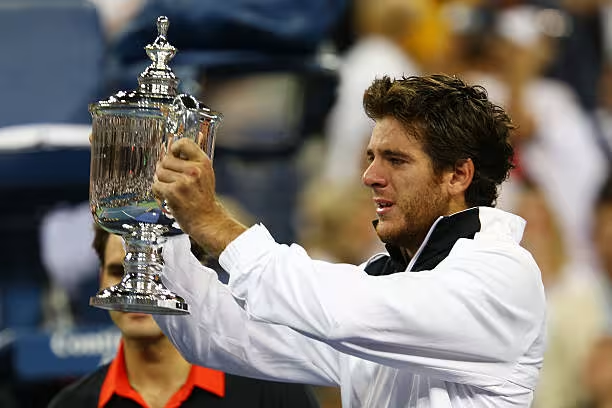
"When I go to the tournament, they remind me of it at every corner of the hallways, the staff there is still the same and they come up to me. It was a very special tournament for me and for all the people there because it was Federer, and nothing like that ever happened again. It moves me to remember it."
The 'thorn' of not having achieved the number one ranking in 2019 and that marked the beginning of the end
"When I reached the final of the 2018 US Open, I was world number 3 and completely exhausted, I ended up going to the Asian tour again. I went because I visualized becoming number 1 after the 2019 Australian Open. I had a real mathematical chance that if I played well in those tournaments, I could be number 1. Then I ended up falling, injuring my knee, had to stop, and then the nightmare of the leg began."
About the level of tennis on the ATP circuit in 2009
"It was the natural development it had to have. Already in 2008, I won tournaments, settled in the top 10, worked a lot with Franco Davín, changed my game, was in full growth. By 2009, I was already consolidated as a top 10 player, I was the number 1 among the 'bad ones' because I was always number 5 and couldn't break that barrier," confesses a Juan Martín del Potro who was a key piece in the tennis of the late 2000s and the 2010s. The big 'what if' if it hadn't been for the cursed injuries.
This is an automatic translation. You can read the original news, Del Potro: "Visualizaba ser número uno después del Open de Australia de 2019"