

Kei, the English classes paid off
Gabe Jaramillo, one of the coaches who trained Kei Nishikori in the United States, dedicates this column to the Japanese tennis player after he concluded his professional career this week in Tokyo.

The career of Kei Nishikori ended this week at the ATP 500 in Tokyo after losing in the first round to Frances Tiafoe. A wonderful opportunity to invite Punto de Break to one of the people who knows him best: Gabe Jaramillo. The man who trained him upon his arrival in Florida wanted to compile a few lines for all of us to understand the mark the Japanese player left behind.
Text: Gabe Jaramillo
—Shut up! I know what I'm doing!
The voice came from the court of the Ariake Colosseum. The English was perfect. The problem was that he was saying it to me. Kei Nishikori was nervous, and his feet seemed stuck to the ground. From my spot, desperate to make him react, I shouted in my rather questionable Japanese:
—Move your feet!
His response came back loud and clear, with no need for a translator. Well, I thought at least my English lessons were paying off.
Today, as Kei bids farewell to professional tennis, that memory makes me smile. Then comes the nostalgia. How can he be retiring? Wasn't it just yesterday that the Japanese kid appeared with a racket and a dream that seemed enormous in the eyes of others, but not in his? After over 50 years as a coach, I have seen many students grow, fill stadiums, and lift trophies. You end up getting used to seeing them on television. What you never get used to is hearing them say goodbye. For the public, a champion retires. For me, it’s also a farewell to a child whom I can still see with my eyes closed.
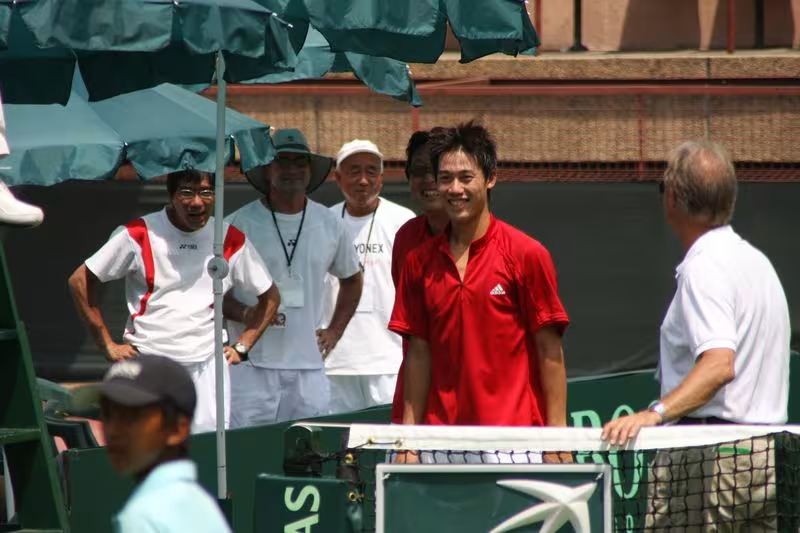
Our story began during a selection process in Japan. There were several talented young players, and Kei did not arrive with the best results. Fumi and Genki were above him in the rankings and had bodies that conformed more to the prototype that many envisioned for a future professional. On paper, there were good arguments to choose them.
Kei also had technical aspects to correct. His serve needed work. His backhand volley did too. If the decision had depended on who had fewer flaws that day, perhaps the story would have been different. But we started playing points. Mr. Morita and some of the most influential people in Japanese tennis were present. There was a lot at stake: an opportunity that could change their lives. And Kei played without fear.
He was fast, but what caught my attention went beyond his legs. He had an extraordinary ability to read the game: perceive what was happening, anticipate, find spaces, and decide in a fraction of a second. His mental speed matched his physical speed. While others had better results to show, he showed me possibilities. And above all, he dared. He didn’t seem to be playing to avoid a mistake in front of those gentlemen. He was playing to win the point.
That is my fundamental rule. My first commandment: NO FEAR.
That does not mean a player never feels nerves. It means they dare to make decisions and trust their game even when they feel them. I knew we could work on the serve and the volley, but that combination of speed, intelligence, and courage was what I was looking for. That’s why I chose Kei.
The Morita Foundation, led by Masaaki Morita, opened the door to a new life for him: to study and train in the United States, with all his expenses covered, including tournaments, until he turned 18. It was an extraordinary opportunity, but it also required a huge sacrifice. The scholarship paid for the travel and all his expenses, but it did not take away the sadness of saying goodbye to his family. Kei was excited about the opportunity, but suddenly he didn’t understand what others were saying.
Kei arrived in Florida to learn tennis, English, and something much more difficult: to live away from home. Shortly after his arrival, his roommates came to tell me something. The new guy had placed a note on the bathroom mirror. The note was written in English: “Number one in the world.”
Number one in the world.
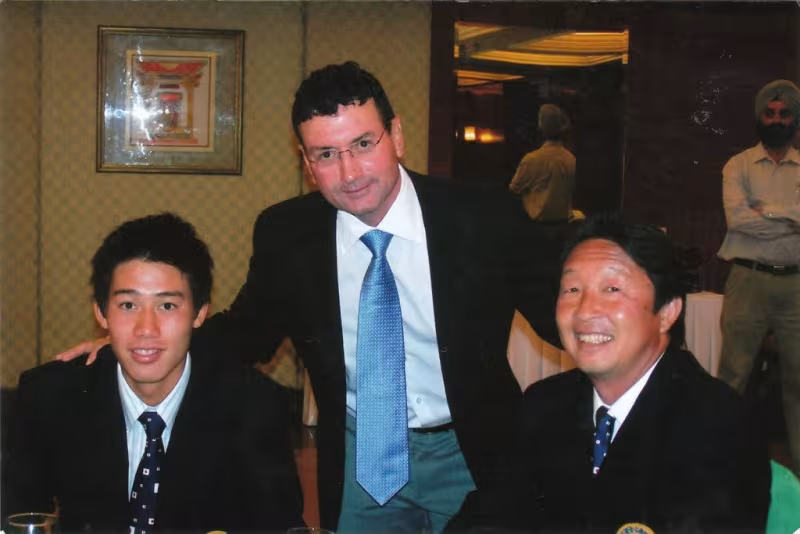
There are many ways to introduce oneself to the peers at an academy. Asking where the towels are kept. Asking for toothpaste. Looking for someone to train with. Kei had decided to announce that he wanted to be the best player on the planet. Naturally, I wanted to know more.
With Sato Nakajima helping us to translate, I asked him about that note. Kei explained that he needed to remember why he had left his family and everything he knew behind. In the morning, those words gave him a purpose. At night, they made him wonder if he had done enough to get closer to his dream. He had placed that message in a spot where he inevitably had to look himself in the eye. Since then, every time I saw Kei training, I thought of that mirror.
Because then came the part that couldn’t fit in a single sentence: the hours on the court, the repetitions, the physical preparation, and school. Above all, school. Education was part of the commitment to the foundation, and a good forehand was no excuse for leaving a task undone. The dream was his. The daily work also had to be. Of course, our work as coaches took paths we had already traveled.
Once we arrived at Narita Airport after a 17-hour flight. Kei looked like he had fought with the pillow and lost. His hair was a mess, his shirt wrinkled, and he was still half asleep. Upon exiting, we were met by a huge group of journalists. We hadn’t received any notice. The cameras, unfortunately, were also not willing to wait for Kei to comb his hair. The questions started.
A short one.
—Hai.
A long one.
—Hai.
Another that seemed to require deep reflection.
—Hai.
Yes. Yes. Yes.
The journalists changed questions. Kei maintained the strategy. That kid could find ten different solutions on the court, but in front of a microphone, he had decided that one answer was enough. That day we understood we had to add something to the program: learning to speak with the press. English was also fundamental. His tennis took him around the world; he needed to express himself through it. And boy did he learn. At least enough to tell me to shut up, with complete clarity, at the Ariake Colosseum.
Then came the moments everyone knows: his first ATP title in Delray Beach in 2008 after coming through qualifying; the victory over David Ferrer at the US Open that year; his first title at the Japan Open in 2012, in front of his people, defeating Milos Raonic. Then, the final at the US Open in 2014. Later, number four in the world.
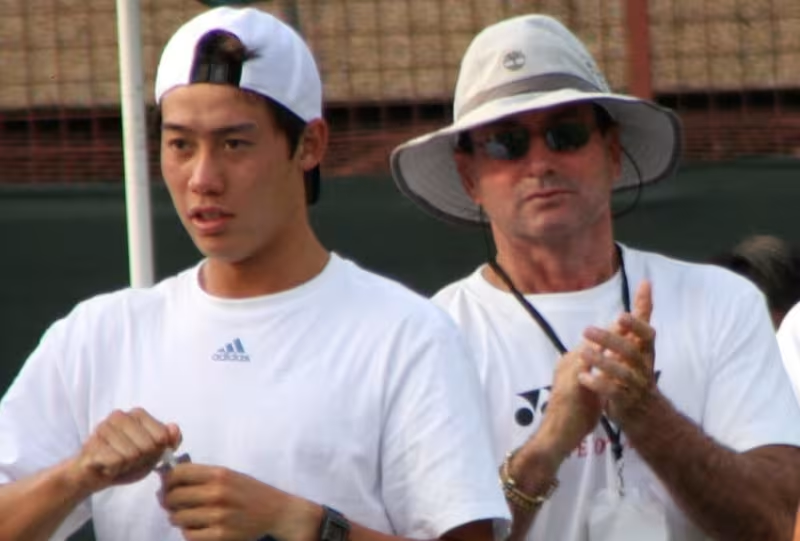
The kid who answered everything with "Hai" had given a lot to talk about regarding tennis. He never reached the number one he had written on the mirror. But how much he achieved by chasing those words. And how many Japanese children could see their own possibilities differently because of him. I had the privilege of knowing him before he reached the big stadiums. Of seeing the effort when there were still no applause. Of sharing the tough days and those little moments that, over the years, end up being as valuable as the trophies.
Thank you, Kei, for the victories, the laughter, and the trust.
Thank you, Masaaki Morita, for believing in that project and in our team.
Thanks to his family, to Sato, to the coaches, and to all those who accompanied him on the journey.
A player enters alone to compete in the match, only his name appears on the board, but no one gets there without help. And behind every player, there is a team that has worked just as hard as he has, and that no one knows. Now, Kei, I wish you a happy life with your family. Time to be, to enjoy, and to fulfill those other dreams that had to wait while tennis took the front seat.
I don’t know what you will write now on the mirror. I hope that when you look at yourself, you can feel pride in everything lived and excitement for what’s to come. For my part, this time I don’t have a training schedule for you. And if you tell me that you know what you’re doing, I promise to be quiet.
This is an automatic translation. You can read the original news, Kei, las clases de inglés dieron resultado