|
22 Jun 2026 | 07.36
|
22 Jun 2026 | 07.36






Jack Draper will return to competition this week in Eastbourne after more than two months away from the courts due to injury. The British player, who was ranked number four in the world just a year ago and now occupies the 160th spot in the ATP ranking, has reflected on the impact of his ongoing physical problems, loss of confidence in his body, and his expectations for Wimbledon 2026.
The comeback of Jack Draper will be one of the most closely followed stories on the grass court circuit. Over the past twelve months, the British player has experienced a true rollercoaster marked by injuries to his arm and knee, unsuccessful attempts at comeback, and a steep drop in the world rankings.
Now, with Wimbledon just around the corner and accompanied by Andy Murray in a new professional phase, he faces a pivotal moment in his career. Beyond immediate results, the big question is whether he can finally leave behind a cycle of setbacks that have hindered the progression of one of the most promising talents on the circuit.
Jack Draper and the frustration of watching all the hard work disappear
Tennis is one of the most ruthless sports when a player is forced to stay away from the courts. While other competitors continue to accumulate victories and points, the rankings keep advancing, and the positions gained through years of effort gradually diminish. Draper has lived this reality over the past few months and did not hide the emotional toll of going through this process.
"Tennis is very tough because I was among the top ten in the world, doing amazing things, and every week you are losing ranking," he explained during the Media Day held in Eastbourne. This reflection perfectly captures the sense of helplessness that many injured players experience, especially when they see from the sidelines how rivals they recently competed evenly with are moving forward.
However, it was a later statement that best summed up the situation he is facing. "It's not like in a football team where a substitute can come in and take your place. It's like watching your own decline." The imagery is particularly powerful as it conveys a very specific reality of professional tennis. When a player gets injured, they not only stop competing but also witness how their position within the circuit progressively fades away.
"I am not an injured player": Draper's mental battle
One of the most interesting aspects of his statements relates to how he interprets his own physical history. Over the past year, reasonable doubts have arisen about Draper's ability to withstand the demands of the ATP circuit. Injuries have become a constant in his career and have fueled the debate on whether he can unleash the full potential he possesses.
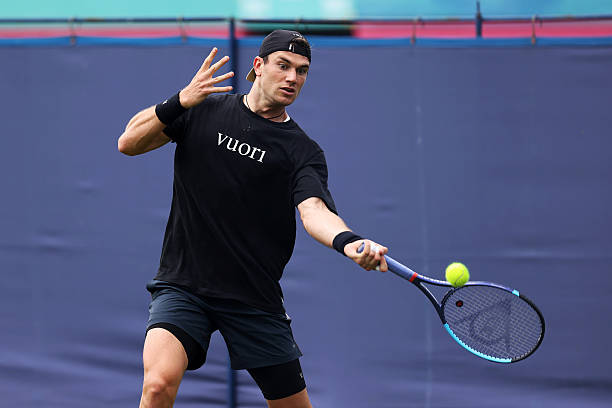
However, the Brit rejects that narrative outright. "I think I have learned a lot about my body in the past year," he stated. Rather than dwelling on the frustrations of his issues, Draper seems to have found an opportunity to better understand how to manage his physique and what changes he needs to make to avoid future setbacks.
The most revealing statement came when he directly addressed the label that many are beginning to associate with him. "I have had many injuries, but I am not an injured athlete. I don't think I am an injured athlete. I am a strong athlete." This is not a trivial distinction. Often, the main challenge for a player experiencing physical problems is to prevent these injuries from defining their competitive identity. Draper seems determined to prevent just that.
His conclusion was equally resolute. "I don't envision my career as one marked by injuries." The statement conveys a significant conviction at a time when external doubts about his future are increasingly common. The Brit still believes that his sporting story is far from being solely determined by the physical issues he has faced so far.
Eastbourne and Wimbledon: the goal is not immediate victories
After so long away from competition, it would have been easy to focus on the results expected during the grass court season. However, Draper surprised by presenting a much broader perspective of the situation.
"I am not just coming back to play here during the grass court swing," he explained. The phrase clearly indicates that his return should not be seen as a desperate attempt to capitalize on Wimbledon but rather as part of a more ambitious and enduring process. The Brit is aware that, having played only nine matches this season, it would be unrealistic to expect an immediately competitive version of himself.
"I don't know how these competitions will turn out in terms of wins and losses," he admitted. This candor contrasts with the typical discourse of many players returning from injury. Draper does not seek to present unrealistic expectations or promise immediate results. His priority seems to lie elsewhere.
"I want to leave behind this period of constantly entering and exiting the circuit, coming back for a week and disappearing for another two." This statement likely encapsulates better than any other the main goal he pursues at this moment. More than a specific victory or standout result at Wimbledon, he is looking for consistency. The opportunity to train, compete, and evolve without constant interruptions.
"I am building again to return to where I want to be," he affirmed. A declaration that suggests the upcoming weeks mark the beginning of a reconstruction rather than a mere return to competition.
Andy Murray, a key ally in regaining confidence
The major novelty of this new phase is the addition of Andy Murray to his team. Despite only collaborating for a few weeks, the influence of the three-time Grand Slam champion seems to be significant from the outset.
Draper acknowledged that one of the most challenging consequences to handle over the past year has been the loss of confidence in his own body. "I have lost a lot of confidence in my body over the past year and now I am rebuilding it." A confession that illustrates why the psychological dimension of recovery is as crucial as the physical one.
In this context, having someone like Murray becomes particularly valuable. Not only for his technical or tactical knowledge but for the authority he conveys as someone who also had to deal with physical problems and extremely complex recovery processes for years.
"Having someone who believes in you as a person and as a player, someone who has been one of your biggest inspirations, is very positive." The admiration between them is longstanding, but now their relationship has taken on a new dimension. Draper believes that the confidence Murray imparts could be decisive during this rebuilding phase.
"We have a very special relationship," he stated. And he added a reflection that helps understand the emotional state he is in. "That gives me a little extra energy, especially at a time when I am returning and need to have that positive energy around me." It seems no coincidence that he chose precisely this moment to start working alongside such a significant figure in British tennis.
More than just a return on grass for Draper
Eastbourne and Wimbledon will mark Draper's competitive return, but the true importance of the upcoming weeks goes beyond the results he might achieve on the court. After a year marked by injuries, doubts, and the frustration of seeing years of accumulated work disappear, the Brit needs to regain something much more vital than ranking points.
He needs to trust his body again. He needs to prove that he can compete for several consecutive weeks without setbacks and that he still has room to build the career he envisioned when he emerged among the world's top players. That's why his statements are so compelling. They speak of injuries and rankings but also of mental resilience, competitive identity, and the determination of a player who refuses to accept that his future will be permanently conditioned by physical problems.
Eastbourne will only be the first chapter of that story. The real challenge will be to demonstrate that, this time, the comeback is here to stay.
This news is an automatic translation. You can read the original news, Draper: "Mi carrera no va a estar marcada por las lesiones"
-
 21 Jun 2026 | 18:00Toni Nadal: "We are facing Djokovic's last season"
 -
 21 Jun 2026 | 15:00"Serena Williams will play in the singles draw at Wimbledon"
 -
 21 Jun 2026 | 14:00In an ideal world, the Australian Open should be played in March
 -
 21 Jun 2026 | 17:00Cerúndolo comes back against Paul and makes history at Queen's
 -
 21 Jun 2026 | 20:00Bombshell: Serena Williams will play in the Wimbledon singles draw
 -
 21 Jun 2026 | 19:00Noskova defeats Pegula in Berlin and makes debut in the WTA top 10 ranking
 -
 22 Jun 2026 | 07:00Draper: "My career will not be marked by injuries"
 -
 21 Jun 2026 | 12:00Murray reveals what Serena told him about his comeback
 -
 21 Jun 2026 | 22:00This is how the seedings line up for Wimbledon 2026
 -
 21 Jun 2026 | 10:00Berrettini gets excited about Wimbledon
 -
 21 Jun 2026 | 21:00"I want to enjoy this experience; I don't know if someday I will be here again"
 -
 21 Jun 2026 | 11:00Haas chooses Alcaraz over Sinner