

Jannik Sinner, a key part of a possible boycott of the US Open
The Italian seems to have positioned himself as a driving force behind a boycott project of the US Open 2026 in order to increase the economic prizes, consisting of not participating in mixed doubles.

Jannik Sinner would be getting involved in a project with a group of players who are refusing to participate in the mixed doubles tournament proposed by the organization of the US Open 2026. This event represented a significant source of income for the tournament, and the players are demanding that the prize money be increased by at least 16% compared to the previous edition.
Tennis is experiencing one of the most institutional tense moments in recent years. While fans' attention remains focused on the major tournaments and the dominant rivalries on the circuit, behind the scenes, a battle is unfolding that threatens to upset the balance of power within this sport. And now the conflict could reach a symbolic stage like the US Open.
Why boycotting the US Open mixed doubles tournament could be a good pressure tactic?
According to The Times, a growing group of top-tier players, including Jannik Sinner, are considering boycotting the mixed doubles tournament at the American Grand Slam as a pressure tactic in their dispute with the organizers of the four major tournaments. The threat is still far from becoming a reality, but it reflects the increasing discontent among the main figures in the circuit.

The involvement of a player like Sinner could have a clear triggering effect for many other top-level players to join this trend. The US Open organization revolutionized the history of mixed doubles with this event, completely changing its essence to attract big names. In exchange, there was an economic compensation for the players, but everything indicates that it was very insufficient compared to the earnings generated that day, fueling the athletes' outrage even more.
Far from being an isolated protest, the potential boycott would simply be the latest chapter in an offensive that has been growing for months and aims to achieve greater player involvement in the earnings generated by the Grand Slams. There was a hint at Roland Garros, the waters seemed to calm down with the increase in Wimbledon's prize money by around 20%, but the players are not going to take a step back and are determined to challenge the USTA, the organizing body of the US Open.
The conflict between players and Grand Slams remains unresolved
The root of the problem is economic, although the players themselves insist that the issue goes beyond money. In recent months, the main stars of the circuit have publicly demanded greater participation in the profits generated by the four Grand Slams.
Players believe there is too great a disparity between the revenues these tournaments produce and the amount that ultimately goes to those who are the main attraction of the show.
The demands are not limited to prize money distribution. They also include greater representation in decision-making, improvements in player welfare issues, and more fluid communication with organizers.
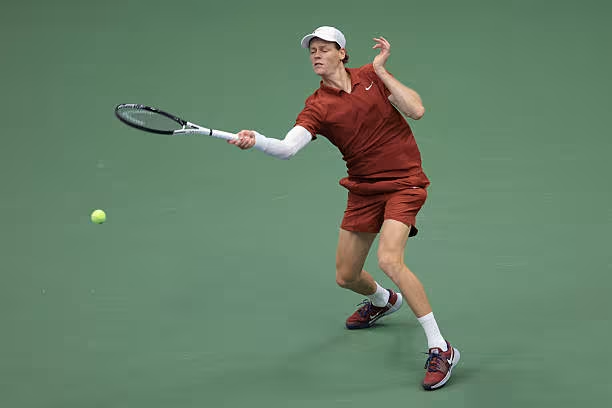
Jannik Sinner has become one of the most visible voices of this movement. Just a few weeks ago, the Italian made it clear that he completely understood the boycott threats beginning to emerge within the locker room and denounced the lack of respect many players feel from the Grand Slam organizers.
The pressure has already prompted some responses. Wimbledon recently announced a significant increase in its prize money pool, around 20%, but many players consider it still insufficient to address the underlying issue.
US Open mixed doubles, becoming a symbol of the dispute
It is striking that the focus of the protest has shifted to the US Open mixed doubles tournament, a competition that was precisely created to attract top stars.
The organization revolutionized the format in 2025. They reduced the draw, concentrated the competition in just two days, significantly increased the prize money, and managed to gather some of the most important names in world tennis. The goal was clear: to turn mixed doubles into a great television spectacle capable of generating interest among the general public.
The bet worked from a media perspective. Players like Jannik Sinner, Carlos Alcaraz, Novak Djokovic, or Iga Swiatek got involved in the project and helped increase the visibility of a discipline historically secondary within the Grand Slams. However, now that same competition could become the chosen tool by players to send a strong message.
The logic is simple. The revamped mixed doubles largely depends on the presence of the circuit's top figures. If those stars decide to coordinatedly abstain, the media impact would be immediate, and the US Open would receive an undeniable blow.
The US Open boycott, a real threat or a pressure tactic?
The big question is how far the players are willing to go. At the moment, no one has publicly confirmed their intention to withdraw from the tournament. There is a latent threat and an increasingly evident willingness to increase pressure on the organizers.
This would not be the first time that the circuit utilizes such strategies to force negotiations. In recent months, there have already been coordinated protests related to media obligations and the economic conditions offered by some tournaments.
What seems clear is that the conflict has ceased to be a private discussion and has become a public matter. Players are openly discussing revenue sharing, comparing tennis' situation with other major sports leagues, and showing a unity that has rarely been visible in the past.
Perhaps that is the most important news of all. Not so much that Jannik Sinner might miss the US Open mixed doubles, but that the sport's main figures seem to have found a common cause. And when the world's most influential players start speaking with one voice, the organizers end up listening sooner or later.
This is an automatic translation. You can read the original news, Jannik Sinner, parte fundamental de un posible boicot al US Open