

Fognini gives his opinion on Sinner's withdrawal in Canada: "Federer, Nadal, and Djokovic never skipped any Masters 1000"
The former Italian player considers Sinner's decision to withdraw from the Canadian tournament to be correct, but highlights a clear generational difference with the Big 3.

Jannik Sinner has decided not to participate in the 2026 Canadian Masters 1000 in order to manage efforts before the US Open, a decision that Fabio Fognini understands, although he uses it to reflect on how the circuit has changed. The Italian recalls that Federer, Nadal, and Djokovic used to compete in practically all the major tournaments.
The absence of Jannik Sinner brings back a recurring discussion. Every time a star voluntarily withdraws from a Masters 1000, voices emerge suggesting that current players compete too little and nostalgically recall the era of the Big 3. The comparison has important nuances: neither Federer, Nadal, nor Djokovic played every single event, nor are the physical demands and schedules exactly the same as today. Fognini, who shared his career with them for almost its entirety, provides a particularly interesting perspective.
Fognini understands Sinner's decision
Sinner could have gone to Canada chasing another great success after a spectacular first half of the season, but he chose to prioritize his physical condition. The US Open is already on the horizon, and the Italian wants to carefully manage his workload after the immense exertion over the past months.
Fognini finds nothing strange in that determination. "I'm not surprised by Jannik's withdrawal from Montreal. He's right to save himself for the US Open," he explained on Sky Sports Italy. It's a reflection stemming from a reality increasingly internalized among the top players. The goal is no longer necessarily to compete every possible week, but to arrive in optimal condition for the tournaments that can truly define a season.
In Sinner's case, any physical issue acquired now could jeopardize Cincinnati and, especially, New York. From that perspective, foregoing Canada can be seen as a strategic decision rather than simply a desire to rest.
Fabio Fognini highlights a clear difference with the Big 3
However, Fognini immediately introduces a counterpoint. The Italian laments the possibility of many stars missing big Masters 1000 events and recalls what it was like to compete during the period when Federer, Nadal, and Djokovic almost monopolized all major titles. "Today, anyone can win a Masters 1000. In my time, Roger, Rafa, and Nole never skipped one - it was impossible," he stated.
The statement may contain some exaggeration if taken literally, but it perfectly reflects a sentiment shared by many fans. During the prime years of the Big 3, attending a Masters 1000 usually meant having to overcome several of the greatest players in history to lift the trophy.
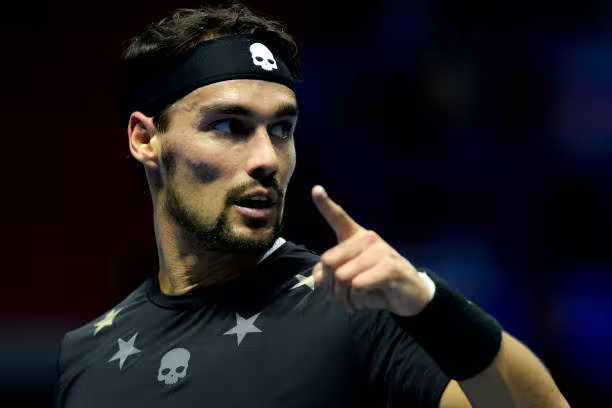
Fognini knows well what it entailed. He rose to world number 9 and claimed victory at the 2019 Monte Carlo Masters 1000, conducting much of his career in an era when Federer, Nadal, and Djokovic made the major tournaments incredibly challenging territories to conquer for others.
Did Federer, Nadal, and Djokovic really play all major tournaments?
Here lies one of the main nuances of the debate. There is a tendency to idealize the past and remember the Big 3 competing relentlessly every week when the reality was far more complex.
All three managed their schedules at different stages of their careers, suffered numerous injuries, and skipped important tournaments when necessary. Nadal is probably the most evident example. For many years, he pushed his body to the limit during the clay court season and often arrived at the season's end heavily depleted, affecting his results and participation in the latter months of the year.
Federer also significantly adjusted his scheduling as his career progressed, being more selective with his tournament choices to extend his longevity. Djokovic has followed a similar path in his recent years. Therefore, the management of efforts is not a new concept brought by the current generation.
A different matter is that during certain peak periods, the three managed to sustain an extraordinarily constant presence in major events. There lies some truth in Fognini's reflection, and it's understandable that someone who competed against them perceives a difference compared to the current scenario.
Modern tennis demands increasing physical explosiveness
It is also risky to interpret today's withdrawals as a generational issue and merely conclude that the younger players are "softer." Professional tennis has undergone enormous physical evolution in recent years.
The average ball speed, the ability to hit powerfully from defensive positions, and particularly the explosiveness required in movements turn every rally into a significant effort. The top players not only hit harder but cover vast amounts of court, abruptly change direction, and constantly accelerate and decelerate.
All of this has consequences. The body must absorb a significant number of impacts during matches that can last for hours and repeat almost every two days during major tournaments. Moreover, the expansion of numerous Masters 1000 events has led to the major tours occupying more weeks of the calendar.
Therefore, directly comparing different eras becomes complex. Federer, Nadal, and Djokovic endured a brutal demand and demonstrated extraordinary physical capabilities, but that doesn't imply that any decision by Sinner, Alcaraz, or any current player to protect their body should be seen as a lack of commitment.
Sinner skips Canada with a much bigger goal in mind
In Sinner's specific case, it's challenging to question his competitive drive. The Italian has been achieving significant results and knows that many of his season objectives will be decided in the upcoming weeks. Opting out of Canada means sacrificing the chance to continue an outstanding streak at the Masters 1000 events but allows more time to prepare for the hard court season and approach Cincinnati and the US Open in better shape.
What happened at Roland Garros, which Jannik himself attributed to the extreme physical and mental effort of playing all the clay court Masters 1000, might have been a turning point in his career and how he manages his schedule. Fognini fully agrees on this point. His criticism isn't directed so much at Sinner as it is at a general evolution of the circuit where Masters 1000 events may face weakened draws when several stars decide to conserve efforts simultaneously.
And that is indeed a significant tennis debate. The circuit needs to uphold the prestige of its major events but also question to what extent it can demand a constant presence from players subjected to an extraordinary calendar and level of physical intensity.
Fognini's remark about Federer, Nadal, and Djokovic inevitably prompts a look back, yet it also discourages overly simplistic comparisons. The Big 3 weren't immune to wear and tear either, and some of its members paid the price for excesses at certain times of the season for years. Sinner seems determined to learn that lesson: he may skip a major event now if he believes it enhances his chances of arriving in prime form at the most important stage for him, the US Open.
This is an automatic translation. You can read the original news, Fognini opina sobre la baja de Sinner en Canadá: "Federer, Nadal y Djokovic no se saltaban ningún Masters 1000"