

The 10 conclusions from the 2026 Rome tournament
We review what happened at the Foro Italico and the impact it could have on the upcoming Roland Garros.

Strong and intense emotions, surprises, disappointments, and great tennis spectacles. All of this has been experienced at ATP Masters 1000 Rome 2026 and WTA 1000 Rome 2026. What happened leaves an indelible mark on both circuits, especially if we perceive the passage through the Foro Italico as a prelude to what will happen at Roland Garros 2026. We analyze the main conclusions, with Jannik Sinner and Elina Svitolina in focus.
It is worth taking a moment to pause and appreciate in full the array of tennis emotions unleashed during more than a week at the Foro Italico. This tournament will always be remembered as the one where Jannik Sinner completed his unique puzzle of Masters 1000, while Elina Svitolina also left her mark in eternity, emerging as a giant slayer ready to sow terror in Paris if she continues this level of play. But there is much more.
Conclusions of the 2026 Rome tournament
1. Jannik Sinner, the one and only
Let the rhythm never stop. He is the best and never tires of proving it tournament after tournament, breaking historical records that seemed unattainable and generating a sense of helplessness among all his rivals. The clear favorite to reach glory in Paris after conquering the Olympian heights in Rome.
2. Casper Ruud and Daniil Medvedev earn the right to dream and enjoy
Remnants of a generation on the brink of extinction, honorable representatives of a batch of tennis players with many shortcomings, yet they find ways to intensify their virtues and minimize their faults. Ruud and Medvedev can be very pleased with the level shown in Rome and for making Sinner seem human at times.
3. Alexander Zverev and self-sabotage
Absurd excuses for insurmountable defeats. That could summarize, somewhat unfairly, what Zverev has been doing for some time. His stumbles resonate more due to his incongruent outbursts in press conferences and his on-court attitude than the relative importance of the defeats. He must improve greatly on the court, but also in front of the microphones because he is making many enemies, rightfully so.

4. Rafael Jódar continues to show clear signs of budding generational talent
Losing is equivalent to learning, especially when fighting to the end against all odds. The Spaniard reached the quarterfinals, captivating the tennis world, and took away valuable lessons for the future in his duel with Darderi. Intangibles of a special potential player and great anticipation for his progress.
5. The ATP circuit goes wild, for better and for worse
Darderi appeared, Landaluce emerged, Rublev and Khachanov returned, all top-10 presence faded in the final rounds beyond Sinner and Medvedev... In essence, a blessed madness is what is experienced in men's tennis, with triumphant skirmishes of true racket bandits, capable of dismantling anyone in a moment of carelessness. Out of sight, out of mind.
6. Elina Svitolina, well-deserved award and a warning to the sailors
Passing years, new rivals emerge, legendary careers are being forged, but she is always there. Perhaps not continuously, not with the most exquisite tennis or sustained regularity, but the name Svitolina inspires fear in her rivals during several important tournaments each year. Defeating so many illustrious names in Rome is the best endorsement to dream of glory in Paris.
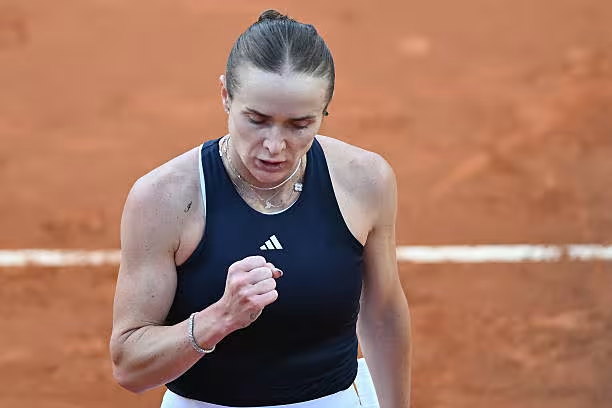
7. Cori Gauff and a lesson in survival awaiting tennis
She is 22 years old, yet competes like a veteran. Gauff still has a lot of room for improvement in all aspects of her game, is not performing well, and her confidence is wavering, but she manages to secure victories. Her acts of escapism against Sierra, Jovic, and Andreeva must be praised and considered for her aspirations in France.
8. Iga Swiatek does not dispel her doubts
Structural changes in her technique and mentality need time to solidify, but tennis grants no respite. Iga needs to think longer term, be patient, and trust in a process that is not yielding results as brilliant and early as expected. A ultimatum awaits her in Paris.
9. Aryna Sabalenka, reasons for concern
Mental fatigue, hangover from success, weariness of winning. Call it what you want. The Belarusian has lost some of her spark on this tour and will need to perform a miracle to conquer that unknown and longed-for territory that is Roland Garros for her. She must elevate her level and rediscover the consistency that seems to have faded.

10. The top-10 regains its luster and looks decisively towards Paris
Once again, we see a strong representation of the best in the final rounds, linking concepts like consistency, solidity, and regularity to the cream of women's tennis. Intimate rivals are emerging, individual stories, and personalities that resonate with a diverse range of fans. The real and potential rise of the WTA circuit.
In conclusion, the 2026 Rome tournament leaves an indelible mark on both circuits and suggests a series of exciting weeks for every tennis fan, with what is to come at Roland Garros 2026. There will be an irreplaceable absentee, such as Alcaraz, but what happened at the Foro Italico shows that the world of tennis is in good hands and that we can truly enjoy what we have. Let's do it without complaining.
This is an automatic translation. You can read the original news, Las 10 conclusiones que deja el torneo de Roma 2026