

INTERVIEW | Kaitlin Quevedo: "My dream is to win Roland Garros and be No.1"
We interviewed the 20-year-old player after her first call-up with the Spanish BJKC team: "When I received the news, I was in shock, I couldn't stop smiling."

A combination of resignations and injuries have led Kaitlin Quevedo (Florida, 2006) to be the top player of the Spanish Billie Jean King Cup team this weekend against Slovenia. The time has come to interview her.
It must be crazy to debut in the Billie Jean King Cup as the highest-ranked player on the team. A unique situation that Kaitlin Quevedo (#127 WTA) will have to experience this week in Slovenia, with Spain vying for a spot in the competition's final phase. The resignations of Bouzas and Badosa, coupled with Bucsa's injury, currently place the Canary Island player as a crucial pillar for Carla Suárez's team to achieve its goal. Before the action begins, we bring you an exclusive interview to discover a profile that promises to lead our women's tennis for the next ten years.
Congratulations on your first call-up to the Billie Jean King Cup; you look radiant.
I am full of excitement, desire, and positive emotions. I am very happy; this is something that any player has dreamed of, representing your country and defending the national team. I am looking forward to competing there.
Did you expect it?
I was confident that I was going to be with the team, but I also didn't know who would be there or in what position I would have to go. This time, Jessica (Bouzas) and Paula (Badosa) won't be there, so I was very happy when Carla called me and communicated it to me. I feel that I am improving, I am working hard, maybe because of ranking issues, I was indeed part of the plans.
What was that moment like when you received the news?
I was in shock, I didn't know what to say, I couldn't stop smiling (laughs). I thanked Carla, I was super happy, but the words wouldn't come out.
Everyone says that this competition is unique, that it's nothing like the others. Do you feel prepared for your debut?
I have discussed it with my team, it's a possibility. I think I am ready, in the end, it's just another match, but with more pressure because you are playing for your country and the whole team, not just for yourself. There is a sense of responsibility, and it will be my first time, I don't know how I will feel. In case I have to play a point, I suppose I will be nervous, but if I can focus and give it my all, I know it cannot go wrong. If we work so hard, it is to face moments like this, I feel like I have earned it. If I am here, it is for a reason.
You were born and raised in the United States, but your father is from the Canary Islands. Did you always know you wanted to play for Spain?
For a long time, I played for the United States, until I changed three years ago. The opportunity to come to Barcelona arose, and the RFET showed a lot of interest in me. They wanted to support me, believed in me, so that changed everything. Besides, I'm not 100% American; I'm also Spanish, so I'm very happy to have made this decision.
Having knowledge of both cultures, do you see many differences between Americans and Spaniards?
I don't think there are many differences, let me think [...] In the United States, everything is on a larger scale, they have big academies and a lot of people, nothing is focused on you because you're always in a group. I remember being there and training a lot, all the time, even though things worked out for me. It's a different way of working compared to Spain, where the mentality is much more determined. Here, they teach you to fight, to find solutions, to trust and be there at all times. I love the competitive spirit they have here. I've learned to focus more on quality rather than quantity, especially in my case, coming from training many hours. Now I work in a much smarter way; before, I did it without really thinking.
How well did you know Spain beforehand?
I was born in Florida, in Naples, where I lived until I was 17. The only time I left the United States to train was when I came here to Barcelona to train at the TEC. My father's entire family lives in Gran Canaria; we used to come here many times on vacation, so I already knew a bit about Spanish culture and their way of working. I've been in Barcelona since I was 17 years old.
You were very brave in taking that step.
I am very clear about what I want to do, how I want to be, and where I want to be. When I talked to my family, at that moment, it was the best option available. Honestly, I did it without thinking, I didn't hesitate for a moment to take the leap, although there are times when you want to be at home. Now I live alone, it was a big change, I lost touch with my friends in the United States. Last November, I returned home for the first time since I moved to Spain at 17, it had been a long time since I had seen some people.
What did you think when you returned home?
I realized I had missed out on many things, but I am very clear about the goals I have ahead of me; the best thing for me right now is to be in Spain.
Some may not understand why a tennis player leaves the United States when you have everything there.
They tell me that, it's true. For example, the IMG academy is in Florida, but there are many more academies, you can find a place to train in any state. The thing is, once I reached a certain level, there weren't as many girls to train with, while here in Spain, there are many professionals training. When I arrived at the TEC, I remember being with Marina Bassols, Camila Osorio, Kaja Juvan, etc. The opportunity to be here training with the best in the world was priceless. I was clear about it, and my family supported me at all times.
Surely, the TEC was also a key point in bringing you here to live. What makes this place so special?
It is a high-performance center, but it goes far beyond tennis. They care a lot about the person, education, sensitivity, being aware of what is happening in the world. In addition to tennis, we have many workshops where we all come together and discuss current issues like climate change, feminism, inequalities, many topics that we should be concerned about. We want to grow as tennis players, but we also want to have good values as individuals. This is fundamental within the TEC, perhaps the most important part.
What is the ultimate goal?
The goal is to build players and individuals who, once they reach the top, can raise their voice about all these concerns, raising awareness among others to live in a fairer and better world. It is vital to be aware of everything happening in the world, we must have that knowledge and stand united. Athletes have a great deal of power to communicate, reaching many people, so my desire is to use tennis to address all these issues. Billie Jean King already did this in her time, a great example for everyone.
What realities drive you to activism?
To advocate for social justice in the world, for equality, well-being, human rights for all, this is non-negotiable. That everyone has health, education, and decent work. We must fight for this to prevent wars, to help all those who are suffering. I am in a privileged position, so I feel that our responsibility is to talk about these things and raise awareness among others.
I don't know to what extent you are involved in these issues; many athletes prefer to live oblivious to these matters so they don't affect them on the court.
Some players think this way, that's why they never talk about these subjects; they don't want to give their opinion. For me, it's a responsibility. Outside of tennis, we work hard to compete well, but we must not be selfish. We are not alone in the world. We should have empathy for everything that is happening. Before coming to the TEC, I wasn't like this, but if you inform yourself and show interest, you start discovering things that are very important, issues where you can make a difference. Does it distract me later to play? I don't think so; I would say it motivates me more. I have had dreams since I was a child, but now I am evolving and have other goals. One of them is to use tennis as a platform to share my ideas and try to make the world a better place.

By the way, you are already the fourth-best racket in the country. How does that sound in your head?
(Laughs) I don't think about it every day... but when you just told me, it sounds crazy. Today I'm here, but three years ago, I was dreaming of being one of the best in Spain. Now, I am finally at that point, so I try to make the most of it.
Has the journey been very tough to get here?
In a tennis player's life, many things happen, there are many changes, injuries come, family problems, conflicts with your team, so many changes that you can only adapt. The excitement behind it is what drives us, we are all a little crazy (laughs). I try to enjoy it, I don't think about whether it was very difficult or not, although there are always challenging moments, of course. On those days when you might not feel like training or getting up, that's when it really matters. The process is long, I have worked a lot, what I want is to give my best every day so I have no regrets in the future.
At 20 years old, you are ranked #127 in the world. Are you happy or should a good tennis player always be unsatisfied?
Until I reach No. 1, I will always have that in my mind. And if someday I get there, I know I won't want to go down. You should never settle. Of course, I am happy and proud to see where I have come, but there is still a long way to go, many things left to experience, much more to give. The sky's the limit! I hold onto this idea to motivate myself every day and give my best, even though sometimes it doesn't work out because I am very demanding.
Let's finish with a quick round. What is your best shot?
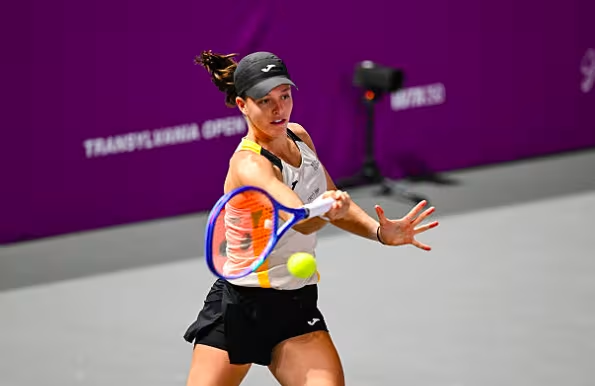
The forehand.
A surface.
Dream tournament.
Roland Garros.

Define your game in three words.
Complete, intense, and brave.
Your best memory in the world of tennis.
When I was young, it was amazing to go to the Miami Open and see Carla Suárez live. She signed some balls for us, and we took a photo with her. I remember we were carrying the Spanish flag... or was it the Canary Islands flag? I have to ask her to see if she remembers (laughs). I also cherish the Junior Grand Slams; it's impressive the first time you interact with the top players.
Do you have a role model?
Iga Swiatek, my favorite player.
What do you like to do in your free time?
I enjoy being calm, spending time with my family, and taking walks with them. I'm not one for going out to parties or anything like that; I prefer staying at home with a blanket.
Do you have a nickname?
I have many because my name is a bit difficult here in Spain. They call me 'K', 'Kate', 'Quevedo', and 'KQ'. The last one is the one I like the most, 'KQ,' let everyone call me that (laughs).
A friend on the circuit.
Lately, I've been meeting Leyre Romero quite often at tournaments; we talk a lot.
Your toughest opponent.
Being World No. 1 or winning a Grand Slam?
Grand Slam.
Grand Slam or Olympic medal?
Olympic medal.
Olympic medal or winning the Billie Jean King Cup?
Phew! [...] Winning the BJKC this season! (laughs).
A member of the Big3.
Rafa Nadal, always.
The best and worst of being a tennis player.
The best part is that you have the opportunity to travel around the world, discover different countries, and experience different cultures; this is a gift. The worst part is that you spend a lot of time away from home, precisely because you are traveling all the time.
Your biggest sacrifice to get here.
Mainly family events, like holidays or New Year's. I had never missed New Year's before, and this season was the first time. That's tennis for you; it doesn't allow you to be there.
An objective.
My goal is to finish in the top 100 this season.
A dream.
My dream is to win Roland Garros and reach World No. 1... and once there, be able to speak up about my concerns.
From 0 to 10, how happy are you at this moment?
Ten!
Wonderful.
You shouldn't be in any other way. There are good days and bad days, of course, but you have to be happy.
This is an automatic translation. You can read the original news, ENTREVISTA | Kaitlin Quevedo: “Mi sueño es ganar Roland Garros y ser Nº1”