

The day Connors collapsed with Lendl... and with the chair umpire
Jimmy Connors was one of the players who suffered the most from Ivan Lendl's on-court solidity. 40 years ago, at the Miami tournament, frustration led to his disqualification.

Jimmy Connors' career was always marked by adversity. The American felt like he was facing the world every day, although there were occasions when this feeling was for real.
But why did he constantly feel that everyone was against him? Perhaps the public never loved him as much as he thought they should? Most likely, but from there grew the roots of pushing against the current each season, of coming back from impossible matches, and of responding firmly to challenges. Despite being the best, Jimmy Connors always had to prove it on the court, even against lesser opponents, silencing the critics who didn't see him as a generational leader. This psychological battle forged a genuine survival instinct in him, although he did not always manage to put it into practice.
Today we take a trip back in time to 1986, 40 years ago. Connors was 34 at that time, with eight Grand Slam titles under his belt. However, the present pointed towards a second-tier stage where John McEnroe and Ivan Lendl had taken over from Björn Borg. Nevertheless, the American's name was still among the top 4 globally, reaching the semifinals in his last seven majors. Few could match his consistency.

The year 1986 started for Jimmy with quarterfinal exits in Philadelphia (lost to Tim Mayotte) and Memphis (lost to Brad Gilbert). With that record, he entered the Lipton International Players Championship in Boca Raton, where he stepped up with good wins against Adrianno Panatta, Thierry Tulasne, and Yannick Noah. Now, the path led him to face one of the ogres of the circuit, arguably the greatest rival of his sports career.
Connors versus Lendl, a legendary rivalry
We are talking about Ivan Lendl, of course, who was the world No. 1 at that time. They had faced each other 25 times, with twelve wins for the Czech and thirteen for the American. It was practically a technical tie. However, the issue lay in their last seven clashes, where Ivan had emerged victorious. This meant that Jimmy had not defeated him since the Tokyo final in 1984, where he won his 105th career title. But what was to unfold between these two bulls on that Friday would be new, a different outcome, a collapse in Connors' mind when the film was already halfway through the fifth set.
The semifinal was tough, but Lendl took the lead in the final set. The Czech was ahead 3-2 and 30-0 up with a break in his favor when a sliced backhand floated across the court until it went out. Or at least, that's how Jimbo saw it. The ball seemed to have gone out by a margin, but the Belleville native questioned the call, just in case. Assuming it was 30-15, the noise in the stands didn't help him grasp what had actually occurred until the chair umpire, Jeremy Shales, reminded him with his verdict: "40-0." That comment ignited a fire impossible to extinguish.
With countless historical articles, there is no need to elaborate on who Jimmy Connors was. His first reaction was to confront the linesman: "No, no, no! You're wrong!". His second move was to target Jeremy, a man he loathed. In fact, according to his memoirs, throughout the match he had been convinced that the chair umpire had been robbing him of points since the beginning.
- "The ball was good, Mr. Connors. Play on."
- "You're kidding me, the ball was far out."
- "Play on Mr. Connors, the score is 40-0."

Jimmy protested until he was drained, his blood boiling, but the atmosphere didn't help either. Seeing the situation escalating, the crowd started shouting at him, something that he couldn't care less about. Even though he was defending his rights, his mind had long stopped wondering why people were never on his side, not even when he played at home. That's why he titled his autobiography 'The Outsider,' that's how he felt throughout his career, emphasizing that detachment when competing in the United States.
- "I won't play under these conditions, call the supervisor."
- "Mr. Connors, you have 30 seconds to resume play, otherwise you will receive a point penalty."
- "Bring the referee and the supervisor here, call them both. You're the one wasting my time."
The commotion intensified, and it was impossible to tell whose side the crowd was on.
- "Point penalty, Mr. Connors. Time violation. Game, Mr. Lendl, leading 4-2 in the final set."
Finally, the two individuals our protagonist had summoned appeared on the scene: Ken Farrar (supervisor) and Alan Mills (referee). The crowd raised the decibel level a couple of notches while Jimbo prepared his defense against the authorities.
- "I've been playing for 3 hours and 41 minutes, but this is too much. This is a clear ball, it's maddening, I didn't even play it because it was way out!"
They tried to calm him down, showing how little they understood him. From his elevated seat, Jeremy Shales kept glancing at the clock, counting the seconds before delivering the final blow to the American.
- "You have a job to do and you're not doing it, this whole situation is your fault. I don't want to play on under these circumstances. Are you going to do something about it?" Connors, fuming, lashed out at everyone there.
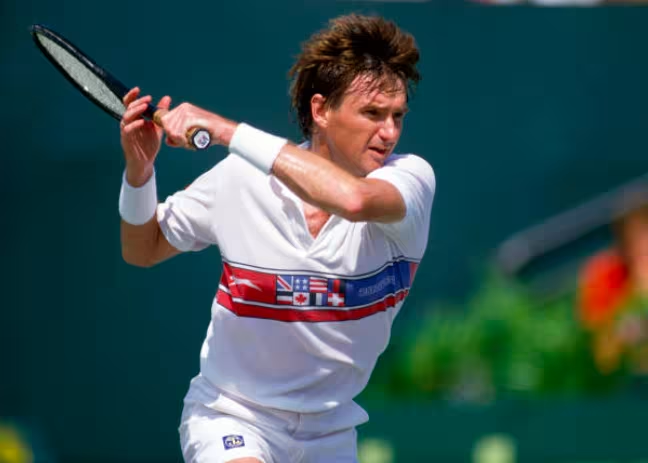
Jimmy Connors, talent and anger in the same bottle
At that moment, Farrar grabbed him, whispering, "Jimmy, please, I don't want it to end like this. Let's return to the game." However, the chair umpire seemed resolute and escalated the situation with his next ruling:
- "Game penalty, Mr. Connors for delaying the game. Mr. Lendl leads 5-2 in the final set."
The public noise reached a peak, the uproar was immense. The law of the jungle activated, and many began hurling objects and insulting the umpire, wanting things to escalate. At this point, Jimmy had no intention of backing down; the damage was done, and the wound was deep. The inevitable was about to happen:
- "Game, set, match to Mr. Lendl, by disqualification: 1-6, 6-1, 6-2, 2-6, 5-2 (DEF)."
Frankly, Connors couldn't care less about any of it. He stored his racket, grabbed his bag, and vanished from the stadium. Patti McGuire, his wife since 1979, joined the chaos and unleashed a torrent of insults at the chair umpire. All of these distractions overshadowed the most crucial fact: Lendl had beaten him again, setting the head-to-head record at 13-13 and dealing him his eighth consecutive defeat. But the worst part of that run was yet to come for Jimmy Connors; the official head-to-head would end with a painful 22-13 advantage for the Czech. Imagine all the bitterness that poor Jimbo had yet to swallow in the years to come.

In terms of consequences, that outburst cost Connors a $25,000 fine and a ten-week suspension from competition. Was it a problem for Jimmy? Not really, as he remained one of the main attractions in the locker room. The Illinois native managed to turn the situation around and used those three months to spend time at home and participate in exhibitions. "That's how I made much more money than I would have playing tournaments," he boasted later on. However, what haunted him forever were the actions of Shales; the mere presence of that chair umpire tormented him.
"He wasn't good enough, he was incompetent, but he wasn't the only one. I never argued with an umpire if I didn't believe it was truly deserved. Our generation fought tooth and nail out there without instant replays to protect us. It was normal for players with stronger temperaments to lose their cool from time to time. The authorities knew they didn't always get their decisions right, but they refused to admit it," reflected the champion in his memoirs. Surely, Connors would have lived a much calmer life in this modern era, shielded by hawk-eye technology and video reviews. He would have been a calmer player, perhaps winning even more tournaments. Those who were fortunate enough to witness him at his peak had quite a stroke of luck.
This is an automatic translation. You can read the original news, El día que Connors colapsó con Lendl… y con el juez de silla