

Would the current Alcaraz beat the Big 3 in their prime?
Right now, it's the big debate in the tennis world: Would the current Carlos Alcaraz beat the Big 3 at their peak? The truth is, the question is tricky... yet fascinating.

Let's set the stage. But first, to avoid misunderstandings, I want to make the question very clear. It's not about deciding who the GOAT is, which, for now and based purely on statistics, would have to be awarded to Novak Djokovic. Nor is it about who the GOAT on grass is, which clearly falls on Roger Federer with his 8 crowns at Wimbledon, 10 in Halle, and one more in Stuttgart. As for who the GOAT on clay is, well, there's nothing to discuss here.
It's also not about whether Carlos Alcaraz would be able to dethrone 'Nole' from his position as the supreme GOAT and monarch of Australia, Roger as the King of Grass, or Rafa Nadal as the God of Clay... I believe he could be the GOAT, I already believed it four years ago, but only time will provide the definitive answer.
Again, the question is solely focused on: Would the current Carlos Alcaraz beat the Big 3 at their prime, at their peak, without delving into other speculations?
To begin to answer it, let's first define at what point in their respective careers each member of the Big 3 was at their prime, at the perfect moment to face them against Carlitos.
The 'prime' of each member of the Big3
Let's talk about Roger Federer, the Roger Federer of Wimbledon 2006. At 24 years old, at his physical peak, the Swiss maestro conquered The Cathedral for the fourth consecutive time with an absolutely dominant game, a tennis that was defined as "perfection on grass". And yes, even though he didn't have to face big future colleagues of the Big Four along his path, he eliminated very dangerous grass court players like local hero Tim Henman, Mario Ancic —a formidable Croatian talent whose career was halted by a severe case of mononucleosis, leaving fans wondering what his peak could have been— and, in the semifinals, the veteran Jonas Björkman, a player better known for his doubles career but let's not forget he was World No. 4, handing him a 6-2, 6-0, 6-2 defeat in just under an hour.
He reached the final without dropping a single set and, once there, after delivering a 6-0 blow to Rafa Nadal, he went up by 2 sets with a 7-6 in the second set and, finally, lost his first set of the tournament in a tiebreak 6-7 only to finish off with a clear 6-3 victory.
A year unmatched, with 92 victories and only 5 defeats, in which Federer maintained the World No. 1 ranking he achieved on February 2, 2004, being part of the 237 consecutive Mondays his name appeared at the top of the list.
Or about Novak Djokovic from the 2015 Australian Open, the Grand Slam where the Serbian legend completed his most superb performance, finishing in the final against Andy Murray —who managed to steal a set (7-6(5), 6-7(4), 6-3, 6-0)—, ending it with a brutal 6-0 in the last set, the first time in AO history that a male final ended that way, winning 36 of the last 49 points played.
A fifth Australian title won at 27 years old was the prelude to a superb season, in which he won two more majors (Wimbledon and the US Open), six Masters 1000, reached sixteen consecutive finals, and with 82 wins and only 6 losses, he was the undisputed World No. 1 for 52 weeks, achieving a historic record of 16,950 ATP points that many consider unreachable. Incredible!

And of course, entering the discussion is Rafa Nadal. Perhaps the year in which the Spaniard reached his peak in tennis was 2010. In that season, the player from Manacor won three Grand Slams (Roland Garros, Wimbledon, and the US Open), completing the Career Grand Slam and finishing as the world No. 1 with a record of 71-10 (87.7% win rate), including a total of 7 titles.
On clay, what can we say? Undefeated throughout the European season (22-0), he swept through Montecarlo, Rome, and Madrid (a feat he alone has achieved), and then Roland Garros without dropping a set. Although the 2008 title on Parisian clay may have been more dominant, the tally in 2010—undefeated season on clay and perhaps a greater maturity at 24 years old, although, well, I believe Nadal was mentally mature from birth and two years more or less won't make a difference in his level of maturity...—makes us choose that year and that Roland Garros to compare him to the present Alcaraz.
And this is the El Palmar Phenomenon that they would face: the current one, a Carlos Alcaraz who in 2025 completed the best year of his short and overwhelming career and who in 2026 has started the year in a big way, defeating Djokovic at the Australian Open, in "his tournament."
So, we would be talking about a guy who has won three of the last four Grand Slams played, who finished the year as No. 1, and who achieved a record of 71-9 (approx. 88.75% effectiveness), displaying a level of play that many tennis greats like John McEnroe, Martina Navratilova, Mats Wilander, or Andre Agassi consider the best ever seen on a tennis court.
The time has come to answer the million-dollar question, knowing that we will never have the answer with 100% certainty and that not even the most advanced AI could give us more than a hypothesis that can never be confirmed, and that only the Tennis God —the same one who has sent us, in my view, the three Evangelists and then the Messiah, in his omniscience— could reveal to us.
My answer, personal and absolutely my own, is that Alcaraz would win two out of the three proposed matches.
The three matches dreamed of by the tennis fan
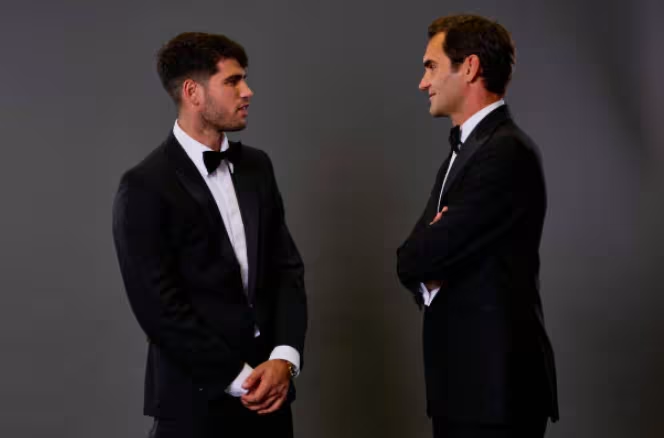
Let's start with the sacred London turf. We would possibly witness the most talented match ever seen on the court, but I lean towards Alcaraz, for pure tennis. Thus, two decades of evolution in ball speed on his side, combined with the exceptional mix of an unstoppable topspin forehand, extreme athletic ability, and talent, a hand capable of going toe to toe with the Swiss maestro, would ultimately tip the scale in favor of Alcaraz.
I repeat: for pure tennis, for pure tennis quality... which, to fervent Federer fans, may sound like heresy: "How dare you say that someone has more talent than Roger?".
They are right, in talent they are very close, but the player from Murcia brings other weapons to the battle that, unfortunately for the “federerians”, would give him the final advantage.
We go to the antipodes. There, in the Rod Laver Arena, the GOAT, the best counterplayer in history, capable of returning like no one else, of turning defense into attack in a way that nobody has achieved, the man who coming from behind reached the top, would also fall to the beast from Murcia.
Because again the concept of pure tennis would play in favor of Carlitos. We would see a crazy match, a "caprine" duel that would give us a display of brutal, insane tennis... but the "alcarazian" ball speed, his ability to respond to the Serb's counters, his lethal drop shot, and a mind that already showed itself by defeating the Serb in two previous Wimbledon finals at 20 and 21 years old, would sentence the Balkan legend.
We saw it in the past AO, although I recognize what the “serbinators” will say, with very good reason: "the 2026 Djokovic is eleven years older and had just given everything he had against Sinner."
Facing this well-founded criticism, my response is that Nole's current level compared to 2015, barring physical recovery capacity, is very similar, and the degree of "savviness" —one of his assets against the superior tennis of Carlitos— is undoubtedly greater nowadays.
On the other hand, with Rafa Nadal, it's a different story. On the clay of Philippe Chatrier, we wouldn't be talking about pure tennis, ball speed, or skills. It's something else here.
Certainly, Rafa's forehand would punish Carlos' backhand, of course, Carlos' magical drop shots would wear down Rafa's legs... But this is not a matter of tennis, of Newtonian physics. Rafael Nadal took the matches to the realm of metaphysics, to a territory where other things came into play, with the will to win as the deciding factor.
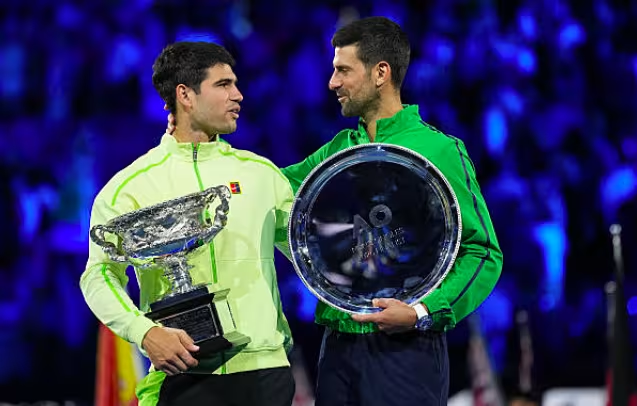
By the way, at no moment am I doubting that will on Carlos's part (or Roger's, or Nole's), but Don Rafael Nadal Parera was a step further: the Will to Win raised to the maximum power.
Let me explain. Roger and Novak, when they were winning, they were "better". When Carlos Alcaraz wins, it's because he "is better". As for Rafa, he didn't need to "be the best" to win. In fact, he beat the best when they were at their best, like in the iconic Wimbledon final in 2008, defeating Roger Federer 6-4, 6-4, 6-7(5), 6-7(8), 9-7, a Roger Federer who, as the world number one, had just won five consecutive titles on the same court. Or like his unforgettable victories in Roland Garros against Djokovic in 2020 and 2022, when it was clear that the Serbian was the undisputed number one... and was better than the Spaniard.
The first one, the year of Covid, in a Roland Garros held in autumn, with heavier balls, which meant adverse conditions for Rafa, who always preferred to play with sun and heat against Djokovic so that his heavy topspin shots could disrupt Djokovic's flat strikes. Even so, with a fierce start and a Nadalian resistance in the third set that stopped the dangerous comeback of a wounded but not defeated opponent, he managed to win the match with an unheard-of 6-0, 6-2, 7-5 in 2 hours and 41 minutes.
The second one, in 2022, where a world number 5 Nadal faced a mighty Djokovic in the quarterfinals, who had defeated him in the final the previous year, getting his revenge from 2020, and whom the betting houses considered a clear favorite.
Here, once again, the Greatest Competitor in the History of Tennis defied all odds and defeated logic, physics, the betting houses, and the number one after four hours of struggle, suffering, and conflicting wills to win.
This is the key, which is why I believe Nadal would win that epic showdown. It's not a matter of pure tennis, where my bet would be on Alcaraz. It's a matter of heart, will, and winning spirit. And here, without denying at any moment that Alcaraz possesses these qualities in a superlative degree, Nadal is superior.

In this regard, the best litmus test between the two was the iconic Indian Wells semifinal in 2022, an epic semifinal with hurricane-like wind, between a Nadal who had once again achieved the impossible against Daniel Medvedev in the Australian Open final and a Carlitos Alcaraz who would win his first major that same year, falling on the side of the Spaniard by sheer willpower (and incidentally, causing me to lose some shrimp I had bet on Carlitos).
Is Carlos Alcaraz better than the best versions of the Big3?
To conclude, let's make it clear. Alcaraz is the one who has played tennis the best in history and would win the proposed matches against Federer and Djokovic... but would succumb on the Parisian clay to the 2010 Rafa Nadal. And this is the moment to remember —I love these analogies with other sports and eras— the statement of the legendary coach of the 1980s Los Angeles Lakers, Pat Riley:
“If I had to choose a player to take a shot to save the game, I would choose Michael Jordan. If I had to choose a player to take a shot to save my life, I would choose Larry Bird”
So, that's it. If I had to choose a player to win any Grand Slam, I would choose Carlos Alcaraz, but if my life depended on that victory, I would choose Don Rafael Nadal Parera.
- Text written by Pablo Carabias, tennis tournament director, national coach, and sports enthusiast in the USA.

This is an automatic translation. You can read the original news, ¿Ganaría el actual Alcaraz al Big 3 en su prime?