

"It is very complicated for young boys to be the bosses of adults who have many years in tennis"
We talked in Rotterdam with the current coach of Hamad Medjedovic who, as a profound connoisseur of the ATP circuit, shares powerful reflections on today's tennis and the relationships between player and coach.

His name embodies a great status on the ATP circuit, and rightfully so. Jorge Aguirre, the man who shaped Alejandro Davidovich's professional career for 14 years, now leads an ambitious project as the coach of Hamad Medjedovich. Accompanying the Serbian in Rotterdam, he speaks to Puntodebreak's microphones with his usual wisdom and generosity.
Walking through the comprehensive facilities of the ATP 500 Rotterdam 2026, enjoying the genuine tennis atmosphere, I come across a familiar face. Jorge Aguirre observes attentively all around him, greets those who recognize him as a key figure on the circuit, and readily sits down to chat with me.
After working with Alejandro Davidovich for 14 years, he founded the Higuerón Tennis Center in Fuengirola, establishing a significant hub for tennis development in Spain and Europe. The cornerstone of the project is Hamad Medjedovic, currently ranked 79th in the world at 22 years old, striving to forge his path while shedding the added pressure he felt after winning the Next Gen ATP Finals 2023. Over two years later, the Serbian appears more mature, with a polished and meticulously crafted upward trend guided by the Spanish coach.
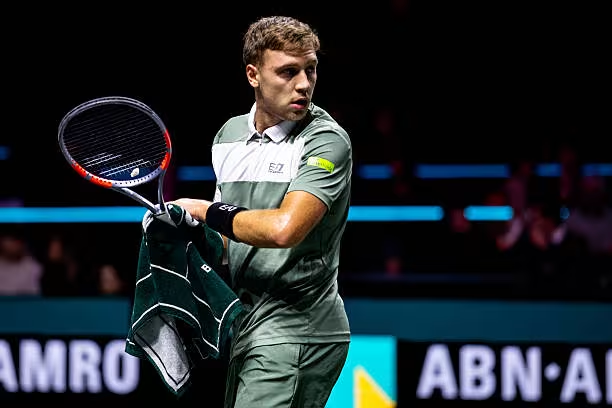
What is it like to work with Hamad Medjedovic? There's a feeling that many believe all young players must progress quickly, especially after his Next Gen Finals victory. Should we understand that each player has their own path?
Well, I agree with what you say. It's true that when you achieve a title of that caliber, like the Next Gen, expectations are quickly raised, placing you in a position, in a ranking, where it needs to be assessed if you truly belong there or not. I believe Hamad has great potential to grow, but I honestly think he wasn't and still isn't ready to be where they tried to place him so soon.
Being young, this situation adds a bit more pressure, a bit more anxiety, hindering one from playing freely and showcasing their abilities, as if you always need to prove that excitement placed upon you. Dealing with that isn't easy, and it needs to be matured gradually. The pressure he faced in Serbia wasn't easy to handle, either.
What do you think is the area where he has the most room for improvement to make that jump in quality?
Clearly, there is room for improvement in the physical aspect. However, I must say it's a bit deceptive. He's not as physically inadequate as it may seem. He's a very powerful guy; I've seen him in training generating a level of power, explosiveness, and strength rarely seen on the circuit.
What he needs is mental freedom and a clear path to express himself on the court. Sometimes that's a challenge for him. There are moments where he shrinks a bit, and then you see greater shortcomings than he really has. But gradually, a great Medjedovic will emerge.
How do you view the evolution of the circuit in recent years? It seems that everything is becoming more professional, and every detail matters more.
Personally, from the inside, I find it thrilling. Our example perfectly illustrates the current reality: a player ranked 90 in the world who in Australia won a set and had a break point in the second set against a top-5 player (De Minaur) or who beats a top-40 player (Bergs) this week. That signifies there's an impressive level of parity.
Everyone is well-trained, well-prepared. Ultimately, it's about being ready for the week when circumstances align, seizing the opportunity, and then consolidating the progress made to maintain that trend. For me, the circuit is fantastic. The work of the top players is commendable because the demands are extremely high, and there is great equality.
It seems that the average level keeps rising in recent times, and the top 50 or top 100, in general, are more competitive than ever.
Absolutely. Undoubtedly, we can't diminish the achievements of those who were in the top 100 20 or 30 years ago, as it's a challenging feat. However, players today are more professional. In my academy, I have 15-year-old juniors training six hours a day, preparing extensively. This dedication is seen in Malaga, Valencia, Barcelona, Australia, and the USA alike. There are numerous players ready to succeed and equipped to secure a spot among the top 70 or 80 in the world, making it challenging to maintain that position.
There is much talk about the quality of tennis balls in recent years, with conditions changing weekly, and some mention attempts to slow down the game. How do you perceive this?
It's a complex issue involving many commercial agreements with television networks, ball brands, etc. Ideally, the same ball should be used throughout the season. Conditions vary significantly from one week to the next. Here in Rotterdam, the conditions are exceedingly slow; I don't recall ever being at an indoor tournament with such sluggish playing conditions. But we must adapt.
The tennis calendar is very demanding, and all players seem to agree on the challenges it poses. How do you see this from a coach's perspective? Does it affect professional and personal relationships between coaches and players?
It's extremely difficult. The way the tennis business is structured, with the player paying the coach, results in very young individuals, lacking developed mental frameworks and lacking in business acumen, being the bosses of highly experienced adults. When they start receiving money, fame, and power, sometimes it's hard for them to listen. Many relationships begin without the coach and player truly knowing each other, and the slightest disagreement leads to a breakup.
Nowadays, there's little tolerance. That's why my philosophy is not to initiate any professional relationship without living together first, spending time together, sharing meals, discussing life and the future. I believe this is the only honest and trust-based way for a collaboration to endure over time and be successful.

You have been a key figure in Alejandro Davidovich's career. Now that some time has passed since your professional split, how do you see him? Would you like to clarify any reasons for your professional separation?
No, I prefer not to discuss that. What I can say is that I have nothing negative to say about him, and I'm truly pleased to see him striving for the goals he had long envisioned. I sincerely wish him all the best.
Lastly, tell us about that significant project you have at hand, the Higerón Tennis Center.
We've been working on the project for a year now, and it's going extraordinarily well. It's growing rapidly, and we need to open more spots because the best players in the province and even players from outside are joining us. We've built a beautiful synergy between young talents in training, players already competing in Futures, and the emblematic figure of Hamad, which generates additional interest. He lives there; we got him an apartment, and he's very content. The working atmosphere at the academy is fantastic.
This is an automatic translation. You can read the original news, "Es muy complicado que chicos jóvenes sean los jefes de adultos que llevan muchos años en el tenis"