

Emerson wants to win Grand Slams and thinks he can do it
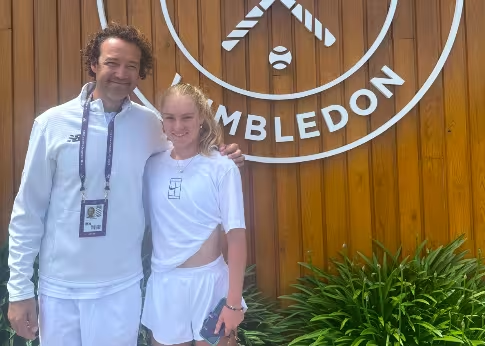
We interviewed Carlos Cuadrado, coach of Emerson Jones, one of the purest diamonds on the women's circuit: “The goal is to break into the top100 this season”.

Right now, there is no player younger than Emerson Jones within the top 250 in the world. The Australian is only 17 years old, but her name has been making waves for a while now. By the way, her coach is Spanish.
If anyone still doesn't have Emerson Jones on their radar, they will surely know the man who has been coaching her for a year and a half. We're talking about Carlos Cuadrado (Barcelona, 1983), one of the most extraordinary interviews we have brought to Punto de Break in recent times. Do you remember that kid who won the Roland Garros Junior and years later sailed around the world? Yes, that's Carlos, the same one who shared his story in a book that we recommend: ‘An Unpredictable Rival’.
Interview with Carlos Cuadrado, the man shaping Emerson Jones
But today we have not come to talk about her book, but about her work as Emerson's coach, a girl who two years ago was #793 in the rankings and today is #147. Impossible to go unnoticed with such a huge breakthrough, especially in Australia, where they still get emotional remembering the retirement of Ashleigh Barty. In the absence of a current great role model, many fans see the Gold Coast native as the chosen one to bring glory to the Oceanics, although it's early to confirm this statement. What we can do is interview Carlos to get to know this project from the inside.
How is the Happy Slam received?
I'm used to it (laughs). It's very enjoyable in Australia, I've been here since 2012, so I couldn't agree more. The other Grand Slams are good too, I like them a lot, but each one is different. The Australian Open is the first of the year, everyone starts very strong, with a lot of enthusiasm, that's why they also arrive delighted.
What does the Australian Open have that the others don't?
Great infrastructure, very friendly people, many volunteers are delighted with what they do, the country in general is wonderful. I remember when I came to play here for the first time at 18, telling my mother that Australia would be a country where I would live. Imagine, it must have so many things for someone to say something like that on their first visit.

What is it like to work for such a large federation like Tennis Australia?
The budget is much larger than in our federation, for example. From the first day, they have treated me very well. In fact, when I sailed around the world, I left not knowing if I would return. The day I decided to come back, they wasted no time in opening the doors for me again. They received me wonderfully, so I am very happy with them. Now they have given me the opportunity to work with Emerson (Jones), which is a pleasure to live this experience with someone of such great potential. With the confidence they have in me, I can only express words of gratitude.
Looking at the numbers, maybe Australia should have more weight on the circuit.
The issue with Australia is that there are very few people living in the country, half the population compared to Spain. On the other hand, tennis is not the number one sport here; football, rugby, or basketball are played much more. Additionally, it is a very isolated country. Although this was what attracted me the most to come and live here, it is evident that it does not help with tennis. This is one of the main problems, although the Federation always compensates for it with a multitude of trips, even if they involve long flights to Europe or the United States.
How do you see the state of Australian tennis?
They are improving; there are more players in the top 100 on the men's side. But there is always room for improvement; Federations always want more. In Spain, there are many private academies, but in Australia, there is none simply because there are no players; you wouldn't have clients. Academies are created to make money, there are many expenses, so here it is an unviable system due to the lack of players.
Let's talk about Emerson Jones, how does it all start?
I met her when she was 12 years old, in fact, there was a period when I was representing her, and I was more involved in management issues. A year and a half ago, her parents got in touch with me and asked if I wanted to work with her. There was a proposal from the Federation, and then the transition has been very quick. We started in the summer of 2024 when she had just turned 16; now she will turn 18 in July.
In this year and a half that you have been working together, do you notice any evolution?
She is very young, I notice the evolution every month, but always in the same direction. She is very mature, her development multiplies when she plays against good players; that's when you can see that she is stepping up. Every day she becomes more professional, making better decisions on and off the court; this is in the natural process of growing up.
Did you have her playing style clear from the beginning?
Yes, always. She is small, so she has to be aggressive. She plays flat, although she is starting to vary this; she needs to keep gaining strength. Her tennis is extremely aggressive; she serves better each time, moves better behind the ball, but always very stable.
This week I heard a journalist comparing her to Barty...
For a year and a half, they have been comparing her to Barty, before I started working with her. Both have been Junior No. 1s, Emerson won some ITF tournaments when she was 14, something only Barty has done. It was an inevitable comparison because they are both Australian; there hasn't been another similar case of a player rising so strongly from those stages.
Emerson said that her priority is no longer studies. Is she certain about that?
She is very certain; her priority has always been tennis, and her results have backed her up from a very young age. She will try to go as far as she can, so it's super easy to work with a profile like hers because she has no doubts. As a coach, being with someone who has so much passion, drive, and ambition is a plus. In every training session, you can see how she pays attention to every detail, how she listens to every word; this makes my job easier.
At 17, do you see her ready to compete with the best already?
Yes, but she is still evolving; it's not something that happens overnight. She still needs to improve; now she is #150 in the world. We have the desire to work, but we are not in a hurry. We want to give our best, but we will go at the pace required. For now... she's not going slowly (laughs).
Is she in a hurry?
She is in a healthy hurry; she has ambition, she wants to break into the top 100, for sure. It's the driving force inside her that motivates her to train hard every day and enjoy herself on the court.

If we talk about precocity and being a good junior, you know a thing or two about it.
Yes, but in boys, it's different. I always knew that my transition to being a professional would be slower than yours. Women tend to progress a bit faster in everything; it's harder for us. At that age, I was going at a normal pace, I was a good junior aiming high. In your case, you are going at the natural speed of the best, following a very upward trajectory. I loved competing; in fact, I competed better than I trained. My desire was also to get to the top as quickly as possible.
What advice do you find yourself repeating the most?
When she loses matches, I remind her she's in a process, she's on the right track. I insist on her continuing to do the things we've been working on, trusting this system, and analyzing each match we lose. The key is that everything aligns with what we practice off the court, then working on what we need to do to beat the top players. It's a long process, but we must have faith and continue on this path; we're doing well.
Is the environment healthy?
Her mother won a silver medal in triathlon at the 2004 Athens Olympics. Her father was a professional Australian rugby player. It's a family coming from the world of sports; they understand perfectly what sacrifice means, what a victory or defeat means. They understand what it's like to travel and what happens in elite environments.
I have to ask: Has Emerson read your book?
She hasn't, but her mother has (laughs). Emerson isn't much of a reader; she's more into watching movies, but she's up to date; I tell her many tales from my sea voyage.
You have highlighted her excessive ambition. Could this be dangerous?
It's always good, there's no need to push her. The downside would be having a lazy player who isn't motivated to work. Nowadays, in tennis as it is, it's essential to have someone who is eager and willing to improve.
I remember a video of Djokovic at 7 years old saying his dream was to be the world number 1. Doesn't Emerson have a similar video?
I don't know if she has that video, but surely her dream is to win Grand Slams. She wants to win Grand Slams and believes she can do it; it's important to have both concepts together. Believing you can achieve it is fundamental; if you're not convinced yourself, it's impossible to succeed. My job is to encourage those thoughts and multiply them if possible because if you don't believe in your own possibilities, it's very unlikely that you will work hard afterward. Luckily, she is very clear about this, which is why her ranking has continuously improved.
Of all the virtues that Emerson has, which one is the most differential?
That she is fearless. Additionally, she competes like few others, competes incredibly, unlike anything I've seen before. That's the most important thing she has, her way of competing; she overcomes obstacles as she faces them.
Do you dare to make a prediction for 2026?
I don't know, it's difficult […]
Right now, she is #147 in the ranking.
I can tell you our goal: to break into the top 100. The handicap we have is that until July, the number of tournaments is limited, breaking into the top 100 with only twenty tournaments is not easy, but we are going to work like crazy to achieve it. Last year the goal was to break into the top 150 and we achieved it in the last week, winning a W75 in Adelaide. I always try to set realistic goals.
How nice it is when goals are discussed without fear of what others may say.
We are clear on our goal, to break into the top 100... but I wouldn't be surprised if expectations are exceeded.
This is an automatic translation. You can read the original news, “Emerson quiere ganar Grand Slams y piensa que puede hacerlo”