

Andrés Santamarta chooses the university path: "If you don't enjoy it, this sport becomes very tough"
The former Junior World No. 1 will kick off a new stage in January after his first professional season: "I need this disconnection, this year I hit rock bottom".

The life of Andrés Santamarta will take a radical turn in the coming weeks. The Valencian tennis player, who was the world's best junior a few months ago, has made a decision that changes everything: to opt for university college.
The decision, obviously, has not been made in haste, although everything stems from the outcome of a season that was too long, full of good moments but also unbearable ones. At 18 years old, Andrés Santamarta (Valencia, 2007) is the first to acknowledge that this professional role has been too much for him at many moments. Is anyone really prepared at his age to face such a demanding circuit? Very few people.
The Valencian doesn't hide the fear he feels after changing his route on the GPS, but the suitcases to move to Virginia from 2026 are already packed. There, he will continue his adventure, where he can combine studies with tennis practice. Fortunately, the path of college has not been seen as a way to escape forward for a long time, although it will involve a slight interruption. "I need this disconnection, this year I hit rock bottom," he tells us exclusively in this interview with Punto de Break. To better understand his case, just listen to him.
What is your assessment of 2025?
It has been a fairly long year, filled with moments where I felt very comfortable on the court, especially in the first months. After summer, I had some mental issues that didn't allow me to compete and train at 100%, but the season is positive. I turned 18, it has been a year of learning, there are still many things to work on.
What mental problems are you referring to?
Perhaps I've exaggerated a bit, but I also don't know how to call it. In some tournament, I noticed a lack of patience, perhaps due to the pressure I had put on myself, the external pressure, from my friends, family, my team, etc. The point is I had very little patience, I couldn't compete at 100%, without that focus, it's impossible to do things right. I couldn't even stand myself.
Had that ever happened to you?
Only this year [...] It may have been due to the excess of tournaments, I practically haven't stopped at all. In the summer, I spent a couple of days without touching the racket, but I haven't stopped enough to rest my mind and find the motivation for the upcoming tournaments.
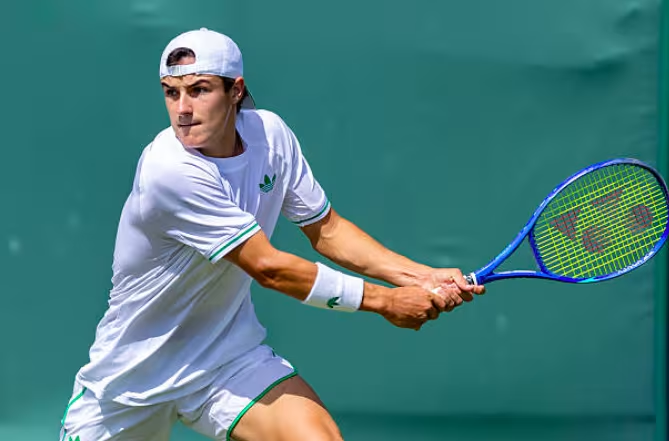
Despite this, considering it was your first season as a professional, it's not bad at all.
I'm happy, I've played Challenger-level matches that give me a lot of confidence, many days I saw myself playing at a good level against opponents with much better ranking and more experience than me. These aspects are a great advantage in this sport, but there were times when I didn't see myself as inferior, I even managed to win some. Then, in the second part of the season, I know I could have done better, I needed a week to disconnect, but I prefer to focus on the positive.
Did you have high expectations at the beginning of the season?
My mindset completely shifted at the end of last year, when I went as a sparring partner to the Davis Cup Finals with Spain, that really impacted me. Then, I won those two junior tournaments and my perspective changed. I felt more confident starting 2025, although I was still in shock for finishing among the top ten juniors. I didn't expect that, but it gave me the chance to play eight Challenger tournaments this season. I didn't have high expectations, just went where my team told me to, and it turned out well. Having low expectations relieved the pressure, but then I played another couple of junior events and did quite well. That's when I put too much pressure on myself, since the summer. I started doing things wrong off the court, but that's a problem of mine that I could have avoided, a problem that didn't allow me to compete as I wanted.
Do you feel the regret of not winning a Junior Grand Slam?
I went to Roland Garros with high expectations, I admit that, but not performing well there actually helped me. Sure, winning would have boosted my confidence a lot, but it wasn't a big deal for me. In junior tournaments, the important thing is to get experience and build confidence to be ready for the next level. Do I feel the regret? Well, a little bit, I won't lie to you. I would have liked to achieve more.
You were the world No. 1 junior, no one can take that from you.
I never wanted to dwell too much on that topic, but unconsciously, something always ends up reaching you. It ends up affecting you. Being the junior world No. 1 is nice, of course, but I never gave it too much importance.
Andrés Santamarta explains his decision to go to the University
When did you decide to go to the United States in 2026?
Before Roland Garros, we studied the options, several universities contacted me, but I had things very clear. Over time, I changed my mind, I thought it could be good for me, as here in Valencia it's always the same. My plan is to leave for five months and then come back here in the summer to see how I perform in tournaments, how confident I am.
Look HOOS joining us in January!!
— Virginia Men's Tennis (@UVAMensTennis) December 4, 2025
Everyone welcome our newest Cavalier Andrés Santamarta Roig
🔶 Reached No. 1 World Junior Ranking
🔷 Won 7 Junior titles, including winning the 2024 Orange Bowl and Eddie Herr
🔶 Ranked No. 611 in the ATP World Rankings#GoHoos pic.twitter.com/NDK0jZG9zi
Is it scary?
It's scary to think that I didn't want to face the problem, but there came a moment when I hit rock bottom. I suppose it hasn't only happened to me, it's a combination of many things. You feel the pressure increasing, maybe you lose a bit of humility, concentration diminishes, and suddenly things stop working. Expectations were not being met, I felt stuck, not happy with anyone in my circle [...] For me, this will be a disconnect, but it's what I need.
Did you seek help in those moments?
I didn't ask for help, maybe I should have. Then the snowball kept getting bigger and there was no turning back.
You mentioned hitting rock bottom; that sounds like a strong statement.
Perhaps 'hitting rock bottom' sounds too strong, but it's the reality, I went through a very tough time. I saw no way out, no door to escape. Luckily, now I'm much better.
Was it hard for you to make the decision?
Many will be surprised by this news.
In Spain, it is not very well seen. People have the idea in their heads that going to university means leaving professional tennis, leaving behind all the sacrifice and discipline, giving up things to enjoy others. I mean, I will still be playing tennis there, but at the same time, I will be able to study a career.

Is your dream still to become a professional tennis player?
I go with the idea that tennis will continue to occupy the main stage, but I also want to complete a degree. Could I do it in Spain? Yes, but I know it will be different here, the challenge is even greater. Fortunately, my family supports me in my decision.
And if you enter the circuit at 20-21 years old, what's the problem?
There are people very stuck in that thinking, people who see not getting to the top at 18, 19, or 20 as a defeat. But it's not true; the university route is not a failure. Besides, I will continue competing. When I think about aspects of my tennis, I see that there is still much I can improve on, but it's not so easy here.
For example?
For example, the serve. Or playing more on fast courts; here, we hardly train on fast courts. There they use a different competition methodology that could be fantastic for me. I'm eager to learn new things.
What do you think about Rafa Jódar?
Since he was little, he was very tall, with a long reach, great ease of play, and a lot of talent in his hand. A strong backhand and a forehand that has improved a lot being there, have changed aspects like the serve and the return. He has all the weapons to be a great player, just competing half of the season, he's already there.
His story can serve as a reference for you.
Of course, my idea is to be there for six months and then come back here to compete as much as possible. The case of Jódar can be taken as a reference, of course, but he was already very good as a child, he won the US Open Junior and this season he has reached many semifinals and finals on the Challenger circuit.
Can you imagine life without tennis?
I don't know what to say... I don't think so.
Have you ever thought: what if this is not really for me?
I've always focused on being a tennis player, but you never know. I'll do everything in my power to achieve it, I'll change some things and leave behind anything that doesn't help me.
People don't understand how tough tennis is.
There are times when this sport becomes very tough, especially if you don't enjoy it. I've had bad months, lacking motivation. If you live angry with everyone, the journey becomes horrible.
By the way, do you like the United States?
You know, there's no place like Spain (laughs). I haven't spent much time in the United States, but I really liked the little I saw. I also feel like I need a change of scenery and to meet new people.
You've chosen to go to Virginia, why?
I had two options in mind, I talked a lot with both, we were in touch almost daily, but the head coach of Virginia ended up convincing me. He's a very serious, calm, professional guy, and I'm really looking forward to working with him. I don't know, he gave me a good vibe, we connected a lot from the very first call.
And when Sunday comes and there's no paella, what then?
Well, I'll have a couple of Krispy Kreme donuts (laughs). Now that's going to be tough!
This is an automatic translation. You can read the original news, Andrés Santamarta elige la ruta de la universidad: "Si no lo disfrutas, este deporte se hace muy duro"