|
10 Dec 2025 | 18.36
|
10 Dec 2025 | 18.36






A natural talent with unlimited potential, the media pressure due to his background and early success, and the sense that his presence is becoming truly polarizing. 2025 has been a fantastic year for Joao Fonseca, who could be defined in many ways and has undeniably earned a spot in the elite ranks of the ATP tour. To what extent is his progress a cause for celebration and, above all, hints at a more stimulating evolution? What is the true ceiling for the Brazilian and with whom could his trajectory on the tour be compared? These are questions that, when delicately analyzed with certain numbers, provide more than interesting answers.
It is undeniable that Joao has been one of the major disruptors on the ATP circuit. Ending the season at 19 years of age and already holding a prestigious position among the world's top 25, thanks to two ATP titles (including a 500 category, Basel; the other, Buenos Aires), two Challenger titles, several victories over top-20 opponents (the most striking and memorable being his breakthrough against Andrey Rublev in his 2025 Australian Open debut), and peaks of play marked by an intensity and quality that set him apart... much like a certain Carlos Alcaraz in 2021.
However, it has also been a year of learning experiences. And with those experiences, of course, come painful defeats, tours where the Brazilian lacked a plan B, doubted his own identity as a player, and stumbled into errors driven by haste. All part of the process, but we glimpsed such enormous potential that perhaps we got carried away, hoping the carioca would ascend to the top echelons of the circuit by skipping stages, embodying the conviction of legends in this sport. Did we get ahead of ourselves? Perhaps... but it does not detract in the slightest from Fonseca's year, especially considering a potential that, whether materializes sooner or later, is there.
Comparing Joao Fonseca's progression to Carlos Alcaraz is daunting and could outline the path for the Brazilian, although matching the speed of the Murcian's ascent to the elite seems improbable
Joao's season gains significance when we look at the numbers left by other precocious talents in similar circumstances. The parallels with Carlos Alcaraz and his 2021 season are striking: numbers don't lie, and the trajectory Fonseca was following was on par with what the one who is already among the circuit's dominators experienced. Despite being a year younger (the South American turned 19 just three months ago, while Carlos turned 18 in the first quarter of 2021), the data are eerily similar.
Common achievements? Plenty. To start with, their ATP ranking jumps are nearly identical: Fonseca rose in 2025 from #145 in the world to the current #24, while Alcaraz saw a leap from #141 to #35 at the end of the season. ATP win-loss balance? Again, a staggering similarity: 26W-16L for the Brazilian versus 27W-17L for the Spaniard. Precise percentages.
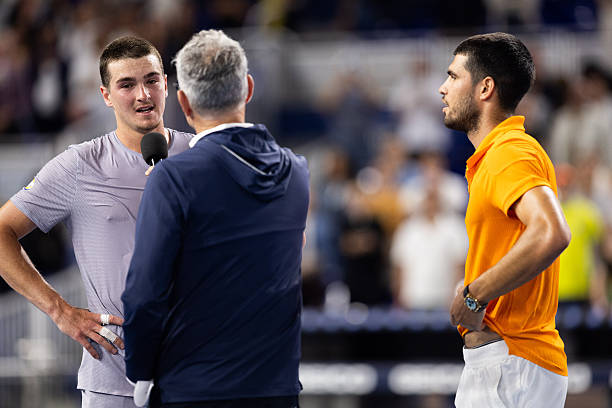
They both secured their first titles (Joao in Buenos Aires, Carlos in Umag), balanced ATP titles with Challenger-level successes (the Murcian victor in Oeiras just before fully transitioning to ATP level, akin to what Rio's player achieved in Canberra just before the Australian Open). Grand Slams? Another intriguing data point: both, virtually in their debuts, clinched victories in all the Majors, although here Alcaraz outshines Joao, who only regrets not having a performance akin to Alcaraz's at the 2021 US Open, the Spaniard's first appearance in a Grand Slam quarter-final.
Does this mean that Joao Fonseca will dominate tennis in four years as Carlos Alcaraz has done? The tour has entered a new era, with two established generational tennis rulers, and even a version with an even higher ceiling seems remote to accomplish such a feat. It also seems unlikely that Joao will secure a Grand Slam next year (Alcaraz followed up his stellar 2021 with that unforgettable US Open 2022 triumph), but...
The numbers deserve reflection and serve as evidence that Fonseca's potential, as many foresaw during his junior years, is real. There's no hype machine or conspiracy forcing the public to consume this product: a look at his progression curve is enough to ascertain that if nothing goes awry and his physique holds up, his potential is extremely high. Small details and decisions in the coming seasons, including diversifying his game and enhancing transitional play, will pave a path that is unlikely to lead to success as early as Carlos... but as you've already seen, my friends, there are many examples of late bloomers, and his journey so far is not typical of such a young player. Let's enjoy the hopeful future the carioca offers us... and perhaps, we revisit this article next year.
This news is an automatic translation. You can read the original news, Joao Fonseca y una evolución que recuerda a... ¿Alcaraz?


-
 10 Dec 2025 | 18:00Joao Fonseca and an Evolution That Recalls... Alcaraz?
 -
 10 Dec 2025 | 20:00Sabalenka warns Kyrgios: "I'm going to beat you decisively"
 -
 10 Dec 2025 | 22:00Cinà: "I feel the pressure of being the new promise, but I have to keep calm"
 -
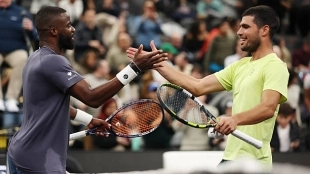 09 Dec 2025 | 19:00Tiafoe reaffirms: "I still think that Alcaraz and Sinner are not invincible"
 -
 10 Dec 2025 | 09:00Alcaraz and an utopian challenge as world number 1
 -
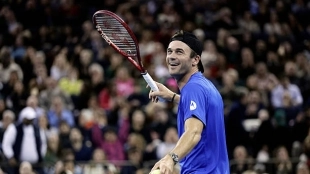 10 Dec 2025 | 15:00Paul reappears on the scene: "I'm more excited than ever to be back playing"
 -
 11 Dec 2025 | 11:00ATP 2025: The Best Matches of the Season
 -
 11 Dec 2025 | 13:002026, Is it the year of Amanda Anisimova?
 -
 10 Dec 2025 | 10:00Kyrgios: "I know I will get very nervous when facing Sabalenka"