

Last night there was a party in the sky
Nicola Pietrangeli bid us farewell this Monday at the age of 92, news that broke the hearts of tennis fans for hours. Thankfully, his great friend Manuel was waiting for him above.

Yesterday, I was thinking about how I could put together some words to pay homage to the figure of Nicola Pietrangeli, a legend of our tennis and an absolute idol in his country. After considering various options, nothing seemed better to me than doing it through the eyes of Manuel Santana, his great rival and companion on the circuit.
Nicola Pietrangeli came into the world on September 11, 1933, in Tunis. Yes, in Tunis, as unbelievable as it sounds, he didn't move to Rome until he turned 13. On May 10, 1938, Manolo Santana was born in Madrid, the capital city as he would end up being in the history of our tennis. Two legends, two pioneers, two players who coexisted in the locker room, faced each other on great stages, and connected in a special way. Their relationship continued even after their retirement. In fact, they were even closer in retirement.
Those who enjoyed tennis in the sixties – there might not be many left – know that one name will always be linked with the other. Against whom did Santana win his first Grand Slam? Against Pietrangeli, in Roland Garros. It was the first time the Spanish fans discovered what absolute success meant, what it meant to have a superlative champion, a world-class athlete proudly carrying the flag internationally. Breaking through was not easy, but everything came together in that Paris final where he had to face the top favorite.
“Against Pietrangeli, there is nothing to be done, he is a wall for all of us,” Santana confessed before the match. This notion had been growing in his mind since they first met back in 1957, at the Monte Carlo tournament. There, the Italian was already one of the best on clay courts, with his baseline game, excellent drop shot, and that trademark passing shot. His privileged physique allowed him to control long matches, but it was his talent that held the whole structure, making it seem easy to watch him play. He was so good that he hardly even trained. This led to the image of him as a free spirit and a bohemian artist.
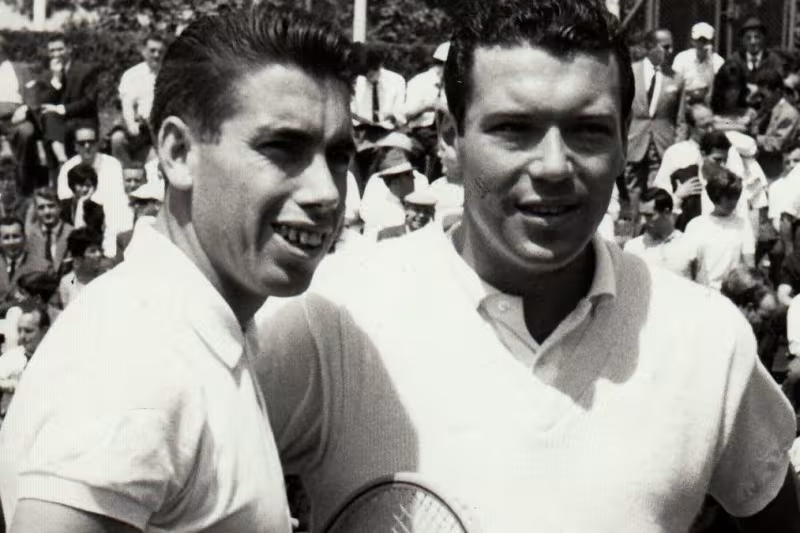
“If there was a party for the players, Nicola Pietrangeli was the king,” Santana recounts in his memoirs, revealing how captivated he was to discover who Nicola was off the court. “He was an elegant man, attractive, worldly, with great ability to naturally fit into any environment,” the Spaniard wrote. But do not think that it was friendship at first sight; their differences, both in terms of gameplay and character, stood out much more at the beginning.
Roland Garros, where a friendship was born
Their first match came in 1961, in the aforementioned Roland Garros final, although it could have happened days earlier. Santana lost in the Rome semifinals to Rod Laver, who would then be thrashed by Pietrangeli on Sunday. Imagine how Nicola arrived in Paris, carrying kilograms of confidence from clinching the title there in the previous two seasons. His third consecutive French Open was at stake, a goal that drove him to dispatch every opponent until he reached another final. On the other side stood Santana – after avenging his loss to Laver in the semis – the man threatening to dethrone the king of clay. And what happened? Let's tell the story properly because the plot has some unknown fragments.
Nicola Pietrangeli became a father on the same Friday as the semifinals, just hours after his victory over Jan-Eric Lundquist. He had to rush back to Rome and only returned three hours before the final. Despite all the commotion, he only had one possibility in mind. His confidence was so overwhelming – perhaps too much – that internally he couldn't conceive of the idea that this Spanish player, no matter how sharp he played, had the slightest chance.
“His attitude bothered me a bit, but, on the other hand, it was logical that the king of the clay court thought I was no threat to him. Maybe because of that overconfidence, I surprised him in the first set, but he swept me off the court in the second and third sets,” Manuel recalled years later about a match that had its ups and downs. At that time, there was an option to take a break after the third set, so both players retreated to the locker rooms to regain strength for a few minutes. Upon their return, the French crowd sided once again with the underdog. And they both played like giants.
Santana claimed the fourth set, the fifth set, and the title (6-4, 1-6, 3-6, 6-0, 6-2). The triumph meant becoming the new king of clay, making a statement that everyone witnessed. In the images, you can see how the golden right-hander bursts with joy; he even thought about jumping over the net to shake hands faster, but the fear of falling made him reconsider the choreography. Just as he did for years working at the Velázquez Club, he preferred to pass under the net to greet Pietrangeli. Reality had exceeded fiction: Manolín, the ball boy, was the champion of Roland Garros.

“For me, that match was everything, it was my dream. Nicola got nervous, and his status as the heavy favorite weighed on him,” he confesses in his autobiography about that showdown. “I remember embracing Nicola and bursting into tears, a moment where the great Italian player consoled me as if I were the defeated one. That day, a great friendship arose between us,” Manuel celebrates about a bond that only grew stronger over time.
Pietrangeli and Santana, more friends than rivals
Despite their social and cultural differences – Pietrangeli spoke more languages, was more well-traveled, and had more life experiences in every aspect – tennis-wise, they were on the same page. They formed a close group that ventured out weekly in search of adventures, a small gang composed of Spaniards Manuel Santana and José Luis Arilla, Mexicans Rafael Osuna and Antonio Palafox, Ecuadorian Francisco Guzmán, and, of course, the Italian Nicola Pietrangeli. Nicola quickly took the lead in this group and was named ‘il capitano’.
“He was the one who led the way and, with his experience and contacts, organized many of our activities [...] Activities that, thanks to him, rose significantly in quality,” Santana notes about the fascinating experience of being around the Italian. Being friends with Nicola was like living a dream, and Manuel can confirm this more than anyone else. Pulling that thread allowed him to meet celebrities like Brigitte Bardot or Claudia Cardinale, but the most amusing anecdote will always be the one he experienced with Virna Lisi.
Virna was one of the leading Italian actresses at that time, starring alongside Jack Lemmon in ‘How to Murder Your Wife’, a woman admired by many, including Manolo. Destiny decided that these two friends would go to the cinema together to watch the premiere, where Pietrangeli confessed that the actress was his friend. A laugh from the Madrilenian clearly showed he wasn't going to take it seriously [...] That same year, both competitors clashed in the Rome semifinals, where Santana would seize the victory to mark his 26th birthday in the best way possible. He only lacked the gift.
“After the match, in the shower, Nicola told me he had organized a dinner to celebrate my birthday with the whole gang, and everything was ‘tutto preparatto’. I found it amusing that after four hours of play, he was thinking about our dinner, but that was his way. When we arrived at the restaurant, the maitre d' and the waiters fawned over and greeted Nicola, and the rest of us... well, they barely acknowledged us. To my right at the table was Nicola's wife, and on my left, there was an empty chair [...] Five minutes later appeared in the restaurant a stunning Virna Lisi and sat in that chair. I remember Nicola's smiling face, pleased to show his skeptical friends that his friendship with Virna was real”.
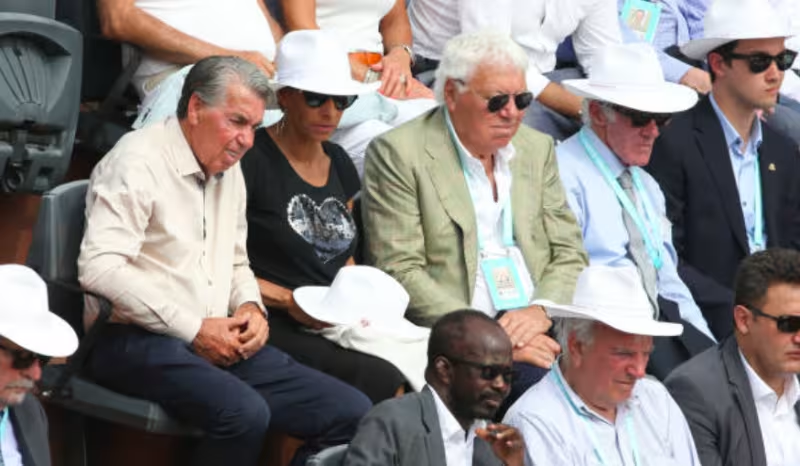
That was Pietrangeli, an expert at smoothly navigating those waters. Perhaps that's why he served for many years as a sports advisor to the Principality of Monaco, owing to his people skills and vast network. Manolo and Nicola never lost touch; no match could break their friendship, not even the Roland Garros final in 1964, where the Spaniard triumphed once again.
Even after retiring, they always sought each other out and always found each other. Whether in Rome, Paris, or Marbella, they remained close friends. You cannot imagine how challenging it is to reach this point between such prominent rivals, but those were different times. They grew old reminiscing about old battles, cherishing every moment, and recalling every anecdote from their long journey. Four years after losing Manolo, the skies witnessed this long-awaited reunion on Monday. I don't need to be there to know that there was a celebration in the sky last night. Today, there probably was a match.
This is an automatic translation. You can read the original news, Anoche hubo fiesta en el cielo