|
21 Oct 2025 | 13.00
|
21 Oct 2025 | 13.00





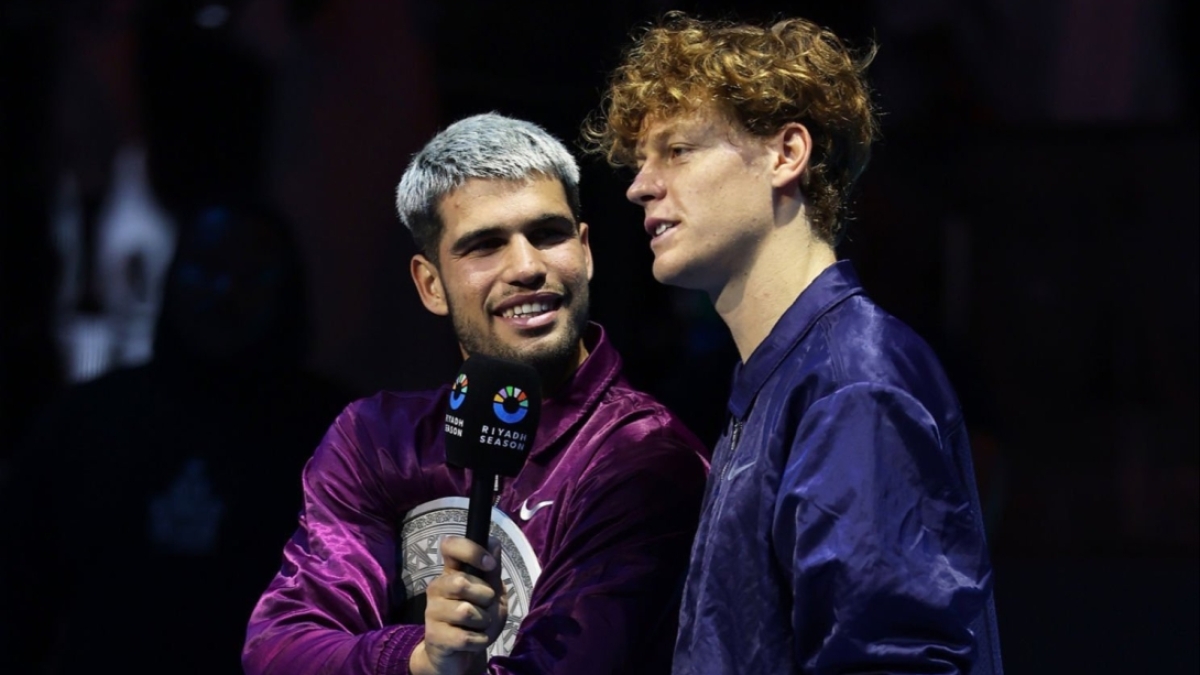


The song says that any past time always seems better to us. In the case of tennis, it seems that this is a maxim that tends to always repeat itself. In the current era, there are many who belittle the achievements of the two great leaders of this generation, Carlos Alcaraz and Jannik Sinner, defending how bad this era is and how good the previous one was, but is it really so?
Memory is short, and they say that history is cyclical and tends to repeat itself. Let's travel back fifteen years.
For years, at the peak of the Big 3 wave, we had to endure the often-repeated label of the 'Weak era' to refer to the period between 2004 and 2010 when Roger Federer raised an impressive 15 Grand Slams, and Rafa Nadal, on his part, claimed nine. In total, the Swiss and the Spaniard shared 24 out of the 28 majors contested over seven consecutive seasons.
To justify that dominance, there were detractors who claimed there was a 'Weak era,' a time of lack of competitiveness at the top that caused Roger and Rafa to dominate everyone with an iron fist. It is true that the focus was more on the Basel native, who from 2004 to 2007 practically strolled alone, but that debate also extended to that part of the story when Rafa began to make a name for himself.
It is curious that in 2025, there are people who fondly remember that era. To such an extent that some even speak of it as a period of absolutely immense level. If someone had come from the future in 2008 to say that era was the most brutal in history, they would probably have been considered crazy.
If we take a look at the year-end Top 10 players in those years, it is true that we see names like Hewitt, Safin, Agassi, Henman, Coria, Nalbandian, or Davydenko, among others. However, it is necessary to always consider the context of everything at that specific moment, and the name of Agassi, although undoubtedly commanding respect, in 2004 the American was far from his peak, just like Safin, who suffered two first-round defeats in a major that season.
This was the Top 10 in 2004, 2005, 2006, and 2007 when Federer and Nadal dominated the Grand Slams as Alcaraz and Sinner do today.
— José Morón (@jmgmoron) October 20, 2025
In that era, there were also those who spoke of a weak era and other remarks.
Harder, equal or easier than now, it doesn’t matter, the point is that there is none... pic.com/syX4u0WmSq
If we look at the present era or the previous season, some may miss the intimidating names because the current levels of Medvedev, Ruud, Zverev, Draper, Shelton, De Miñaur, or Fritz do not mean much to some. However, who knows if in 15 years, when they retire, some of them will have several Grand Slam finals or titles, weeks as number 1, and other achievements.
Therefore, it would not be unreasonable to think that in 2050, when talking about tennis in 2025, this era will be remembered as abnormal, with two beasts like Alcaraz and Sinner winning everything amidst an incredible second line with very potent players. In fact, it is quite probable that this will happen because human memory always tends to be very short, and the past always seems better to us.
Perhaps in 2050, those reading these lines will be having a good laugh to see that this is the case. It is likely that what Carlitos and Jannik are doing now will be given the credit it deserves when they are no longer active, and we look back. Maybe then, this generation will be spoken of positively, and once again, there will be talk of another future 'Weak era' in the never-ending tale.
Let's stop comparing them to the Big 3: Alcaraz and Sinner are forging their own path
The words of Tsonga last weekend, saying that he would have loved to see Carlos and Jannik in his time, facing Delpo in the third round, Murray in the round of 16, Djokovic in the quarterfinals, Federer in the semis, and Nadal in the final, carry a certain hint of belittling on his part to justify what Alcaraz and Sinner are achieving.
For this to come from @Javi_Frus69 on the X social network is somewhat imaginable, but for someone from the tennis world like Tsonga to say this, knowing how extremely difficult it is to win a single Grand Slam when one has six and the other four at 22 and 24 years old, is not understandable.
Firstly, what Alcaraz and Sinner are doing is very difficult. If it were easy, there would be another 300 doing the same, and that is not the case. They are two extraordinary talents, two talents that emerge once in a while. Two legends who tomorrow will be among the top 10 best tennis players in history. We are witnessing history with some of the best matches our eyes have seen. We cannot discredit their triumphs like this. Not after what we experienced at Roland Garros just this year. That didn't happen 50 times in 10 years for us to trivialize it.
And secondly, Alcaraz and Sinner cannot and should not apologize for not coinciding during the Big 3 era. They cannot be born in 1985 and compete against them. There are always those who try to diminish their titles, claiming that it is now easy to win, as if Grand Slams were distributed at random. Winning a major now is as valuable as doing it in 2008 or 1984.
As if what Carlitos did in May 2022, defeating Djokovic, Zverev, and Nadal in the same tournament, the same Nadal who a month later won Roland Garros, was something normal. As if defeating Jarry, Berrettini, Rune, Medvedev, and Djokovic to win Wimbledon for the first time happened every year, like something ordinary. No, this is extraordinary.
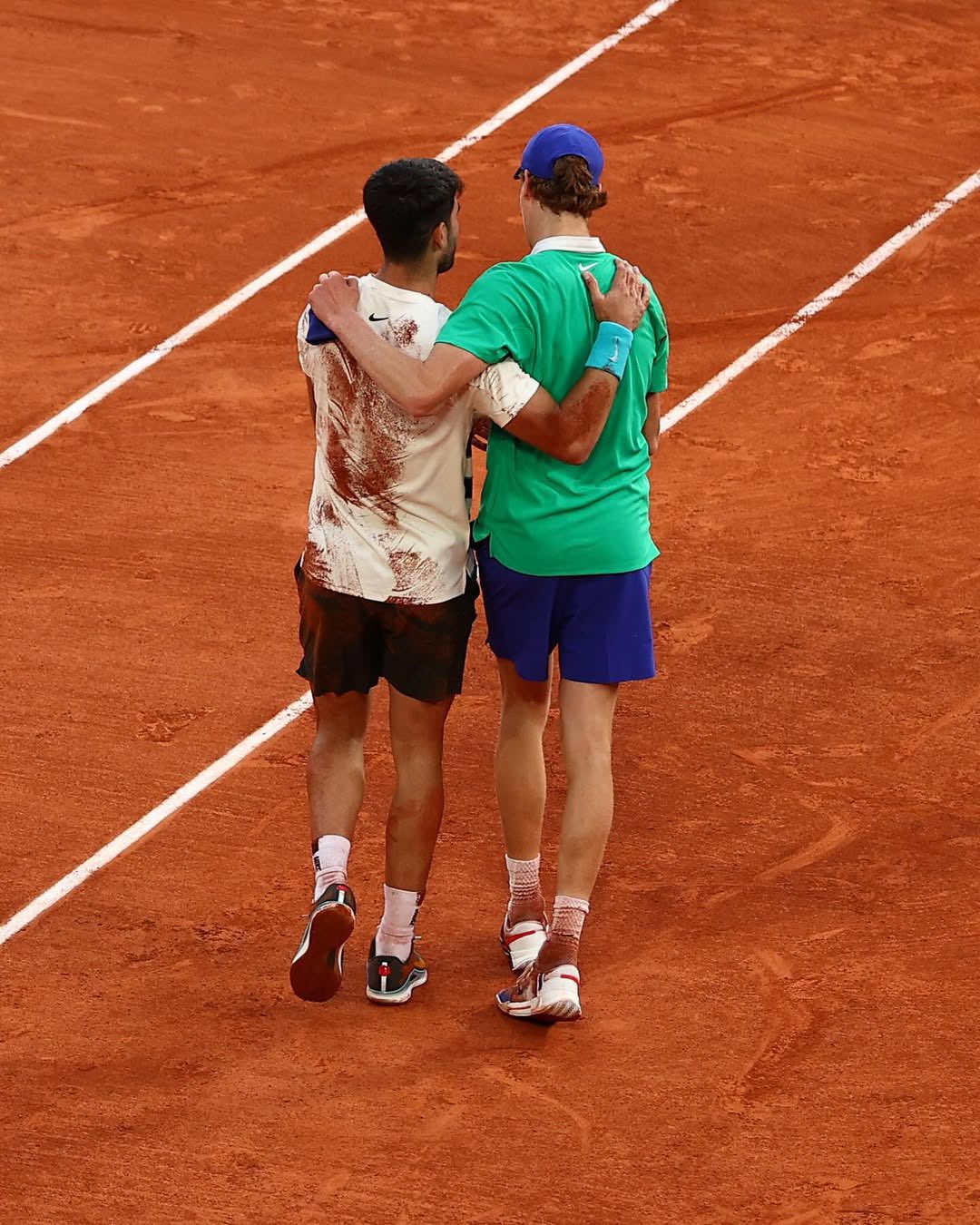
Whether it was harder or easier than before is another story, but any of the Big 3 also has draws that seem easy to us now to win some of their titles. What needs to be understood is that winning a major is a tremendously difficult achievement. If not, there would not be only 56 Grand Slam winners since the start of the Open Era back in 1969.
We do miss someone from the current second or third tier stepping up and having the faith and desire necessary to break the current duopoly, to add some excitement to this. Still, we must appreciate our fortune in having two players the caliber of Sinner and Alcaraz to create another historic rivalry in this sport.
And as I mentioned before, maybe we will have to wait until 2050 for Carlos and Jannik to receive the recognition they deserve. Here, I can only urge you to live and enjoy the present. What has passed is gone and will never return. We have already experienced that, and looking back is good sometimes, but looking forward is living without fear.
This news is an automatic translation. You can read the original news, Buscando en el baúl de los recuerdos... ¿el tiempo pasado del Big 3 nos parece mejor que el actual?
-
 11 Jul 2026 | 19:00Noskova overcomes nerves in an inexplicable final
 -
 12 Jul 2026 | 16:00Navratilova wants to end the let in tennis: "Get rid of it, it's useless!"
 -
 12 Jul 2026 | 11:00Who is Anna Pushkareva, the new junior queen of Wimbledon
 -
 11 Jul 2026 | 22:00WTA Ranking: The Czech Republic Requests Entry into the Top 10
 -
 12 Jul 2026 | 14:00"Zverev has taken advantage of Alcaraz's absence"
 -
 12 Jul 2026 | 20:00The legend continues
 -
 11 Jul 2026 | 22:00Linda Noskova and the Wonderful Triumph of Simplicity
 -
 12 Jul 2026 | 14:00Can a Spaniard Win on Grass?
 -
 12 Jul 2026 | 14:00Badosa's ticket to the US Open goes through the WTA Iasi