

Albert Ramos: "The only thing that worried me was finishing at a good level"
The Catalan gives us his first interview after hanging up the racket in Valencia: "In these last months I have realized how difficult the life of a tennis player is".

One week after playing the last match of his career in the Copa Faulcombridge, Albert Ramos speaks to Punto de Break to analyze his time in Valencia, take stock of his career, and point towards new concerns for the future.
The expression on Albert Ramos's face (Barcelona, 1988) after losing to Jan Choinski last Thursday is not that of a player who has just retired. The Spaniard landed at the Copa Faulcombridge to compete in the final tournament of his career, but reaching the quarterfinals changed his perspective. What if I can fight for the title? It was the Brit who shut the door on him, before going on to claim the title three days later. This is why Albert ended up affected that night, although he only needed a few minutes to put aside the defeat and reflect on his 18 seasons in the elite.
- Albert Ramos' First Interview after Retirement
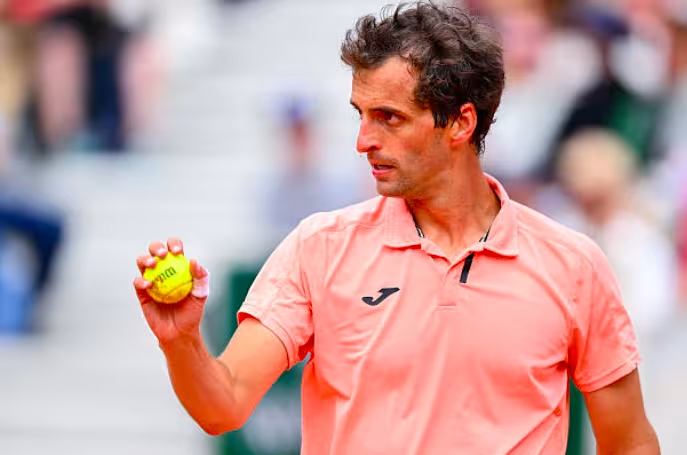
Ramos' farewell marks the end of a gladiator, a tennis dignitary, one of those players who dignify the profession. Someone who touched the top 20 worldwide, reached a Masters 1000 final, or defeated Roger Federer on hard courts, but what really gave him satisfaction was his mindset of always wanting to take one more step. An athlete obsessed with daily improvement, hence his longevity. Now that a few days have passed since his retirement, it was time to pick up the phone and bring you the interview with the main character.
Several days have passed, how is your mindset?
My mind is very calm [...] This year has been different; I made the decision to retire in March, but I always approached it very calmly. I thought about competing this last season to gradually say goodbye mentally. I didn't do it thinking about the tournaments; I don't think the tournaments care if I retire or not. I did it for psychological reasons. From the very beginning, I was in touch with my psychologist to see how I could manage it, which helped me adjust to this new reality without it being radical.
Has this helped you handle these days better?
Not only these days, I have been transitioning all year. For example, this summer I played very little; since Kitzbühel, I was living like a retiree, finding it hard to train due to lack of motivation. All this adaptation has made me calmer when facing these last tournaments.
Although you came to Valencia to retire, losing is always losing. I saw you affected after losing to Choinski.
I played quite well in the early matches, including the last one against Choinski. Comparing it with the rest of this year's matches, I believe I was at a good level, much better than expected after a summer where I barely trained. I felt very good, you know how it goes: as soon as you win a couple of matches, even if you're retiring, you start thinking about winning. We are athletes, we've been doing this our whole lives, so at times, I thought about winning the tournament... Perhaps that's why I was a bit shaken after losing to Choinski, it was the typical moments after a defeat.
Why Valencia?
In my case, although I decided to retire at the beginning of the season, the reality was that I wasn't ready yet. The most natural place would have been the Godó, given that I'm from Barcelona, but I did it for the reasons I explained. It has gone well; I was treated very well in Valencia, the only thing that worried me was finishing at a good level... I don't like having meaningless matches.
You can be satisfied.
I played quite well, I can't complain, better than expected. Even though I wanted to play at a good level, sometimes the mind relaxes a bit, and you stop training, but in Valencia, I managed to play quite well.

You had a set point to force a third set against Choinski, fighting until the last match, like your whole career.
My tennis has always been like that, maybe because I never had a great serve, which meant I always had to work hard in matches. The moment I started to mount a comeback and had that set point, my mind was already thinking that I could win the match... but it slipped away from me. In the end, it was somewhat the story of my career in that match.
What happened in the locker room afterward? What did José María tell you?
Good, quite natural; we were calm. Nothing special, we both had already assimilated that it was time to retire. We had more in-depth conversations after other unexpected defeats that led me to make the decision. We talked a bit about how the match went, and that was about it.
Did you receive many congratulatory messages?
Yes, many messages from players and coaches, people I have met at tournaments. I have been lucky to meet many people after traveling for so many years to tournaments.
Any special ones?
There was a message from a player that really touched me, but I can't mention the name, a young player. He said he had grown up watching me play, that I had inspired him a lot, which moved me.
From a media perspective, it seems you were given the recognition you deserved.
I believe so; I received many notifications that night, a lot of people talking about me. Honestly, and as we have discussed before, it's not something that concerns me too much, although after many years of work, of course, it's nice to receive recognition. Especially for what those messages said about me.
La última ovación a Albert Ramos en una pista. Adiós a una trayectoria profesional de 18 temporadas en el @CTValencia ♥️ pic.twitter.com/KtGVON87Zk
— Fernando Murciego (@fermurciego) October 9, 2025
What did they say?
That I had worked hard throughout my career, that I had fought a lot. After a lifetime of striving to do things well, it's nice to read those kinds of messages; they make you happy.
Can you enjoy a retirement?
Truly, yes. Above all, I enjoyed seeing my wife and daughters at tournaments, as they couldn't come on many occasions. One of the goals was for them to have memories of watching me play, and they were able to come to several tournaments. Fortunately, they were very calm weeks, less stressful than my entire career, always focused on winning, results, and rankings. We suffered a lot from that; these months have been much more peaceful, and I have enjoyed it.
Once you reach the quarterfinals and see the draw, did you think about becoming champion?
Well, I would have loved to finish my career with a trophy, but I knew it was almost impossible. When you win a couple of matches, you start feeling better, your confidence multiplies, then you see that you lost to the one who ended up winning the tournament... at that moment, I did imagine it, but that match and two more were still missing. For a tennis player, winning a couple of matches is like if you had never lost; that's when you start remembering the other times you won.
Imagine you became the champion, would it have changed anything?
No, no (laughs). During this time, I made the mental shift, to travel less and be more at home. Once you accept this, it's challenging afterward. In these last months, I realized how difficult everything we tennis players do is, especially regarding the travel aspect. I don't want it to sound like we have a very tough life; in the end, we are privileged to do what we love, and it's something precious. But internally, we live with constant suffering, wanting to travel more, win more, not seeing family, etc. You only realize this when you stop, then you discover how good it is to be at home, that not everything is about competition.
And now, what's next? Will you continue training?
Well, yesterday I went to train a bit with Jaume Munar (laughs). Obviously, I won't train with the same intensity as before, but I like it, I have fun, I will keep playing.

I'd love to see you coaching someone.
It's an option, but there are many. For now, I don't know; it's been a short time; now I want to be calm. Some people have already asked me, but it's not an easy decision; I want to give myself some time to see what I feel like doing.
You have been with the same coach for 19 years, can you imagine repeating something like that?
I see it as difficult considering how the world is now (laughs). At some point, I would like to coach a young player and make them a professional, someone with a lot of desire. I would love to give back to tennis a bit of what it has given me, but I don't know if now is the right time.
Give me a word that defines your career.
Throughout my career, I have always emphasized how much I insisted on improvement, on working to keep getting better. How can you say that in one word? Beyond the results, my whole life, I sought ways to be a better player, even when it didn't always work out well. This is what made me evolve in moments when others might have thought it was impossible.
A restless type.
Very restless, you're right. That could be a good word.
This is an automatic translation. You can read the original news, Albert Ramos: “Lo único que me preocupaba era terminar con buen nivel”