|
15 Mar 2025 | 02.29
|
15 Mar 2025 | 02.29





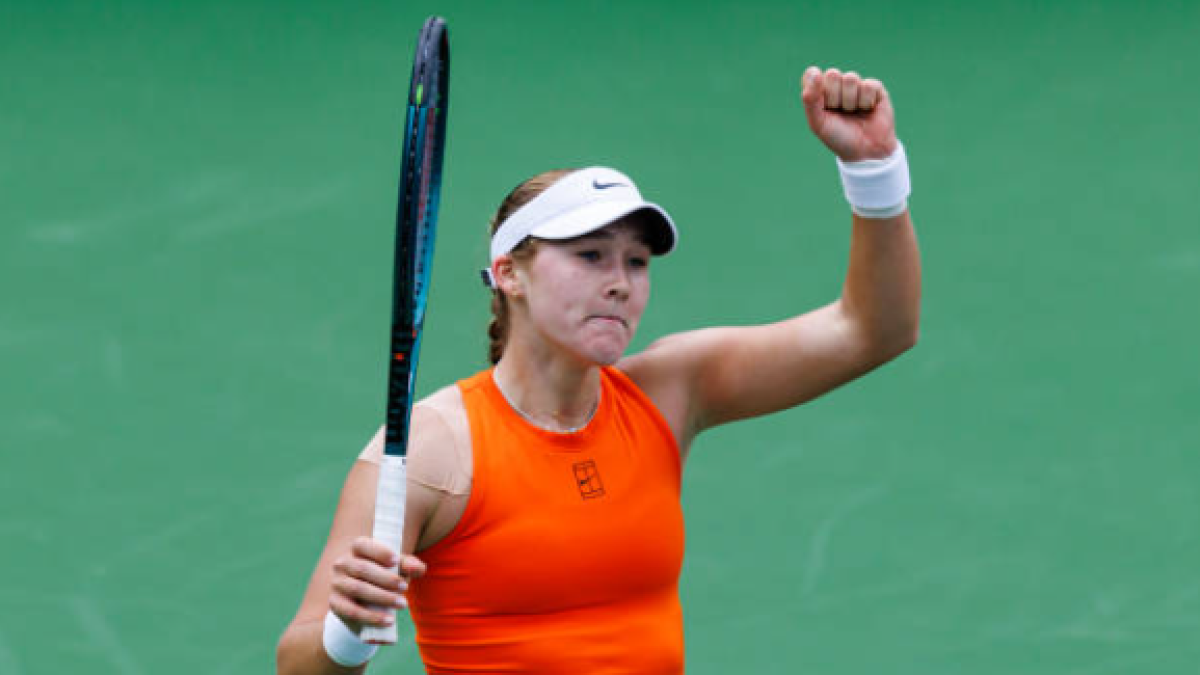


Any precaution is necessary with a 17-year-old player, but Mirra Andreeva insists on proving every time she steps onto the court that age is just a number, that what matters is what happens on the court, and that, as of today, she is one of the best on the circuit. This was evident in the Indian Wells semifinals where she defeated Iga Swiatek, who, as happened a month ago in Dubai, could not decode the Russian's game. Patient and defensive against the attacks of the Polish player, yet aggressive and incisive when an opportunity arose. In this way, after a lesson on how to play a high-level match as a teenager, she defeated the reigning champion by 7-6(1), 1-6, 6-3 after two hours and 16 minutes. This secures her spot for the first time in the final of the Californian tournament, awaiting Aryna Sabalenka or Madison Keys.
Two of the best tennis players on the professional circuit were present on the sunny and always windy central court of Indian Wells. Iga Swiatek and Mirra Andreeva, or in other words: present against future. Although the Russian is 17 years old and a promise, she continues to grow by leaps and bounds. It was already noticeable when she won the WTA 1000 in Dubai a month ago, where she eliminated Swiatek in the quarterfinals.
Therefore, the current world number two did not want a repeat of what happened in the Middle East and came into the match very focused and without making errors on her serve. Aware that it would be a match requiring high concentration to break down the Russian's defense. However, despite her intentions, she displayed extra aggressiveness on returns, benefiting Andreeva, who, although struggled with the first serve, remained unfazed in holding her own service games.
From Andreeva's composure to Swiatek's despair
Swiatek seemed too hurried, attempting to finish points quickly, while Andreeva was all about patience and defense, yet quick to counterattack to gain control of the point, especially with a punishing crosscourt backhand that tormented the Polish player throughout the match. Nevertheless, the wind once again became a significant factor, complicating the game for both players.
The feelings from the first set showed Andreeva more at ease on the hard courts of Indian Wells and Swiatek struggling to find a way around the game of the 17-year-old. She became visibly frustrated after a double fault, allowing the Russian to break her serve for the first time. However, from that moment on, the 2024 champion changed aggression to a more effective and rational approach; creating angles, moving forward, and getting the break.
The Russian dominated the tiebreak to take the first set
The first set would be decided in a tiebreak, where Andreeva once again demonstrated champion-like composure. She remained unfazed by the Polish player's strong comeback, maintaining her level of play and ultimately securing a first set where she was superior, dominating the tiebreak (7-1).
Swiatek went to the locker room in search of solutions or to regroup, aiming to come back and seek a turnaround. She knew what needed to be done, but whether she rushed or not, the young Russian was always one step ahead. While the number two player was in the locker room, Andreeva took out a notebook with notes, as if in a classroom, because her tennis lesson in the first set was truly worth studying.
A completely different Swiatek
There was a shift in the mindset of the Polish player as she came out with renewed energy in the second set. She displayed the pride of a champion and the composure of an established player to break Andreeva's serve for the first time. The number two seemed to have figured out her game, both tactically and mentally. She no longer took excessive risks or aimed to finish points in just a few shots. Embracing the tactics of the young player, she quickly took a commanding lead at 5-1, eventually leveling the match with a convincing 6-1. The first semi-final headed to the decisive third set after two completely contrasting sets: from Andreeva's control in the first to Swiatek's intensity and dominance in the second.
Iga’s change in mentality caught the 17-year-old off guard, sending her to the locker room to see if she could muster the same response as the Polish player. And indeed, she did, breaking in the first game. It seemed like they were back to the first set because Swiatek once again rushed, and Andreeva resumed strong defense.
Where other players retreat, Andreeva demonstrates her best tennis
The match entered its most heated phase, yet instead of getting nervous, the Russian displayed an uncommon composure rarely seen in a 17-year-old. She withstood Swiatek's assaults, adapted to the unusual bounces due to the wind, and chose the perfect moment to attack. With this comprehensive and composed game, the defending champion slowly but surely gained the upper hand, although she fought until the end to defend her reign.
Her second set was a reflection of her level, but throughout the remainder of the match, she found herself at the mercy of a teenage opponent, still a minor, unswayed by any stage fright, challenger, or the prospect of reaching an Indian Wells final. She secured a very serious match (7-6(1), 1-6, 6-3) where she kept her emotions in check and disconcerted the world number two. Swiatek will not defend her crown in Indian Wells, but perhaps there's a worthy 17-year-old successor.
This news is an automatic translation. You can read the original news, Andreeva no entiende de edades ni jerarquías y rinde de nuevo a Swiatek
-
 26 Jun 2026 | 18:00Schedule and where to watch Jódar's debut at Wimbledon 2026 against Gill
 -
 27 Jun 2026 | 16:00Davidovich breaks free from the chains in Mallorca: finally champion!
 -
 26 Jun 2026 | 23:00Sabalenka and the Wimbledon crossroads: title or alarm
 -
 27 Jun 2026 | 12:00Carlos and Jannik are very close to the level of Federer, Nadal, and Djokovic
 -
 27 Jun 2026 | 19:00Fils maintains mystery about his injury before Wimbledon: "I can't say it"
 -
 27 Jun 2026 | 13:00Sinner reveals the plan outlined to endure longer matches
 -
 26 Jun 2026 | 18:00Schedule and where to watch Djokovic's debut at Wimbledon 2026 against Yibing Wu
 -
 26 Jun 2026 | 22:00Davidovich, Mallorca and the golden opportunity to end his great nightmare