

汤米·保罗和使他在温布尔登成为严重威胁的变化
Tommy Paul 的教练 Brad Stine 讲述了他们为了让这位美国选手在草地上表现更好,并成为全面候选人而付出的努力。

Tommy Paul is facing the grass season and Wimbledon 2026 as one of the most dangerous players on the ATP circuit. The American, champion of Queen's in 2024, has explained alongside his coach, Brad Stine, the keys to a transformation that has made him a threat on this surface and fuels his aspirations to achieve the best result of his career at Wimbledon.
Not long ago, the idea would have seemed strange even to the protagonist himself. Tommy Paul never considered himself a grass court specialist and did not fit the classic profile of an American player built around serve and short points. However, the results have ended up creating a different reality.
With a title at Queen's, a final in Eastbourne, and a increasingly solid performance on grass, the American arrives at this part of the season convinced that he can compete against anyone. A large part of this evolution has a clear reason: Brad Stine, the coach who identified huge potential on grass when the player himself couldn't see it.
Brad Stine and the transformation of Tommy Paul on grass
Their relationship began in 2019, a moment that Paul still considers one of the most important of his entire career. Not only because he brought in a coach with high-level experience, but also because it marked a shift in mentality. It was when he decided to take a much more active role in his career development and started building a professional structure around his tennis.
"When I started working with Brad, it was a very important moment in my career because it was the first time I invested in a coach and really took the initiative in my career," Paul explained in comments collected by ATP. The curious thing is that Stine saw something in his tennis that the player himself couldn't appreciate. While Paul still associated his game with other surfaces, the coach was convinced that grass could become one of his best scenarios.
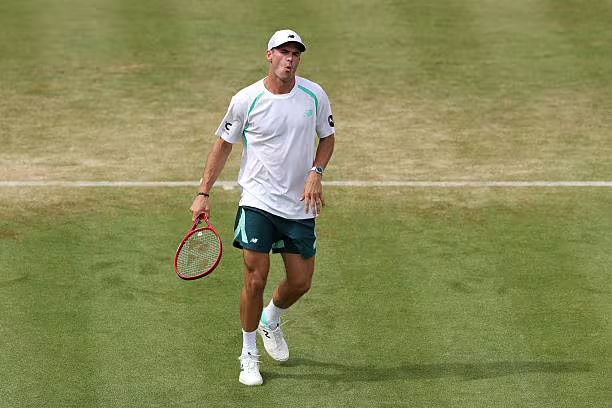
"I never thought I would be a grass court player. Interestingly, he was one of the people who told me that my game would fit very well on this surface." That idea was repeated over time until it became a shared conviction. "He told me so many times that I ended up believing it."
The anecdote perfectly reflects the work done by many elite coaches. It's not just about correcting technical aspects or designing tactics for matches. It's also about helping the player discover facets of themselves that they have not fully developed yet. Stine had been convinced for years that Paul's mobility, coordination, athletic ability, and hand sensitivity could make him an extremely effective player on grass.
Tommy Paul, capable of performing well on clay and grass
One of the most interesting aspects of this evolution is that it breaks some of the old stereotypes associated with surfaces. For decades, there was the sense that clay court specialists and grass court specialists belonged to completely different categories. However, modern tennis is showing that this boundary is much more blurred than it seemed.
Tommy Paul perfectly represents this trend. Despite being American, he has probably become the player from his country who offers the best performance on clay. His results on the surface in recent years have been extraordinary and have allowed him to compete on equal terms with some of the best specialists on the circuit.
Far from hindering his performance on grass, those qualities seem to complement it. The same can be said for Lorenzo Musetti. The Italian has shown that a tennis based on creativity, tactical intelligence, variety, and the ability to interpret points can work just as well on clay as on grass. These are players who understand the game beyond a specific surface.
Paul clearly belongs to that group. He doesn't depend solely on the serve or power. He is a player capable of building points, reading complex situations, and finding different solutions depending on the circumstances of the match. In an era marked by the homogenization of surfaces, these abilities have become extremely valuable tools.
The aggressiveness that Brad Stine introduced to Tommy Paul's game
Although tactical intelligence has always been part of his game, Stine believed from the outset that Paul needed to develop a more aggressive version of himself to make the final leap.
"I think he also transformed my game a bit to make me a more aggressive player and it has been a very important part of the overall success I have had."
This evolution is clearly seen when analyzing the American's trajectory over the past few seasons. He remains one of the best defenders on the circuit and continues to stand out for his speed on the court, but now he incorporates offensive patterns much more frequently than before.
In fact, Stine himself believes there is still room for further evolution. "Tommy doesn't come to the net enough for my liking." The coach admits with laughter that it is a constant battle between them. "I always want him to come to the net more."
The explanation makes a lot of sense when considering the nature of the surface. Grass rewards those who can take the initiative and shorten exchanges when the opportunity arises. That's why Stine constantly insists on the need to incorporate more offensive resources.
"Sometimes he tells me that it's difficult to come to the net against certain players because they hit very deep and make it difficult to attack. My response is always the same: you can always serve and volley, and you can always come in behind the second serve." According to the coach, these types of patterns are part of the strategy designed specifically for this time of year. "They are two ways to put more pressure on opponents and make them uncomfortable on grass. These are aspects on which we continuously insist during this tour."
Wimbledon emerges as a great opportunity for Tommy Paul
The grass season comes at a particularly favorable time for the American. After the physical problems that affected this part of the calendar last year, he has barely any points to defend in the coming weeks, a circumstance that allows him to approach each tournament with the feeling of having much more to gain than to lose.
Stine admits that he would love to have more time to exploit his player's virtues on this surface. "I wish the grass season lasted four more weeks." The reason is simple. Paul could barely compete during the lead-up to Wimbledon last year, which puts him in a very favorable ranking position.
"He has practically no points to defend. Before Wimbledon last season, he couldn't even play the tournaments leading up to the grass season. Whatever he achieves now will be a gain."
However, the matter goes far beyond the world ranking. For Stine, the most important thing is to arrive at the All England Club with confidence, competitive rhythm, and the feeling of playing solid tennis.
"Before Wimbledon, you want to play as many matches as possible on this surface. Winning matches in a tournament like Queen's is fantastic for confidence."
Perhaps that is the main difference compared to previous years. Tommy Paul no longer arrives at the grass questioning whether he can adapt to it. That phase was left behind long ago. The results have shown that he possesses all the necessary tools to perform at a high level on grass and that his combination of tactical intelligence, mobility, and aggressiveness can be extremely effective under these conditions.
Now the challenge is different. It's no longer about proving he belongs in the conversation. It's about seeing how far he can go within it. And with Wimbledon drawing closer, both Tommy Paul and Brad Stine seem convinced that there is still room to discover the best version of a player who, against all odds, has ended up finding one of his favorite surfaces in grass.
This is an automatic translation. You can read the original news, Tommy Paul y la metamorfosis que le convierte en seria amenaza en Wimbledon