

Problems for a historic Spanish tennis tournament: "We need €35,000 for the tournament to take place in 2027"
The WTA 125K in La Bisbal, held since the 2016 season, is hanging by a thread due to economic reasons: “There are many campaigns for female leadership, but there is no money behind them.”

For any racket sports lover, hearing ‘La Bisbal’ means being teleported directly to a tennis court. An event that has continued to grow since its inception and now fights to avoid disappearing next season.
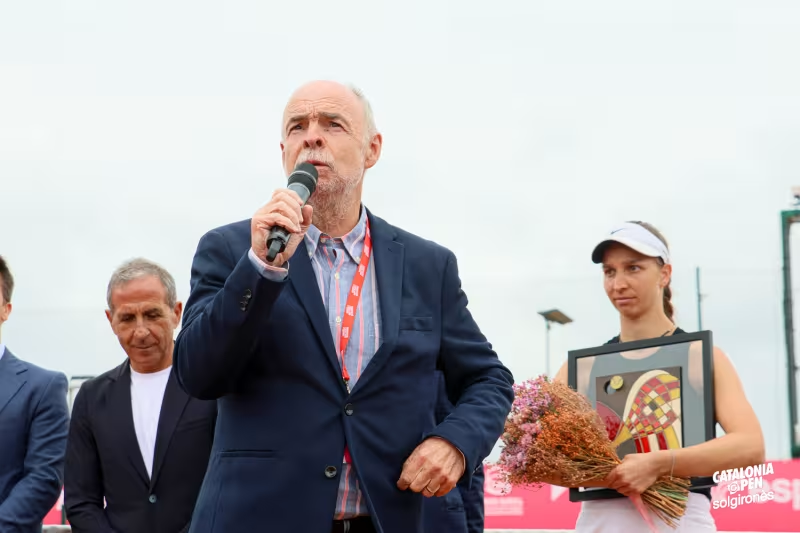
The situation is critical, but not as dire as it seems. Problems began when the event's largest sponsor (Solgironès) informed the organization that it would not participate in the project in 2027. A gap that, despite being revealed with plenty of time to react, is not easy to fill. Xavier Ponsatí (La Bisbal d’Empordà, 1959) is the person who knows the case best, having directed the tournament since its first edition in 2016. An interview is our best recipe to understand where the tournament currently stands and what the solution is so that the WTA 125K of La Bisbal does not miss out on tennis next spring.
Interview with Xavier Ponsatí, director of the WTA of La Bisbal
What is the current situation of the tournament?
Right now, we have 30 new companies selected as potential new sponsors. This year, our main sponsor left us after ten years, telling us that they had different goals regarding support, so they informed us in advance that they would not be able to help us in 2027.
What does this loss mean?
We gather half of the tournament's budget through Federations, the Town Hall, the Generalitat, and the Diputación, while the other half typically comes from commercial companies. Of the €200,000, we have fallen short by €50,000, all from the same source. Every year, there is always a company that withdraws, companies that contributed about €5,000, but that is easy to handle. Now we are looking for ten companies that can help us with €5,000 each, to at least break even on the budget and hold the tournament.
And how is the search going?
So far, we have three companies, that’s €15,000, so we still need €35,000 to reach our goal. We give ourselves time until early November, but I am hopeful that everything will work out. Brands have responded well, and they are considering it; plus, this year we are putting the naming of the tournament on the table, it has been called Solgironès until now. This new product includes the tournament's name, so we offer companies the possibility of paying a little more if they want to take that name.
Are you considering holding the tournament at a loss?
Impossible, we have never had an edition at a loss. We couldn't; we want every person who works for the tournament to receive their share. From the first year we started, if we have managed to carry it forward, it is because the numbers have always added up. My wish is that we talk at the end of October and I can tell you that we have found all the sponsors we are looking for.
And what if luck is not on your side?
We would have to take a one-year break [...] I am super happy with the support we receive from institutions; during these ten years, they have always covered 50% of the budget. However, when it comes to companies, my feeling with women's sports is that there is still a long way to go.
In what sense?
There are now many campaigns for female leadership. Many initiatives to create new tournaments, if we talk about tennis… but then, the reality is that there is no money behind it. In 2024, we managed to get ourselves declared a public utility tournament, a condition we renew every year. What does this mean? That, from a tax perspective, all our sponsors get a 40% deduction. If someone wants to invest €10,000, it only costs them €6,000; the rest is received later through the tax office. This is a very important aspect for companies to see a return on their investment.
What else can you offer brands?
We are currently fighting to ensure all sponsorships can have a 95% deduction. Imagine a company that contributes €100,000 and then gets back €95,000; the joke only costs them €5,000. Securing this sponsorship is a bit more complicated, but it is already being processed by the Catalan Tennis Federation for next year, when the federation celebrates its 125th anniversary. We have to work on this with the tax office through the Higher Sports Council; it is a bit more technical, but these are fiscal benefits that would greatly help promote women's tennis.
And dropping categories in 2027?
We have already been an ITF 100K, but it incurs practically the same expenses as a WTA 125K. If we have to drop to a 60K or a lower category, perhaps the smartest move would be to take a year off and return the following year with more strength. We have been doing a WTA 125K for four years; people want to have a WTA.
What do sponsors usually ask for during negotiations?
Everyone seeks a return, although there are some companies that also look for contacts, clients, exposure, etc. The excuse they often use is that their goal is not this sport, or not women's tennis, or simply that we do not fit into their plans. They demand a lot of visibility and a return, but measuring returns is very complicated. Visibility is straightforward; we have television and audience impact. For example, last year, we reached 80 million people, of which 10% resulted in direct impacts.
Are you open to partnering with any company?
We are open to working with any company, but we like to give exclusivity by sector. For example, if we already have a contract with a car brand, we are not going to look for a second. If we have an insurance company, we won't seek another one. We give them exclusivity in the product; this seems fundamental to me. That’s why there comes a point when sponsors run out, although we try to embrace new sectors every season. Fortunately, we have several local companies from the province; this is a significant difference between holding an event like this in Barcelona or in La Bisbal, the fact of decentralizing it from a capital.
Sometimes fans find it hard to follow tournaments of this category; I imagine that companies' tennis knowledge is limited.
There is little tennis training, much less so for women's tennis. Everything that does not appear in newspapers and on television daily... people know Sabalenka, Badosa, and that’s about it. Personally, in the ten years I have been here, never has anyone asked me which players would be coming to the tournament. What we usually highlight is the number of top 100 players that will be in the draw; it’s a way to convince that brand that may not be very familiar with the circuit, although I don’t think the persuasion works that way.
If the tournament were male, would negotiations be easier?
It depends, at the level we are at, I don't think so; it would be the same. I know that Sabalenka will never come here, nor any of the top 25 in the world, just as challengers know they will not have Alcaraz. Last year we were close to bringing Alexandra Eala, but she went very far in the previous tournament (Miami). It was a bit of bad luck, but sometimes you announce a player and then they withdraw at the last minute.
Which player could multiply the impact of La Bisbal? Paula Badosa?
She could help us a lot, especially since she is from Begur, a town near La Bisbal. I fondly remember those early years of the tournament when she would tell me: ‘Xavier, why don’t you organize a WTA?’. Six years later, we ended up organizing one, but she no longer came because she was very well positioned in the rankings. This year, for example, we had a very special edition with Aliona Bolsova, another girl from the area. She was delighted with everything we set up for her farewell, which also helped us a lot. Or with Marina Bassols’ presence, who is from Girona. However, it is clear that the most visible person and the one who attracts the most media attention is Paula Badosa.
Imagine some businessman is reading this interview and is considering sponsoring the tournament. What information do they need to clear their doubts?
Well, we have this clear. Firstly, they need to have a good contact within the company for decision-making, whether it’s the boss or the executive director. If they also have connections with someone who plays tennis, this is super important, because it will resonate more closely and be perceived differently. Or if the director themselves plays tennis, in 80% of cases, negotiations will end positively.
As someone who has been leading the tournament for a decade, in what phase would you say the project stands?
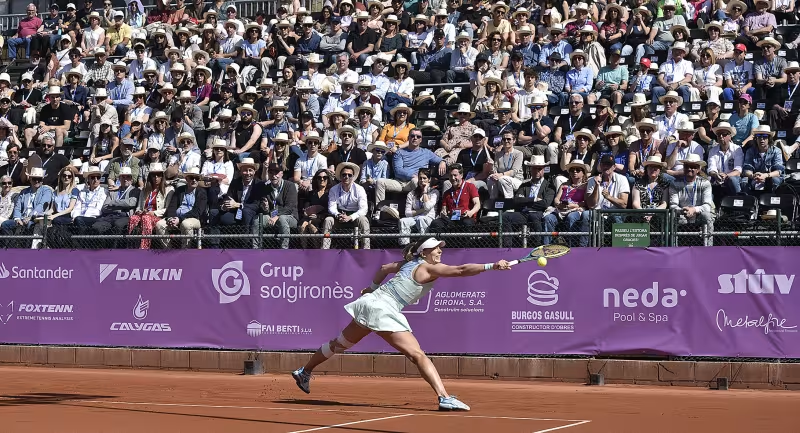
Every year, the impact has grown, both in terms of audience and presence on social media, but this year we closed feeling that more people than ever attended. Do you know what it means to see 400 people in the stands all day? We experienced that this year; people were coming and going during breaks between matches, as if it were the Godó. We have managed to make people aware of what happens in La Bisbal, for them to mark this date on their calendars, to want to come and enjoy good tennis. Many don’t even look at who is playing; they simply come to hang out and enjoy live sports. If we add everything we do to promote this tournament, the reality is that we are doing many more things; that’s why we reach more people... However, there are still people who are unaware; there is still room for growth. It is a shame; on paper, we are the second most important tennis tournament in all of Catalonia.
Beyond the Mutua Madrid Open, to find the next most important women's tournament in Spain, you have to look at the WTA 125K category: Villa de Madrid, La Bisbal, Valencia, and Mallorca. What do you think the situation will be like in ten years?
I hope I’m wrong, but... money is needed here; having to go out there to find sponsors is exhausting and overwhelming. For every one that goes well, four go poorly; this can be very demoralizing. And then there’s the cost of maintaining them each year. We have been going for ten years, and more or less, we have kept them. Now it is the first time we’ve encountered a problem because our most important sponsor has fallen through, but don’t think the Town Hall will come and say to you: ‘Do you need €50,000? I’ll give it to you.’ It won’t happen because each Town Hall has its economy and its priorities. If we are already in a bad situation now, I don’t want to think about how we will be in ten years.
Hopefully, good news will come.
Just ahead of 2027, we have requested a change of dates; I share this because I am optimistic and convinced that we will carry the tournament forward. We have been allocated one of the weeks prior to Roland Garros, so not all news is bad. I have hope that all the pieces will fall into place; this month we will work to the maximum to ensure everything goes well.
This is an automatic translation. You can read the original news, Problemas para un histórico torneo del tenis español: “Necesitamos 35.000€ para que haya torneo en 2027”