

INTERVIEW | Juan Carlos Ferrero: "I have nothing finalized; I will only return if something excites me"
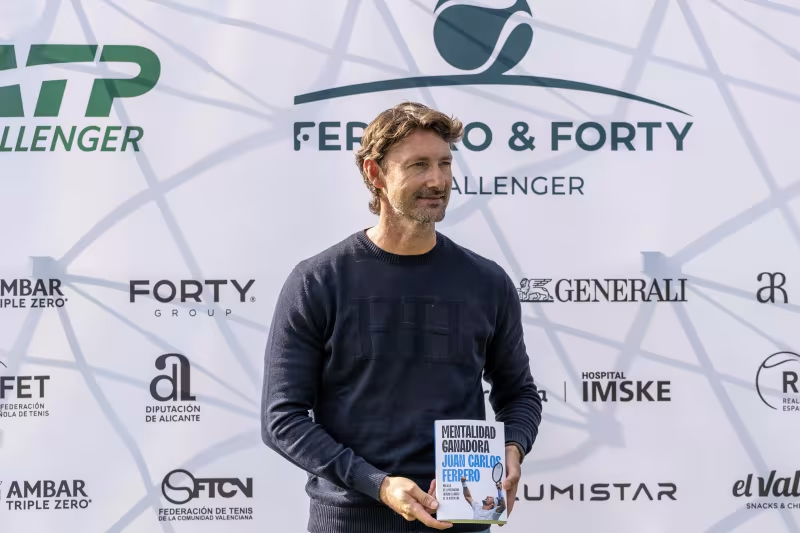
The Valencian presents his first autobiographical book this Wednesday: 'Winning Mentality'. An ideal opportunity to read it and interview him exclusively to talk about his career and his return to the circuit.

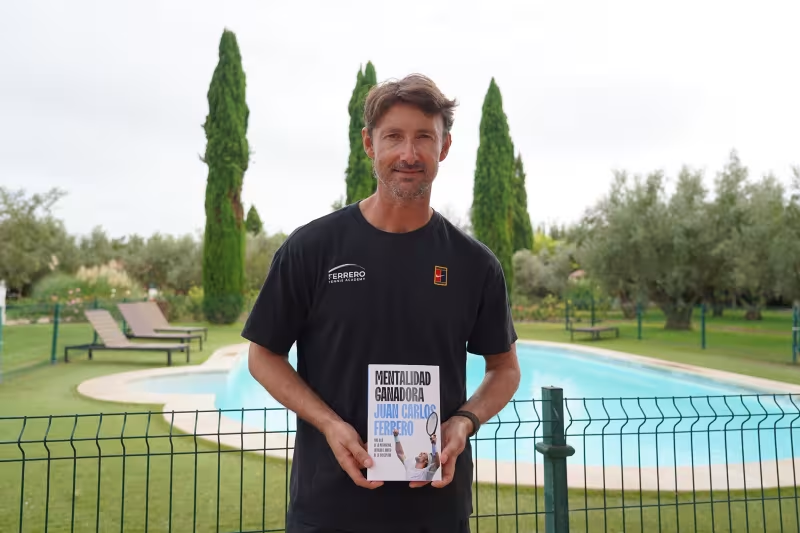
The name of Juan Carlos Ferrero is back in the spotlight this week. The former world number one is releasing his first book this Wednesday: ‘Winning Mentality’. A retrospective of his entire career, starting from his origins and ending with his time as a coach.
The book is very easy and quick to read; I can tell you that I devoured my copy in less than 24 hours. That's the good thing about being Juan Carlos Ferrero (Ontinyent, 1980), as he has so much to share. So many stories that some of them require separate reflection, which is why Punto de Break felt compelled to sit down with the Valencian to delve into this work, review some chapters of his narrative, and inquire about which bench we will see him on in the 2027 season. A very timely interview.
How did the idea of writing a book come about?
I had the idea for a while, but I had never fully encouraged myself to do it because I was almost always busy. A few months after I stopped working with Carlos, the Planeta publishing house approached me and proposed writing the book. They gave me plenty of ideas, and in the end, I was convinced, although I also wanted to do it.
Has it been a long process?
About seven or eight months; every week we looked for a slot to talk about everything that has happened during my career. In the end, one remembers things and explains everything he has lived… I think the book has turned out quite well.
What do its pages convey?
The difficulties of a tennis career from start to finish. I hope people understand it, share it, and like it. I suppose it won't please everyone, but I hope it does for the vast majority.
‘Winning Mindset’ has been the definitive title.
Why that title?
I had several ideas, but looking with the publisher we reached the conclusion of which one could be the most suitable. It is never easy to choose a title, but out of the 4-5 possible options, ‘Winning Mindset’ was the one we liked the most.
Perhaps the one that represents you the most.
It has always been one of the things I have highlighted most about myself, that strength to always move forward with the right mindset. More or less a winning one, but always the right one. When you compete as I can, if you don’t have a winning mindset, it’s hard to keep improving. I believe that title is quite close to who I am.
As it's an autobiography, you decide how much you want to share. Have you held back a lot?
I suppose you always hold back small details; you don’t want everything to be known. However, I think I have opened up quite a bit regarding the situations I have experienced and what I felt at each moment. I don’t think anyone reading it would think I’ve held back things. I’ve read it a couple of times already, and the feeling is that I haven’t left much unsaid.
Tell me about a chapter where it was especially hard for you to dive deep.
The chapter of six years without winning a title […] That is one of the most complicated, I remember the editor asking me why, but it has always been very difficult for me to find the answer. Even today, I couldn't give you a reason. It is true that I played eight finals during that period, but it all starts from 2004 when I got chickenpox, being No. 2 in the world. From that moment on, I never managed to get back to the top, at most I climbed to position #14 or #15.
Why?
It's hard, I suppose it was a matter of confidence, of not getting the results, of facing the best in earlier rounds and not contending for those points that are at stake in the later rounds.
During those six years, did you maintain a winning mentality?
Yes, yes, even close to retirement. The winning mentality is always there; if you ask Novak Djokovic now, who isn't achieving his best results, he will tell you that the competitive shark is still inside him. When you step onto the court to compete, you transform; in a way, we are born with that gift which we then perfect during tournaments, turning it into something natural every week.
After reminiscing about your entire career, have you discovered something new about yourself?
Careers, once they are over, are viewed from a different perspective. The book captures all the problems that one experiences in sports, such as injuries and various difficulties. It's good for people to know this, but I would like them to focus more on the beauty of what it means to have a sporting career at these levels. Despite the challenges, today's kids need to stay motivated to try, not to stop because of those difficulties. Has it helped me get to know myself better? Well, a bit yes; until you review everything you've experienced, it seems a bit hidden in your memory, but breaking down each topic has been nice to expose.
In the book, there is one word that stands out: discipline.
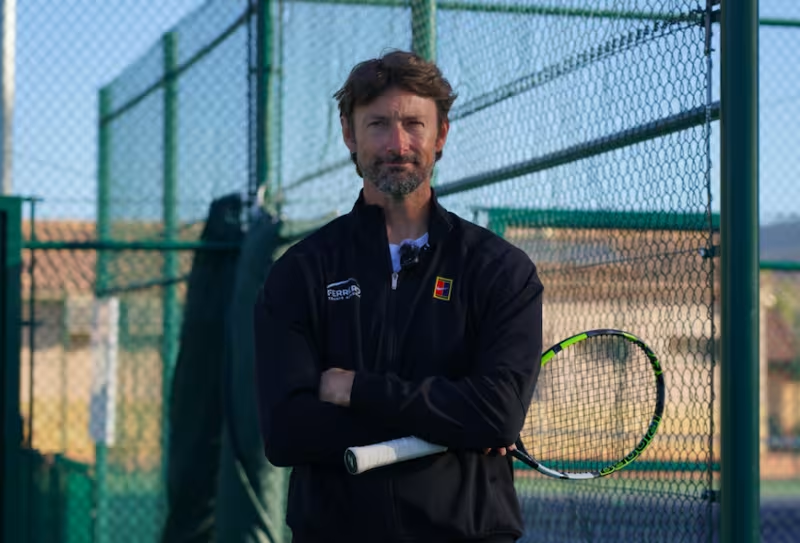
It is my backbone; there must be order and discipline in everything one does. One feels more at ease knowing they have given absolutely everything; the results will speak for themselves. This comes from my time as a player; it's not something that arrives when you mature. In my case, it was very much tied to my character; from a young age, it was one of the values that characterized me, something that I have tried to adapt to my players as a coach.
Thus, you have created a reputation as a tough, strict, very methodical coach.
(Laughter) Well, I wouldn't say that much, but I like it when things are done well, with awareness of what needs improvement, although there are also many fun and relaxing moments. When one steps onto the court, it's to work; that doesn't mean being super demanding or super strict. My work approach is to study every detail that needs attention and then apply it with seriousness and attitude. The important thing is to do quality work that is well analyzed; no successful career can be built without hard work and discipline.
“When motivation ends, discipline begins”, another of your mantras.
This is true in all areas of life. Within the circuit, I don't believe that everyone remains equally motivated as tournaments or years go by, just like you don't go to the office to write every day with the same motivation. Applied to sports, when you've been playing the same tournaments and seeing the same people for 6-7 years, motivation can take a back seat. It's important to differentiate motivation from being mentally fresh to compete. You choose to be an elite athlete knowing you have to compete every week, so the most important thing is to arrive as fresh as possible.
How do you achieve that?
When motivation wanes, by holding on to discipline. If you don't work consistently, it will be difficult for good results to keep coming.
How would Juan Carlos Ferrero have been trained by Juan Carlos Ferrero?
[…] Well, something similar to what I had. Toni (Martínez Cascales) has been a tough, strict, and disciplined person in every training session, and that has helped me to develop. In many aspects of my coaching, I have followed Antonio's lead because I know his way of working and I know it has worked well for us. Obviously, because of my character, I have tried to adapt many things to the people I have trained, both Sascha and Carlos. Let's say I have personalized my training style.
Would you have liked to enjoy your victories a little more? I imagine that a lot of discipline sometimes doesn't allow you to do that.
Of course, it's one of the things I should have improved, I mention this a lot in the book. After defeats, I used to punish myself excessively, creating an unnecessarily prolonged drama. In that aspect, I have improved a lot; I have managed to transfer it to my coaching and make it feel natural. In the sports career of a normal player, there are many more defeats than victories, but I think what is important is to learn from the defeats; that’s where you can analyze many things to improve. When you win, that euphoria prevents you from analyzing anything afterward; it’s taken for granted that you did well by winning. With defeats, you can apply a winning mentality if you stop to think about how to improve for next time.
Did you see the image of Alcaraz smiling after losing to Shelton at the US Open? Some criticized him for a lack of ambition, for not coming out with his fangs.
I do not agree at all. Carlos had those 30 minutes of anger after a defeat where he needed time to cool off, but that is good. Defeats should sting; it's fundamental within the competitive spirit. From there, it was very easy to sit down with him to talk about what had happened; great champions learn to get everything out of their defeats.
The subject that was so difficult for you...
I never managed to normalize defeats; Toni insisted that I shouldn't dramatize so much, but I never succeeded in my career—I could never calm down. That's why there were many defeats that hurt me deeply.
Spring of 2003, champion of Roland Garros. What happens the day after fulfilling your dream?
When you chase something for so long and finally achieve it, your body tends to relax a lot. In my case, I came from two semifinals and one final at Roland Garros, so when I won it in 2003, it was like… I wouldn't say it lifted a weight off my shoulders, but it brought a lot of joy for achieving it. It's such great joy that it entails a subsequent process of assimilation.
Carlos Moyà told me he felt an emptiness after winning Roland Garros, that he lost his hunger.
Hunger always returns; that same year I reached the final of the US Open, indicative that the competitive spirit was still alive after winning my first Grand Slam. I tried; that year was very good for me, and I remember talking a lot with Toni about this. We had fought hard, we had achieved it, but now it was time to get back to work with the same hunger to maintain the results.
The hungrier you are, the less time you have to enjoy victories.
I wish victories could be enjoyed more; it's necessary for the mind. After achieving something like that, it's key to reset and refresh the mind before starting again. The problem is that the demands of the schedule don’t allow it. I remember winning the Madrid Masters 1000 in 2003, a tournament I had to win to maintain the No. 1 ranking, but instead of enjoying it, I remember that the next day I had to catch a flight to Bangkok where I had to reach the final to not lose that No. 1. Here, you are in constant tension all the time; you can't let your guard down because, once you relax, others will pass you.
Maybe someone else would have sacrificed the No. 1.
When you are up there, you don’t want to lose it. I went to Bangkok, reached the final, and maintained the No. 1, but I couldn't hold on to it at the end of the season, which was really the goal. Many times you can't enjoy these things, even though we should give ourselves that opportunity.
Let’s talk a little about the current situation, about the famous duo Sinner-Alcaraz.
It's hard to choose one […] What Jannik has achieved since the beginning of the year, winning so many Masters 1000, is worthy of recognition. Right now, the best of all is the one who is up there. We also can't undermine what Sascha has accomplished; some say he did it because the others weren’t there, but Sascha has always been there, competing against Jannik and Carlos. It's true that he has never surpassed them, but he has always been very close, so let's let him enjoy it now; with this new confidence, he will surely fight more face to face with them.
Who is the best for you?
We could give it to either of the two; they are impressive players, hard to choose […] From the heart, I would go with Carlos, but based on numbers, we would have to go with Jannik.
If we talk about coaches, who would you highlight right now?
Obviously, Jannik's coaches deserve recognition; in the last 3-4 years, he has shown great improvement, especially with his desire to improve in certain areas. He used to be a player who hit the ball super hard, but now he has added aspects like coming to the net, changing pace with drop shots, or hitting more down the sidelines. The coaches deserve a lot of credit in this aspect. Samuel (López) is doing a great job too, although the injury situation and being four months out of competition complicated their plans to maintain that good trajectory. I would also highlight Sascha's team and Shelton's.
I see you are eager to return to the circuit.
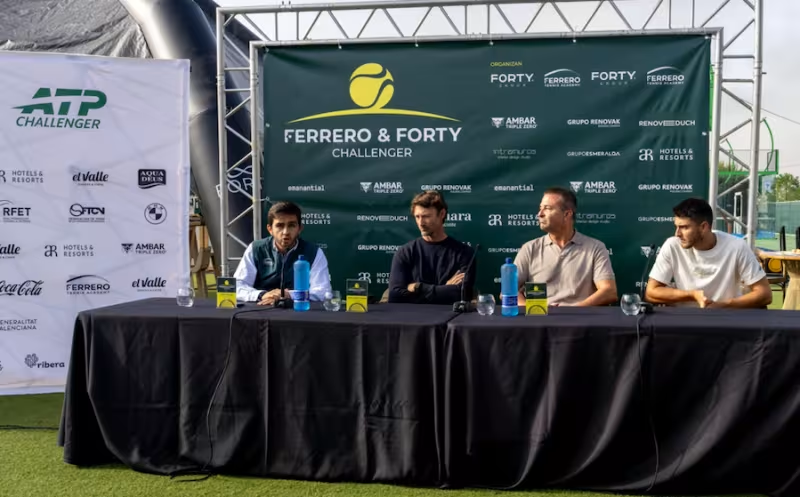
(Laughs) I'm fine, I'm eager; in the end, competition calls me. For now, I have nothing set in stone, I say this with all the sincerity in the world. I will only return if something truly excites and fulfills me; if not, I will be calm at the Academy.
Do you really have nothing lined up?
No, I truly don’t. In that on-field interview, some things were taken out of context; if I didn't say who I was going to return with, it was because I had absolutely nothing. Things are like that for the moment.
Are you interested in another project like Alcaraz's or something more relaxed?
A bit more relaxed, yes. The relationship with Carlos started when he was very young, requiring a lot of time investment to cover all areas of play and organize his playing arsenal. Now I would lean towards a player who is a bit more developed, players who are already more trained and do not require you to be at 200% every day. I'm sure opportunities will arise, so I hope to come back strong.
Do you see yourself on the WTA circuit?
I have had many offers, but for now, I would say no. In the end, what I know is the ATP circuit, where I usually operate and where I know the players. Everything can be a good opportunity, I do not rule it out at all, but my idea today is to focus more on the men's side.
The polls see you with Sinner in 2027, something that might not sit well with Alcaraz fans. Should you be crucified for saying 'yes' to the world No. 1?
The people who follow Carlitos want the best for him; it may bother them to see me on Jannik's team. If this had happened a month after breaking off the relationship, they might have thought I was doing it out of revenge or to annoy him. Beyond all that, once the relationship has ended and a year has passed, what I am trying to do now is focus on my growth as a coach and how to improve my career. The name should not matter too much, although if it were Jannik I know people might think that. People need to respect my decision and, above all, that if I were to go to Jannik's team in the future, it would never be to annoy Carlos.
For what purpose?
To grow as a coach and have had the opportunity to work with two of the best players of this generation. Just because I coach Carlos does not mean I can't also coach his biggest rival. The competitive world is like that; sometimes you are with one group and then with another. I only ask people for a little respect for the decision I ultimately make; I would never want anything bad for Carlos.
This is an automatic translation. You can read the original news, Juan Carlos Ferrero: “No tengo nada cerrado, solo volveré si sale algo que me ilusione”