

"Changing as a player scared me a lot" | Interview with Jaume Munar
Puntodebreak sits down with the Mallorcan to chat about tennis: the drift that the circuit has taken, the reason for his revolution as a player, the Davis Cup in Chile... and much more.

I confess that Jaume Munar Clar (Santanyí, Mallorca, May 5, 1997) was one of those players who had been on my radar for a long time. Long before tennis circles began to nickname him 'the Magician', the Balearic was already showcasing an eloquence and maturity in his words that made any future conversation potentially ideal. In 2025, of course, everything went out of control: he arrived at his 2.0 version, got close to the top-30, became the leader of Spain in the Davis Cup, and demonstrated that you can always reinvent your tennis if willpower and work ethic are there, making him an absolute draw for the media at every tournament he attended.
Last season, when I found him in Bologna and managed to exchange a few words with him, my last reflection was very clear. "Next year, you know, a solo interview for the channel". I had to wait until the Seville Cup 2026, an unmatched springboard before landing in Santiago, Chile, for the qualifying round for the Davis Cup Finals 2026, to confirm all my hunches. Indeed, the conversation will not revolve around Jaume Munar; his figure will simply serve as a catalyst to analyze the current state of the circuit, the context surrounding it, the future to come, and ultimately, to share ideas about a sport that, each from their position and role, we are completely in love with.
Munar speaks exclusively about the Davis Cup tie and reveals his doubts and fears throughout a complicated 2026
It has not been the season Jaume expected, with mixed results, losses that sow doubts, and, above all, long breaks due to physical issues... which even made him reconsider ending the season after the American tour. "I love playing tennis. I love the life I have. Throughout my career, I've really enjoyed the simple challenge of trying to be a bit better, of trying to do things as well as possible.
This year has been very difficult for me at times due to physical issues. I have suffered a lot with my arm, and then due to the lack of continuity in training, that leads to small pains appearing elsewhere... I worked a lot of methods with my team, but at times I couldn't see the light at the end of the tunnel. I decided, before the US Open, to change my approach: to learn to manage the situation I had instead of looking for solutions.
I thought about quitting playing this year: it was seriously on the table. The aim was to give myself time, space, to find those more positive routines and dynamics again. I have never doubted my level: I believe that this year, in the little I've been able to play, I have been competitive in good matches. There have been flashes, not the continuity of last year, but I have competed and won against good players. After the US Open, I know I am on the right path, I have made a decision and I am 100% committed to it: what is clear is that the physical problems are now set aside."
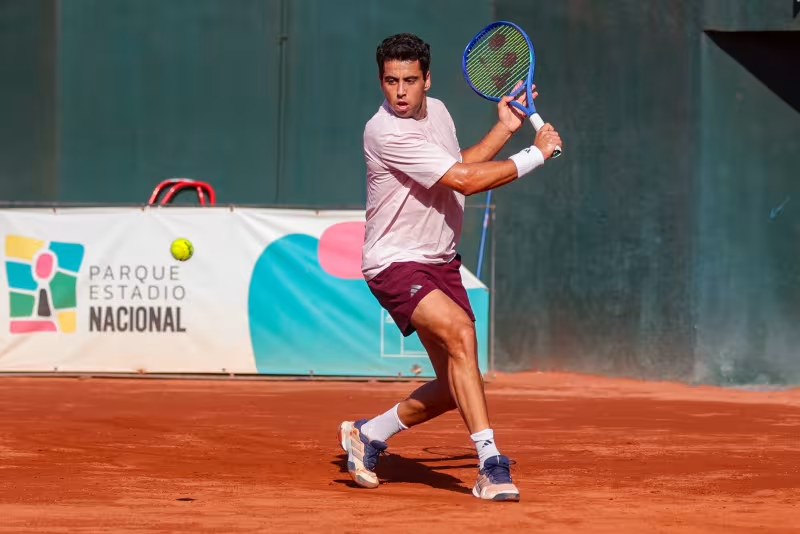
One of the major driving forces in the Balearic's career has always been the Davis Cup. Representing Spain has become, especially in recent seasons, Jaume's number one priority: he will be the most "veteran," along with Pedro Martínez, of a group of hungry 'youngsters' seeking glory for the Armada in Chile. What advice could he give to Jódar or Mérida, knowing how difficult it was for him to debut as a leader in Marbella and how tough this competition can be?
"The most important thing in the Davis Cup is to try to isolate yourself a bit from all that noise when the environment is not in your favor... and when it is in your favor, to soak up that positive energy. Against Cobolli in Bologna, for example, I think I played a great match and absorbed the excitement of this competition. We are five players; I believe there is no exact advice to give them, but I am very excited about this tie.
Jódar comes from a spectacular year, Mérida is playing incredible tennis, and Landaluce has perfectly demonstrated what he is capable of doing on big stages like Miami or Rome. Personally, I do not feel like the leader of the team: first of all, there is Pedro (Martínez), who has a lot of experience, and if we were in Bologna last year, it is largely thanks to him, after what he did in Marbella. I will try to help from the emotional management perspective, but everyone who is here is because the captain thinks they are ready, and I feel exactly the same."
The evolution of the ATP circuit, according to Jaume Munar: less tactics, somewhat less attractive tennis
Last year, as we mentioned in the opening lines, we saw a Jaume Munar who transformed radically. He needed, as he himself acknowledges, "more than a year and nine months" to feel comfortable in his new skin, that of a versatile player, able to hit with his serve, attack the mid-court, and dominate with precise angles. Even the results began to come more on hard courts than on clay, an evolution that has been a long time coming and responds to an imperative need: to be competitive on this circuit, the Mallorcan had to make changes in his playbook.
"Maybe to the public it doesn't show as much, but for me the change, which is very big, comes from an extremely selfish desire... which is that I want to win. I start to see that the way I play is not going to lead to victories, nor to aiming for other things. With a realistic analysis, seeing all my flaws, and knowing that the circuit has undergone a massive change since 2019 or 2020, I have to change.
@jamunar_38 is a guy with clear ideas.
The evolution of tennis, the complacency of new generations, enjoying sacrifice, changing this sport
Half an hour purely about tennis. A conversation beyond Jaume 2.0. Enjoy it as much as I did.https://t.co/bGnKRRCVLG pic.twitter.com/aVfpveKEP2— Carlos Navarro (@TheMagician5GS) September 17, 2026
The big difference is that before you could decide, perhaps, if you wanted to play at different speeds. There was a larger tactical component. Now, speed predominates above all, the serve is undoubtedly the most important shot, and there is a fundamental note: if we play two and one decides to play fast, it is played fast. There is no way to stop or deviate from that. I perhaps felt more comfortable in another context of longer points, perhaps stemming from my character; I firmly believed that if I didn't change I would fall behind."
Diving deeper into the moment the ATP circuit is living requires an almost abstract exercise in which Jaume puts all his effort. His reflection possesses a wonderful force and introduces what he considers the four pillars of this sport: tactics, technique, physicality, and mental strength, pillars that, according to him with total sincerity, tennis is moving away from at certain moments.
"The differentiation of styles used to contribute greatly to tennis and is increasingly being lost. Tennis has always been an extremely complete sport (with those four pillars), and in some aspects we are moving away from them. The striking of the ball has always been very important, it is true; tactics are fading, the physical element is losing ground due to tactics, and mental strength remains important at the management level, but sometimes it also dilutes, because if you have a way of playing where you are not obliged to hit six or seven balls, the mental aspect becomes less important.
For me, the level of #200 in the world and below has skyrocketed. People are much better at everything. The level of the top-50, in this case, is very high when (the players) manage to play well, but it can be much lower than before in certain matches. Maybe it's not that players are complacent, it’s that they are very clear about what they want to do, they are on that path and have accepted that they will crash many times, something that was hard for me to understand. They accept that within that process, they will experience those accidents. This leads to, for me, today in tennis, there are bad matches that are difficult to watch; it’s a very different kind of tennis from before that I like less; that said, I accept the consequences and needs of the circuit in which I compete, regardless of whether I like it more or less."
He always has one more trick 🎩.@jamunar_38 equalizes the tie.#CopaDavis #LaPistaDelTenis pic.twitter.com/Q3IQrhE0f7
— Tenis en Movistar Plus (@MovistarTenis) November 20, 2025
These are just some of the reflections from a guy who himself defines as "somewhat anxious," one of those thinkers who dedicates all the time in the world to finding the cracks in the intricacies of his own tennis. What’s the goal? To improve, to enjoy the suffering, to find nobility in sacrifice. I have no doubt that the day the excitement ends, Jaume Munar will be a magnificent tennis coach... but for now, still within the top-60 and with the flame of excitement fully lit, let’s keep enjoying the Magician.
Full interview on the Puntodebreak YouTube channel, where all these topics are covered in total depth.
This is an automatic translation. You can read the original news, "Cambiar como jugador me asustó muchísimo" | Entrevista con Jaume Munar