

The Top 100 no longer has teenagers
Jódar was the only one in the top 100 of the ATP ranking, but after turning 20 years old, he is no longer a teenager, and the world ranking, for the first time in a decade, is left without any ‘kids’.

Tennis players grow, and the ATP ranking no longer has young promises. After several years of the rise and subsequent establishment of gems that later became stars, men's professional tennis is experiencing a pause in this process of unveiling new pearls from the world of tennis. The last and most dazzling of recent times has been Rafael Jódar, who until yesterday was the only teenager remaining on the list, but upon turning 20, leaves that stage behind and creates a gap not seen for over a decade, specifically since October 2014.
Accustomed in recent times to the emergence of names like the aforementioned Jódar, Joao Fonseca, Martín Landaluce, Learner Tien, Jakub Mensik, Alexander Blockx, Alex Michelsen, or Arthur Fils, and previously to the already established Carlos Alcaraz, Jannik Sinner, Ben Shelton, or Félix Auger-Aliassime, the world of tennis finds itself in a moment where all these players, who were once promises, are now a complete reality.
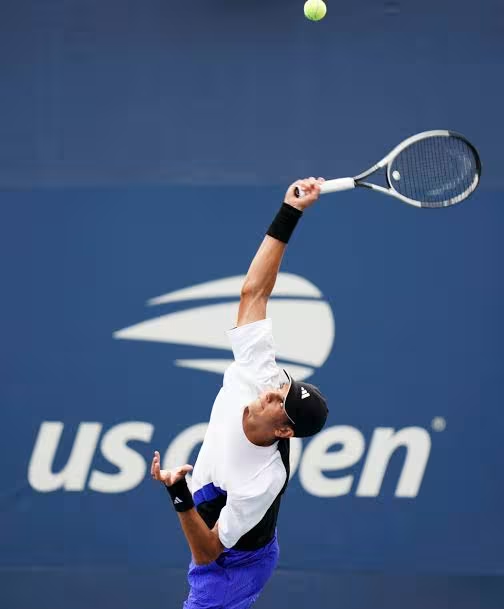
Is it a crisis, coincidence, or an insignificant fact?
While the problem arises in the following generations, specifically those of 2008, 2009, and 2010. Although there are names of players who are expected to reach the top 100 very soon, such as Moise Kouamé, who is already ranked 189th at 17 years and 5 months, there is no movement or foundation of young players who will storm the list of the top 100 players in the near future.
The teenagers who are most notable and have the best chances of ending this absence in the top 100 are: Federico Cinà (19 years and 4 months, 166th), Diego Dedura (18 years and 5 months, 184th), Jan Kumstát (19 years and 7 months, 185th), and the aforementioned Moise Kouamé. Meanwhile, further back is Lleyton Hewitt's son, Cruz Hewitt (17 years and 7 months, 322nd).
History. Made. 📜
16-year-old Moise Kouame breaks new ground in Lille, downing Dodig 6-4, 6-2#ATPChallenger | @FFTennis pic.twitter.com/084RKcw8RR— ATP Challenger (@ATPChallenger) February 17, 2026
For some, alarms of a crisis may sound, while for others, it is the consequence of a generation of players who have emerged in recent years with a dizzying rise, having been able to maintain themselves among the elite of world tennis.
Another reason for this absence of teenagers in the Top 100 is the intense competitiveness that prevails in the ATP circuit, where the level and competition in the middle class is so fierce that a bad streak of results over weeks or months can hinder one's goal of entering or even staying in the rankings. Not to mention injuries, which are increasingly common in a squeezed calendar.
In fact, of the teenage players mentioned as having options to enter the Top 100, four out of the five are the only teenage players appearing in the Top 200. This demonstrates that the current equality that prevails in professional tennis extends beyond the top 100 in the world.
This is an automatic translation. You can read the original news, El Top 100 ya no tiene adolescentes