

Good things come to those who wait
Alcaraz made a grand return at the US Open with a very serious and convincing debut against an innocuous Saifullin.

There is no better news for the tennis world than Carlos Alcaraz returning, winning, and impressing. The Spaniard made his debut at the US Open as if no time had passed. Four and a half months of absence due to his wrist injury seems to have had no effect on him at all, as he started in New York with his usual tennis—somewhat rusty from inactivity, but just as devastating. Roman Saifullin (6-4, 6-4, 6-4) suffered, having little chance against the return of the prodigal son, who came back just as he left: winning.
139 days after that afternoon at the Reial Club de Tennis de Barcelona, four and a half months after a bad movement in his wrist, from a simple discomfort that turned into a much more serious injury, tennis was left orphaned of its star. And there was no better place to return, for the prodigal son's comeback, than on a court of his size and magnitude, the largest of them all, Arthur Ashe in New York. But, above all, in the place where he made his name, where he won his first Grand Slam and became the youngest player to be world number one at just 19 years old. It was the ideal spot for his return to competition.
This was Carlos Alcaraz's dream return to the circuit at the US Open
But, as expected, the comeback wasn’t going to be easy. Four and a half months off the circuit takes its toll on everyone, even the last champion of this tournament. The first games are filled with doubts, errors, and nerves. Something completely normal. He saves a break point in his first service game, and another in the sixth.
Everything is very calm, even very cold. The court is not full, and Alcaraz's game is not yet ready for the kind of show that excites the crowd while Saifullin sticks to his plan of just putting balls in play until the Spaniard falters. But it’s at the moment he saves that second break point that everything changes. Why? Because it’s the moment when the player from El Palmar looks at his team and bursts out laughing. It’s confirmed, no matter what happens, Alcaraz is back.
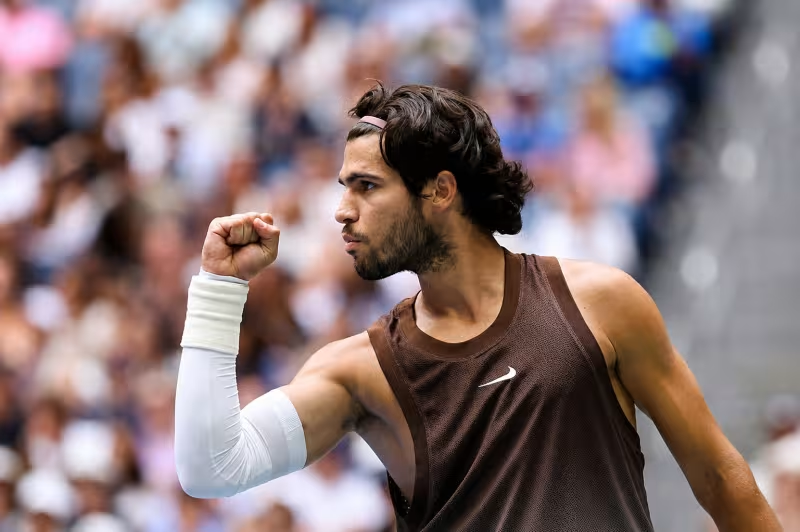
He confirms it in the next game with his first break on his first break point. How does he do it? With a cross-court forehand that Saifullin can only watch. The Spaniard shouts and lets out his feelings because he knows that while the machine is still not at 100%, the talent and competitive hunger remain immaculate. And with that, why not? Alcaraz will attempt the difficult task of lifting his 8th Grand Slam, his third US Open.
He closes the first set (6-4) after going from less to more against an unsuspecting Safiullin. Four and a half months have passed, yes, but nothing has changed. In purely tennis and competitive terms, few can face the greatest star of current tennis, with the exception of Jannik Sinner.
Still producing magic.
Still smiling ear to ear.
Carlos Alcaraz is so back ✨ pic.twitter.com/2hSupQA7GV— US Open Tennis (@usopen) August 31, 2026
And if Alcaraz returns with everything, he also returns with his lapses. The lack of competitive rhythm and the mental demands it brings cause him to lose concentration at the start of the second set. He gives away his serve, and Saifullin threatens to make it 3-0 in the blink of an eye, but the Murcia native reacts and immediately breaks back.
As happened at the beginning of the first set, little by little the Spaniard loosens up, reconnects with his tennis and, most importantly, his wrist is responding perfectly. Safiullin remains flat in his ideas, and Alcaraz takes advantage of it for another break in the seventh game. He smells blood, his senses heighten, and there, once again, the Spaniard does not miss the opportunity to pocket the second set (6-4).
It is in the third set where Saifullin throws in the towel. He realizes that no matter how long his opponent has been away from competition, the essence of his tennis, his reason for being, remains intact. And against that, there's not much one can do. So Carlos Alcaraz, with a smile from ear to ear, seals a first win (6-4, 6-4, 6-4) at the US Open that is serious and convincing, with some areas to improve but with many positives.
After the long agony of his recovery, after the doubts and those intrusive thoughts, which are one’s worst enemy. After dropping out of tournaments like crossing off days on a calendar, Alcaraz returned and came back just as he knows how, with a bang.
This is an automatic translation. You can read the original news, Lo bueno siempre se hace esperar