

Mirka, the woman who "saved" Federer
Mirka Federer met Roger Federer when he had not yet won an ATP title. Her discipline and support were key in transforming the Swiss champion.

Roger Federer seemed to have been born to make the impossible easy, but behind that image of elegance and self-control was an explosive, impatient teenager still unable to manage all the talent he had in his hands. In that transformation, there were coaches, trainers, and a fundamental family, but among them, there was one person who was essential to him: Mirka Federer. She met Roger when he had not yet won a single ATP title and stayed by his side through the 103 he would eventually lift. More than Federer’s wife, Mirka was one of the people who helped turn that wild talent into one of the most stable athletes in history.
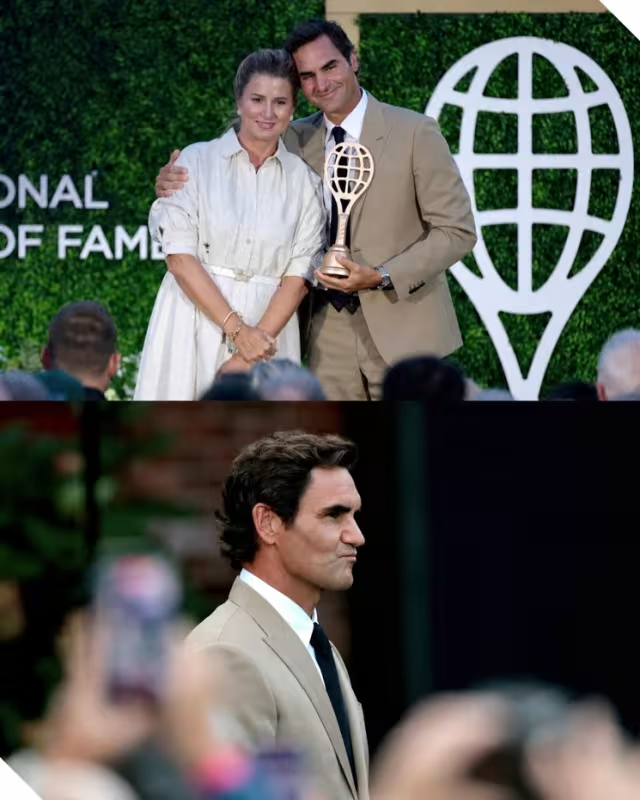
The story regained relevance this weekend. On August 29, 2026, Roger Federer was officially inducted into the International Tennis Hall of Fame in Newport and chose Mirka to be the one to introduce him. She, usually away from the spotlight, recounted some of the early chapters of their relationship and recalled a seemingly simple fact that summarizes a lifetime: when they began dating during the 2000 Sydney Olympics, Federer had exactly "zero" titles on the ATP tour. Twenty-six years later, Mirka was introducing the winner of 20 Grand Slams at the Hall of Fame. Federer ended up in tears when it came time to publicly thank her for all she had done for him.
Roger Federer and Mirka Federer: when the future champion was still throwing rackets
It is difficult to reconcile the final image of Roger Federer with the boy that Mirka Federer met. The man who would become associated with calmness, silence, and control had spent a good part of his adolescence doing exactly the opposite.
Federer was an extraordinary talent from a very young age, but he could also cry during matches, scream, throw his racket, or completely lose concentration when things did not go as he expected. He himself recounted many years later an anecdote that perfectly explains that fame. Before meeting him in person, Mirka had heard about the prodigy emerging in Swiss tennis and was advised to go watch him play. When she did, one of the first images she received was of Roger losing his cool and throwing his racket.
To Mirka, that first version of the future champion did not impress her.
Federer's problem was not playing tennis. He already knew how to do that better than almost everyone. The challenge was learning to coexist with what he felt when competing. For years, his coaches tried to find a balance: they could not completely extinguish that fire because it also fueled his competitiveness, but they needed to prevent it from ultimately consuming him.
At this point, Mirka's emergence takes on a much greater dimension than just the sentimental one.
The two met while representing Switzerland at the Sydney 2000 Olympic Games. Federer had just turned 19, and Mirka was 22. She was also a professional tennis player and would later reach number 76 in the world rankings. During those weeks, their relationship began. Roger was already considered one of the great promises of international tennis. But he was still just that. He had not won any ATP titles. His first trophy would not come until February 2001, in Milan.
That detail is particularly significant when viewed from 2026. Mirka did not know the champion Federer. She did not appear when Wimbledon, millions, sponsors, or number one status existed. She knew the boy who was still trying to figure out how to turn professional.
And there was something she possessed to a much greater degree: discipline.
Federer has recalled how Mirka was able to train for five or six hours, while he could lose concentration after about an hour. Roger would get bored, disconnect, and even had sessions where his behavior eventually got him sent off the court.
Technically, Federer could do things that Mirka could never do. Mentally, however, she understood a work culture that he was still learning. Many years later, Roger himself summed up her influence in the simplest possible way: Mirka taught him what discipline truly meant.
He did not teach him the serve. Nor that forehand or the footwork that would eventually become his trademark. He showed him something possibly more important for a prodigy: that being able to play better than others did not eliminate the obligation to work as hard as they did.
Here lies probably the best way to understand that Mirka helped "save" Federer. Not because without her he would have been inevitably doomed to failure, something impossible to know, but because she appeared at a stage when Roger needed to turn an extraordinary gift into championship habits.
Lo de Federer y Mirka es amor puro.
Roger no habría sido el mismo sin su mujer.
De esa manera, podríamos decir que Mirka "salvó" a Federer para ayudarle a ser LEYENDA.
Cuando lo conoció, aún no había ganado ningún título.
De hecho, ocurrió algo realmente curioso... pic.twitter.com/bGtfMfNlig— José Morón (@jmgmoron) August 30, 2026
Mirka Federer and Roger Federer: from couple to cornerstone of the team
The relationship took on a new dimension when Mirka Federer had to prematurely leave her own career. Physical problems, especially a foot injury, ultimately sidelined her from the professional circuit in 2002. It was a devastating blow for her. But this also led to her traveling more with Roger Federer and becoming a part of the structure being built around the Swiss player.
Mirka had a huge advantage over any conventional companion: she understood professional tennis from the inside. She knew the training sessions, the losses, the locker rooms, the endless travels, and the pressure of competition. When Roger returned from a match, he didn’t need to explain to her why certain points had been important. Mirka could see it.
The most interesting example came precisely during one of the most important years of his career.
At the end of 2003, Federer ended his professional relationship with Peter Lundgren and faced much of 2004 without a permanent coach. This might seem like absolute folly today. However, it was the season in which Roger completely conquered the world: he won the Australian Open, Wimbledon, and the US Open, established himself as number one, and began one of the most impressive domination periods in history.
During those months, Federer publicly acknowledged that Mirka was one of the people with whom he analyzed his matches.
Roger could ask her what she had seen, what she thought about his performance, or what she had noticed in certain situations. He never tried to present her as his coach because she wasn’t, but as someone whose tennis opinion held value.
The anecdote that Mirka recalled this Saturday in Newport illustrates how involved she was during those early years. She even warmed up on the court with Roger before some matches. Andy Roddick would joke after losing to him that he couldn't believe he had been defeated by a player his own girlfriend had warmed up. More than two decades later, Mirka still remembered the scene.
But her importance did not end in tennis.
The more Federer earned, the greater everything around Federer became.
Sponsors, media, commercial commitments, travel, requests, interviews, and a growing global exposure could turn into another parallel competition. Mirka began to play an important role in helping to manage that reality and protecting the space Roger needed to continue being a tennis player.
This is something different members of his circle have highlighted over the years. Christopher Clarey, author of 'The Master: The Long Run and Beautiful Game of Roger Federer', reconstructs a structure in which Mirka ended up being much more than a family presence. She was someone who knew Roger's game perfectly, understood his needs, and could assess what worked or did not work within his team.
Paul Annacone, Federer’s coach from 2010 to 2013, was also impressed by that knowledge. Mirka asked specific questions and understood perfectly what they were discussing.
She was not a privileged spectator of the Federer phenomenon. She was part of it.
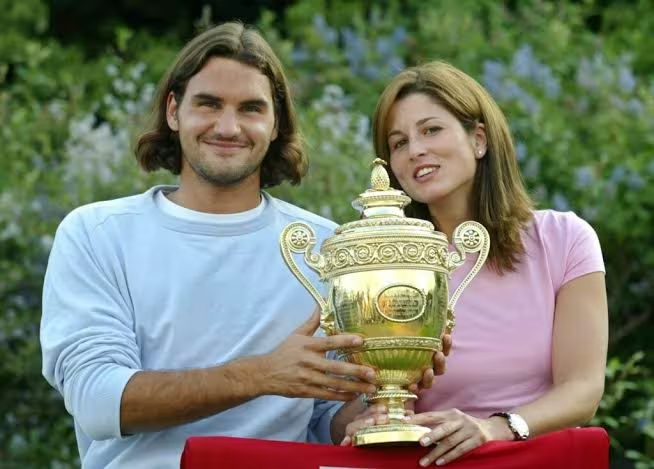
Roger Federer and Mirka Federer: all of his titles came with her by his side
There is a statistic that does not appear in Roger Federer's official records, but it explains better than many others the dimension of Mirka Federer in his career.
When they started their relationship: 0 ATP titles.
When Federer retired from tennis: 103 ATP titles.
Everyone arrived with Mirka by his side.
The story, moreover, underwent a second transformation when the couple began to start a family. They got married in 2009. First, their twins Myla and Charlene were born; later, two more twins, Leo and Lenny, would come along. This could have led Federer to choose. Family or the tour. But for many years he managed to avoid that choice.
Mirka took on a huge part of the logistics necessary to turn the professional tour into a possible family life. Continually traveling with four children while Roger trained, competed, and attended his commitments required immense organization.
Federer has always acknowledged that without that support, his career would probably have been different.
In fact, Mirka revealed during her speech in Newport a particularly significant episode. When she was pregnant with their first daughters, she told Roger that she probably wouldn’t be able to travel with him as she had before. Federer’s response was immediate: if she stopped traveling, he would stop playing.
Mirka insisted this Saturday that Roger was not being theatrical. He meant it seriously. For him, family came first.
Eventually, they found another solution.
And Federer continued.
This is where Mirka’s second major influence on his career appears. During the first years, she helped provide the stability and discipline the young man needed to learn to behave like a champion. Later, she contributed to creating the necessary conditions for that champion to extend his career without feeling he was permanently giving up his family.
The farewell of the 2022 Laver Cup made it clear.
When Federer began to thank others after playing the last match of his professional life alongside Rafael Nadal, there came a moment when he could hardly speak. When mentioning Mirka, he remembered that she could have urged him to retire much earlier.
She never did.
She continued to support him.
That is why the image of Newport in August 2026 has something of a perfect circle. The woman who had known the titleless teenager, who had seen the rackets fly, who had trained for hours while he was still bored, who warmed up with him before some matches, who accompanied him when he conquered Wimbledon, and who later built a family around the circuit was also the one who had the last word before Roger officially entered the Hall of Fame.
Federer became emotional when the time came to talk about her.
It was inevitable.
The Federer we know cannot be explained solely by Mirka. Peter Carter was crucial in his development as a player and as a person, and his death in 2002 had a profound impact on young Roger. Pierre Paganini built for decades the physique that allowed him to sustain that tennis and that longevity. His parents, Robert and Lynette Federer, provided stability long before the champion existed. Then came Severin Lüthi and many others who formed one of the strongest teams the circuit has known.
They all had a part in the metamorphosis.
But Mirka occupies a different space.
Because she was there before the Grand Slams and after them.
She met the Federer who still didn't know how to control everything he had inside and ended up introducing the world to the Hall of Fame Federer.
Between them, there were 103 titles, 20 Grand Slams, 310 weeks as number one, and 26 years of shared life.
All of them with Mirka by his side.
This is an automatic translation. You can read the original news, Mirka, la mujer que "salvó" a Federer