

Roddick Launches a Theory About Alcaraz's Wrist That Reduces Fear
Carlos Alcaraz appeared in public again with protection on his right wrist, triggering alarms, although Andy Roddick offers a much more reassuring theory.

The wrist injury of Carlos Alcaraz continues to be one of the great mysteries of the tennis world. The Spaniard has been out of competition for over three months, and every time he appears in public, any detail related to his right arm immediately becomes a topic of analysis. This time it happened during the 2026 World Cup final, where the Murcian appeared with protection on his right wrist. The image was enough for many fans to question once again if the recovery is proving to be more complicated than expected.
Alcaraz played a prominent role in the final held in New Jersey between Spain and Argentina. The Spanish champion was responsible for bringing the trophy onto the field before the start of the match and later celebrated the 1-0 victory alongside the players. However, the cameras also captured an image that quickly drew attention: the seven-time Grand Slam champion had the area where he suffered the injury covered, keeping him away from the circuit.
The issue arose during the Barcelona ATP 500, where the Spaniard had to withdraw from the competition after his first match. Since then, his schedule has been progressively falling apart, and the lack of specific information has only fueled doubts. Alcaraz has not played an official match again, and for now, there is no definitive date for his return.
Roddick's explanation of Alcaraz's injury
In his podcast Served, Andy Roddick wanted to provide some context to the image. The former world number one admits that his initial reaction was also one of concern, but he quickly presented a much simpler possibility.
“I thought, ‘Oh, my God, that's not good’. But if I were him, if you're surrounded by a lot of people and have had a wrist injury, I would 100% have some kind of signal that says, ‘Don't come shake my hand’. Maybe that's all it is,” commented the American.
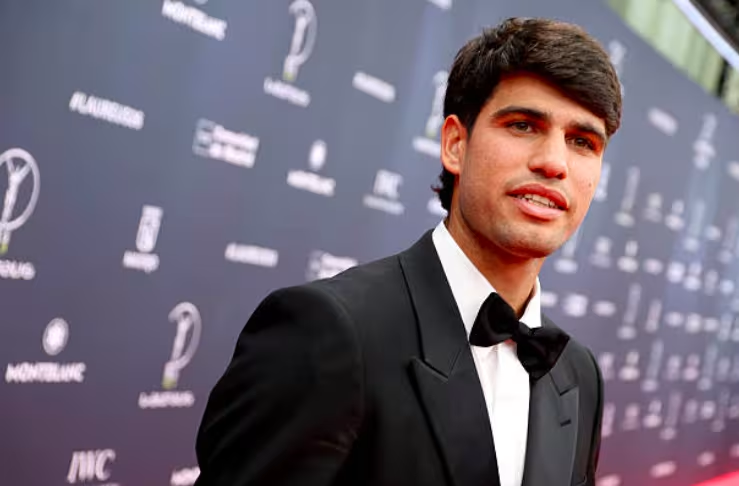
Roddick's theory makes logical sense. Alcaraz was in one of the most crowded sporting events on the planet, surrounded by players, fans, officials, and hundreds of people who wanted to greet him. In that context, visible protection could also serve as a physical barrier and a way to avoid constant handshakes.
“If I'm at the World Cup and about to shake 250 hands, and someone who's had a few drinks comes towards me... I get it,” explained the American. Roddick also emphasized that, so far, Alcaraz seems to be following a recovery process without rushing. “What we want is for him to be back in the mix, but pragmatically I think: take your time, you have a long road ahead,” he pointed out.
“It doesn't seem like he's forcing anything or announcing a date where you'd think, ‘Are you really ready?’. With protection or without it, I would still wear something even if it was practically fine.” The last sentence, however, sums up the current state of affairs. Although Roddick's theory brings optimism, the mystery continues. “We'll all have our eyes on that wrist until we see him come out and hit the ball with force,” he concluded.
Therefore, the image from the World Cup does not offer a definitive answer. It could be a sign that the issue persists, but it could also be exactly what Roddick suggests: a simple precaution. In the case of Alcaraz, after more than three months off the courts, any bandage becomes news. And until the racket speaks again, theories will continue to fill the space that was once occupied by his shots.
This is an automatic translation. You can read the original news, Roddick lanza una teoría sobre la muñeca de Alcaraz que rebaja el miedo