

The 10+1 big conclusions left by Wimbledon 2026
We take a thorough look at everything that happened at Wimbledon 2026 and the influence it may have on upcoming important tournaments.

Wimbledon 2026 is now part of history. The third Grand Slam of the season has once again provided unforgettable moments, great champions, unexpected revelations, and numerous questions for the second half of the year, confirming once again its status as the most special tournament on the calendar.
Beyond Jannik Sinner claiming another title and the extraordinary level of competition displayed over two weeks on the grass of the All England Club, the British tournament offers multiple profound interpretations. The emergence of new figures, the ongoing uncertainties surrounding some of the great names on the circuit, and the breakthrough of Arthur Fery paint an incredibly interesting scenario for the upcoming months. Here are the first five major conclusions from Wimbledon 2026.
What conclusions has Wimbledon 2026 brought?
1. Sinner keeps winning
It is difficult to find new praises for a player who seems to have turned excellence into routine. After the harsh blow suffered at Roland Garros, where his triumphant streak was halted in a very delicate physical and mental context, many wondered what his response would be. Wimbledon offered the best possible answer. Champions are not defined by how they win, but by how they react when they lose, and the Italian once again demonstrated that he belongs to a special category.
Beyond the title, what is striking is the competitive evolution he is showing. He no longer needs to dominate every match from start to finish or display absolutely brilliant tennis to end up lifting the trophy. He knows how to endure, interpret delicate moments, and accept that a Grand Slam is also conquered by surviving uncomfortable matches like the first round against Miomir Kecmanovic. His serve continues to improve, his ability to manage efforts is growing, and his mental strength seems to have taken another leap in quality.
With four Grand Slams already in his trophy cabinet and a sense of increasingly consolidated authority, it is hard to find arguments to think that his dominance will stop in the short term. Sinner has ceased to be the man of the future to become the great reference of the present.
2. Zverev and the inexhaustible engine of ambition and confidence
For years, he lived with the label of the best player in the world without a Grand Slam. That burden conditioned too many important matches, too many finals, and too many wasted opportunities. However, finally winning a major seems to have profoundly changed Alexander Zverev.
Many might have thought that, after achieving that vital goal, a certain competitive relaxation would come. The exact opposite has happened. Zverev now plays with an unknown freedom, showing a much more positive body language, making aggressive decisions in crucial moments, and conveying a confidence that seemed to be lacking before when the stage became enormous.
His Wimbledon victory confirms a feeling that began to be perceived after lifting his first Grand Slam: the German has overcome the biggest obstacle of his entire career. From now on, he will not compete to prove he can win a major; he will compete knowing he has already achieved it. That psychological difference could make him a constant contender in the years to come.
3. Novak Djokovic, so close yet so far
Every Grand Slam seems to fuel the same debate: Has the definitive decline of Novak Djokovic finally arrived? Wimbledon has once again offered a response similar to recent times. No. The Serb remains fully competitive, continues to reach the final rounds, and maintains an extraordinary level. However, there is also the feeling that he is one small step away from where he has always been accustomed to living.
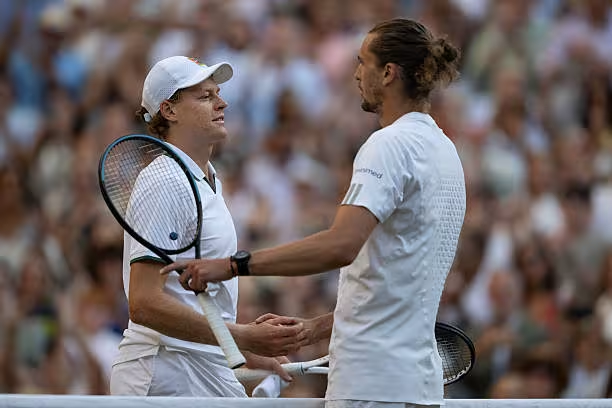
His defeat against Sinner once again highlights that reality. For many moments, he was able to challenge the dominance of the Italian, but he no longer manages to sustain that level for five sets against the world's best players with the same frequency as a few years ago. The physical margin is smaller, recovery demands more, and each match entails immense wear and tear.
This doesn't mean that the dream of the 25th Grand Slam is over. Quite the opposite. If anyone deserves to still be considered a contender in any major tournament, it is precisely Djokovic. But it also seems evident that he needs many pieces to fall into place simultaneously to lift one of the four major trophies again. He remains very close... although, paradoxically, he also gives the impression of being further away than ever before.
4. Arthur Fery's revolution, fantastic news for tennis
Few stories have enriched this Wimbledon as much as the one starring Arthur Fery. The British player, coming from the NCAA and far from the top positions in the rankings, reminded the world that tennis still leaves room for unexpected tales. His breakthrough should not be interpreted as an anomaly, but as a logical consequence of the sport's evolution.
It is becoming increasingly common for players outside the Top-100 to be able to compete on equal terms with established members of the elite. The professionalization of the Challenger circuit, the growth of American college tennis, the improvement of physical preparation, and access to resources that were previously reserved only for the best have significantly reduced competitive differences.
Perhaps Fery will end up establishing himself, or maybe this Wimbledon will be the best tournament of his life. In either case, his story is fantastic news for tennis. It shows that there is still room for surprise, for excitement, and for discovering new protagonists capable of altering the established order during two unforgettable weeks.
5. A Top-10 languishing inexorably
If there is one thing that Wimbledon has once again highlighted, it is the huge gap that currently exists between the big dominators and much of the rest of the Top-10. Sinner, Zverev, and Djokovic seem to be competing in a different dimension, while other names expected to lead the circuit continue to struggle with consistency.
Daniil Medvedev remains far from the form that made him a Grand Slam champion. Ben Shelton still alternates brilliant performances with inexplicable disconnects. Alex de Miñaur maintains his usual consistency, but still encounters a competitive ceiling in big events. Expanding the focus further, the landscape becomes equally striking: Andrey Rublev, Stefanos Tsitsipas, or Casper Ruud have practically disappeared from the crucial rounds of major tournaments.
All of this helps paint a peculiar scenario. There is a huge competitive void behind the major contenders, while the next generation is still evolving. Fonseca, Mensik, Rafael Jódar, and other young talents are aiming high, but they still need time to acquire the necessary consistency. Until then, the circuit will continue to experience an interesting transitional phase where a handful of dominators coexist with a pursuing group unable, for now, to truly threaten their position.
6. Linda Noskova, a new star in the sky
Linda Noskova may not yet arouse the media interest that other young figures on the circuit do, but Wimbledon has confirmed a reality that has been simmering for some time: the Czech fully belongs to the elite. Reaching her first Grand Slam semifinals does not seem to be the ceiling for a player who has been quietly establishing herself among the best for years.

Her evolution is particularly interesting because it is not solely based on natural talent. Noskova has been adding resources to a game that was initially very straightforward. Today, she combines an excellent serve with increasingly complete tactical variations: she smartly uses the slice, approaches the net judiciously, executes drop shots naturally, and understands perfectly when to accelerate and when to construct the point. On grass, all these virtues gain even more value.
At just 21 years old, she exudes a mature competitiveness unusual for her age. She doesn't need grand gestures or flashy statements to stand out. Her tennis speaks for her, and everything suggests that these semifinals will not be an isolated exception but the first major step towards a regular presence in the decisive rounds of Grand Slam tournaments.
7. Karolina Muchova continues knocking on heaven's door
There are few players on the circuit capable of generating as much consensus as Karolina Muchova. Each time her physical condition allows, she proves once again that she possesses one of the most complete, imaginative, and difficult-to-read games on the women's circuit. Wimbledon only reinforced that impression.
The Czech once again demonstrated flashes of immense quality, mixing pace changes, drop shots, volleys, and a privileged tactical intelligence. Her ability to adapt to any surface remains extraordinary, to the point that it is difficult to find a rival who can feel comfortable facing her when she reaches a high level.
Muchova's biggest enemy remains the same as always: her own body. Injuries have conditioned much of her career and prevented her from enjoying the necessary continuity to establish herself among the top dominators of the circuit. However, every important tournament serves as a reminder that her competitive peak is still that of a Grand Slam champion. If she manages to string together several months without physical issues, few would doubt seeing her lift one of the major titles she has been so close to for a long time.
8. Sabalenka and Rybakina lose momentum
Just a few months ago, it seemed evident that Aryna Sabalenka and Elena Rybakina were going to dominate much of the season. However, Wimbledon has left a very different impression. Both have lost some of their authority with which they started the year and leave London with more questions than answers.
Sabalenka still holds the top of the rankings and remains a reference on the women's circuit, but she no longer conveys that sense of invincibility that accompanied her during the first part of the season. Rybakina, on the other hand, missed a magnificent opportunity to narrow the gap in the rankings and once again demonstrated a worrying inability to compete at the highest level consistently for several months.
The most striking aspect is not so much that they have lost, but the way in which they did. Neither managed to impose their identity when the matches started to get tough. The dominance of women's tennis is once again open for grabs, something that seemed unlikely just a few weeks ago and turns the American tour into a much more unpredictable scenario.
9. Structural issues with Gauff, Pegula, and Swiatek
Each defeat may have multiple explanations, but when the same problems recur tournament after tournament, they stop being mere accidents. Wimbledon once again highlighted that three of the top references on the women's circuit are still struggling with limitations that their teams have not yet managed to resolve.
In the case of Coco Gauff, the forehand and the serve continue to appear as areas of insecurity in crucial moments, especially on fast surfaces. Jessica Pegula still retains her tactical intelligence, but she struggles again when she needs to take the lead against opponents who constantly accelerate the game. As for Iga Swiatek, the story repeats itself every summer: she is still looking for the formula to transfer her dominance on clay to a grass surface that continues to resist her much more than expected.
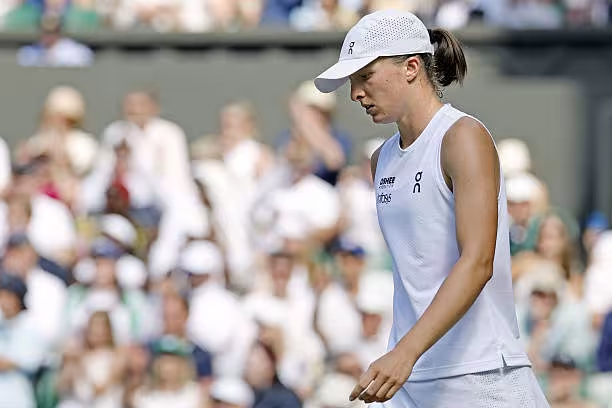
None of the three have ceased to belong to the elite, far from it. But their shortcomings are beginning to take on a structural nature and not merely circumstantial. Addressing them will be essential if they want to regain the prominence lost during the second half of the season.
10. Marta Kostyuk keeps progressing
In a Wimbledon full of standout names, perhaps one of the most consistent developments has been that of Marta Kostyuk. The Ukrainian continues to advance almost silently, but every major tournament confirms that her evolution is no longer just based on talent but also on a clear competitive maturity.
Her tennis has gained stability from the baseline, she makes better decisions under pressure, and she is starting to manage crucial moments much more naturally. She no longer relies solely on inspiration but has built a much more solid identity, capable of competing regularly against the best players in the world.
It may still be too early to place her among the top favorites to win a Grand Slam, but Wimbledon reinforces a very clear feeling: Kostyuk already belongs to the group of contenders who can breakthrough in any major tournament if they have a good week. And considering the progress she is making, no one should be surprised if that definitive leap comes sooner rather than later.
Bonus Track: Serena Williams and a look ahead to the US Open
Wimbledon 2026 leaves many uncertainties for the upcoming North American hardcourt swing, with the main focus once again on the US Open. Much attention will be paid to whether Sinner can prolong his extraordinary dominance, if Zverev definitively confirms his status as a constant contender for major titles, and if Djokovic finds one last opportunity to win the coveted 25th Grand Slam.
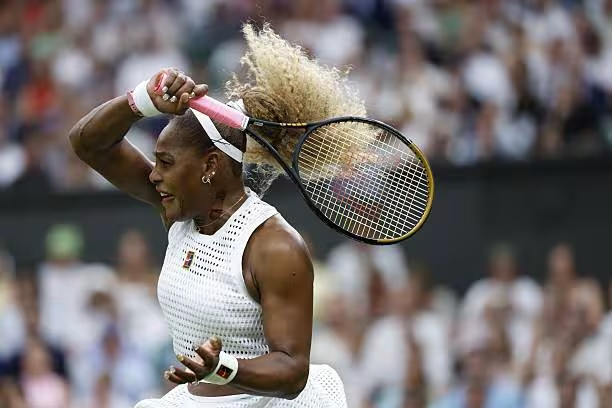
However, one name that will continue to capture the spotlight is that of Serena Williams. Her return evoked deeply contrasting feelings. On one hand, she showed that she can still compete at a surprisingly high level and challenge some of the best players in the world.
On the other hand, the injury suffered during the tournament and an occasionally perplexing attitude once again raised doubts about the trajectory of this new journey. The US Open is already on the horizon as the big stage where the American will try to provide answers. Given her historical significance, it is impossible not to think that she will once again become one of the major focal points of the tennis world.