

Arthur Fery and the false crisis of tennis: why the level was never so high
We analyze how Arthur Fery's bombshell at Wimbledon 2026 can be interpreted, whether seeing the glass half full or half empty, and if this trend of big surprises may have arrived to stay on the ATP circuit.

The emergence of Arthur Fery at Wimbledon 2026 has reopened a recurrent debate about the level of world tennis, the depth of the ATP circuit, and the ability of players outside the Top-100 to compete on equal terms with the best. However, it is advisable to analyze the phenomenon with perspective, because perhaps the explanation is very different from what many defend.
Every time an unexpected name reaches the decisive rounds of a Grand Slam, the same messages resurface. Talks about whether the circuit has weakened, how unthinkable this was a few years ago, and that only Jannik Sinner and Carlos Alcaraz maintain the competitive level. It is a quick, simple conclusion... and probably wrong. The story of Arthur Fery speaks less of a supposed decline of the elite and more of the extraordinary growth experienced by the rest of the circuit during the last decade. Tennis has changed much more than it seems, and perhaps we continue to analyze it with a historical reference completely exceptional.
Arthur Fery is not an anomaly of modern tennis
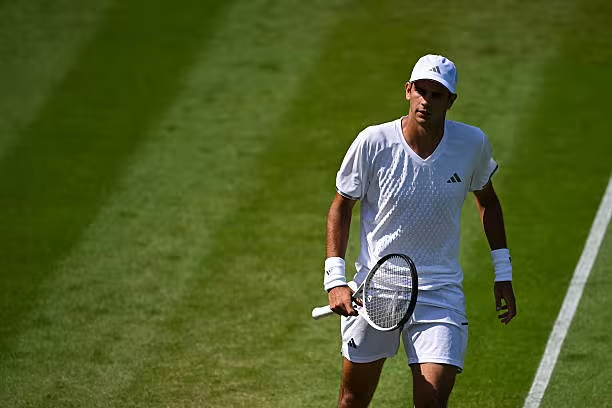
It is logical that a story like the British one attracts attention. A player outside the Top-100, coming from American college tennis, and practically unknown to the general public, bursts onto the Wimbledon scene with brilliant tennis and puts higher-ranked players in trouble. For many, this constitutes clear evidence that the overall level has declined.
However, this interpretation is based on a debatable premise. The present is still being measured against the most extraordinary era this sport has ever known. For almost two decades, Roger Federer, Rafael Nadal, and Novak Djokovic made routine what had never been normal: linking semifinals, finals, and Grand Slam titles for fifteen consecutive years, minimizing surprises and creating a nearly unbreakable hierarchy. That did not represent the norm in tennis but a historical anomaly that is hardly repeatable.
What is truly striking is not that Arthur Fery reached such a level at Wimbledon. What is truly striking is that there are still those who interpret his success exclusively as a discredit to the best players. Because the explanation seems much more complex. If today the world No. 114 can compete in that way, perhaps the question should not be what is happening to the top-ranked players but how the tennis of those ranking between 50 and 200 in the world has evolved.

It's enough to observe the reality of the circuit to see that the differences are becoming smaller. Sinner, Alcaraz, and, to a lesser extent, Djokovic and Alexander Zverev continue to stand out from the rest. But just behind them is a much more open scenario, where a good day, a specific surface, or a favorable draw can significantly alter the hierarchy. This doesn't necessarily mean that the favorites are worse. It means, above all, that the pursuers are better than ever.
The world's top 100 has never been so good
There is an aspect that often goes unnoticed when analyzing modern tennis. For many years, the difference between the 20th and 120th-ranked players in the world was not just about tennis. It was mainly economic.
While the best players could travel with coaches, fitness trainers, physiotherapists, video analysts, or nutrition specialists, many Challenger circuit players could barely afford a stable coach throughout the season. The talent was there, but the tools to develop it were infinitely lesser.
That scenario has changed radically in recent years. ATP has driven a profound transformation of the Challenger circuit, especially since the pandemic and the implementation of the OneVision plan. Economic prizes have increased dramatically, the calendar has strengthened, and the creation of categories like the Challenger 175 has significantly raised the competitive level of those tournaments. It is now much more feasible to spend several years developing in this ecosystem without it being an insurmountable economic burden.
The consequences are evident. More and more players ranked between 100 and 200 can invest in better coaches, travel with more complete teams, access advanced technology to analyze their game, or plan their physical preparation with much greater precision. Professional tennis is no longer just a matter of talent. It also depends on the available resources to turn that talent into competitive performance, and that gap has been greatly reduced.
In addition, another decisive element must be added: the evolution of the athlete. Physical preparation, injury prevention, nutrition, recovery, biomechanics, and statistical analysis have seen a spectacular growth over the last decade. What used to be reserved for the world's top five is now within reach of a much larger part of the circuit. Never before have so many players been so well prepared to compete at the highest level.
Perhaps that's why it's becoming less strange to witness big surprises in major tournaments. Not because the favorite plays worse, but because the opponent facing them has a technical, physical, and tactical level infinitely superior to what a player with the same ranking offered fifteen or twenty years ago.
The silent revolution of the Challenger circuit, the NCAA, and the globalization of talent
If there is a phenomenon that explains this transformation better than any other, it is the growth of alternative paths to the elite. For decades, the path seemed unique: stand out as a junior, quickly make the leap to professionalism, and survive in Futures to break through to the Challenger Tour. Today, the landscape is completely different.
The Challenger circuit has ceased to be a mere waiting room and has become a true high-performance laboratory. It is where players with ATP level, young promises, veterans seeking to regain sensations, and emerging talents face off weekly, finding the necessary conditions to keep growing without rushing their definitive leap.
Simultaneously, the NCAA is no longer seen as a destination for those who give up professionalism. More and more players are using college tennis as a development platform. Arthur Fery perfectly embodies this new reality, as do Michael Zheng, Cameron Norrie, and Nuno Borges. They all realized that four years of physical, tactical, and mental maturation could be much more valuable than a hasty adventure through Futures tournaments.
This collegiate model offers something that was previously hard to come by: stability. Top-notch facilities, highly qualified coaches, demanding competitions, and comprehensive training that enables players to enter the professional circuit much better prepared for the weekly demands.
At the same time, tennis has globalized like never before. Great traditional schools in Spain, the United States, or France are no longer the only ones. Talent can emerge from virtually anywhere on the planet because knowledge no longer has borders. Coaches share information, video analysis is accessible to anyone, and training methodologies are spreading at an unimaginable pace compared to just twenty years ago.
Ultimately, the circuit today produces many more players prepared to compete at the highest level. The logical consequence could only be increasing equality, especially in those early rounds of the major tournaments where the favorites no longer face inexperienced rivals, but genuine specialists capable of seizing any opportunity.
The Big Three made us believe that was normal
There is a factor that inevitably conditions any debate about the current level of tennis: our memory is completely distorted by the era of the Big Three. Roger Federer, Rafael Nadal, and Novak Djokovic not only dominated the circuit; they redefined what we understood as normal. For almost two decades, they accustomed fans to seeing them effortlessly reach semifinals and finals of Grand Slams, monopolizing titles and minimizing the margin for surprises.
However, that was never the historical norm in tennis. It was probably the greatest competitive anomaly that an individual sport has ever known. Never before had three players ruled for such a long time with such authority, or turned something as extraordinary as playing practically all the final rounds of major tournaments for fifteen years into routine.
Perhaps the biggest mistake we make today is precisely that: continuing to use that era as a measuring unit. When a player outside the Top-100 reaches the second week of a Grand Slam, many automatically interpret that the tour has weakened. But perhaps the comparison should not be made with the Federer-Nadal-Djokovic era, but with the rest of tennis history, where unexpected breakthroughs have always been part of the competitive landscape.
Because even during the peak of the Big Three, improbable stories were still emerging. It's just that their dominance was so overwhelming that we tend to forget them.
History shows that major surprises have always existed
Arthur Fery is not experiencing a completely new phenomenon. Tennis has always found openings for unexpected protagonists to emerge, even when it seemed that the established order was unchangeable.
It's enough to look back to find examples of all kinds. Vladimir Voltchkov reached the Wimbledon semifinals in 2000 without ever surpassing the second round of a Grand Slam again. Three years later, Martin Verkerk surprised the world by reaching the Roland Garros final, a result he never came close to repeating. A similar story happened with Mariano Puerta, finalist in Paris in 2005 despite never going beyond the second round in any other major.

The examples multiply as the years go by. Jerzy Janowicz enchanted the world at Wimbledon 2013 with his irreverent tennis that led him to the semifinals. Hyeon Chung delivered an unforgettable semifinal at the 2018 Australian Open, even defeating Novak Djokovic along the way. That same year, Marco Cecchinato staged one of the biggest surprises of the last decade by reaching the Roland Garros semifinals after beating Djokovic himself. More recently, Aslan Karatsev burst onto the scene from outside the Top-100 to reach the 2021 Australian Open semifinals, a story that seemed impossible before it happened.
None of those cases were interpreted as irrefutable proof that tennis was in crisis. They were simply reminders that this sport still allows for exceptions, for moments of inspiration, and for those players capable of seizing an opportunity when the draw opens up or when they reach the peak of their careers.
📊 The lowest-ranked players to reach the semifinals of a Grand Slam tournament in the last 40 years:
— Jeu, Set et Maths (@JeuSetMaths) July 8, 2026
▪️ N°237: Vladimir Voltchkov 🇧🇾 (Wim 2000)
▪️ N°200: Henri Leconte 🇫🇷 (RG 1992)
▪️ N°174: Jimmy Connors 🇺🇸 (US 1991)
▪️ N°125: Goran Ivanisevic 🇭🇷 (Wim… pic.twitter.com/WTOqWRE19c
Recent tennis itself continues to offer examples. Martín Landaluce surprised this year in Miami and Rome with performances well above expectations. Terence Atmane burst onto the scene in Cincinnati. Valentin Vacherot made a huge competitive leap with his title in Shanghai. Matteo Arnaldi reached the semifinals of Roland Garros when few counted on him. None of them have won a Grand Slam yet, but they all represent a much broader phenomenon: the increasing ability of players outside the elite to compete at the highest level for a week or two.
A generational transition does not equate to a tennis crisis
It is true that the men's circuit is going through a transitional period. It would also be absurd to deny it. Daniil Medvedev, Alex de Miñaur, or Ben Shelton are not currently experiencing the best moments of their careers. Other names that seemed destined to dominate the circuit, like Andrey Rublev, Stefanos Tsitsipas, or Casper Ruud, have lost some of the spotlight they had just a few years ago.
At the same time, the new generation is still being built. Joao Fonseca, Jakub Mensik, or Rafael Jódar possess extraordinary talent but still need continuity. Other players expected to make a difference, like Arthur Fils, Jack Draper, or Lorenzo Musetti, have seen their progress hindered by injuries.
All of this creates a sense of certain competitive instability behind Sinner, Alcaraz, and Djokovic. However, confusing this transition with a supposed decline in world tennis is simplistic. All major generational changes produce periods of readjustment, and precisely those moments are often seized by players who seize the opportunity to deliver the performance of their lives.
It's not a structural weakness. It's a much more open scenario, where differences are smaller, and where every detail becomes crucial.
More equality does not mean less quality
There is a deeply ingrained idea among many fans: if a player outside the Top-100 eliminates one of the favorites, then the level of the circuit has necessarily declined. But this conclusion only considers one part of the equation.
What if the real change is happening much lower? What if the world's 120th player had reached a level that only the top thirty possessed twenty years ago? The economic growth of the Challenger circuit, the professionalization of work teams, the revolution in physical preparation, the rise of the NCAA, the globalization of talent, and universal access to technical knowledge all point precisely in that direction.
Today, it is much more difficult to find an easy first round in a Grand Slam. The favorites are no longer facing only talented players but are up against extraordinarily prepared professionals, with resources, international experience, and the ability to compete from the first point. The resulting increase in surprises should not be seen as bad news. On the contrary.
Tennis needs dominators. Sinner and Alcaraz are the best examples of this. But it also needs uncertainty. It needs to continue to have the potential to discover new names, to get excited about unexpected trajectories, and to prove that talent can make its way even starting from anonymity.
Because, after all, the greatness of this sport never solely resided in its champions. It was also built by those players capable of defying all odds during two unforgettable weeks.
Perhaps Arthur Fery will not reach a Grand Slam semifinal again. Perhaps in a few years, another name will surprise the world from outside the Top-100. That is precisely the beauty of tennis. Stories like his should not be seen as a threat to the circuit's credibility, but as proof that the competitive depth has never been greater.
And perhaps that is the main conclusion. Arthur Fery has not come this far because tennis is worse. He has come because, probably, never before had the world number 114 played this sport so well. That is not bad news. It is, most likely, the best evidence of the extraordinary evolution that professional tennis has undergone in the last fifteen years.
This is an automatic translation. You can read the original news, Arthur Fery y la falsa crisis del tenis: por qué el nivel nunca fue tan alto