

We Tested the Wilson Blade 98 V10 16x19: More Aggressive, Just as Blade
We thoroughly analyze the new Wilson Blade 98 v10 racket, the weapon used by Sabalenka, Andreeva, Mensik, and others.

The Wilson Blade is one of those series that needs no introduction. Since its launch, it has become one of the most popular racket families both on and off the professional circuit. It's no coincidence that top players like Aryna Sabalenka, Jakub Mensik, and the recent Roland Garros champion, Mirra Andreeva, have trusted it to take their tennis to the highest level. Its combination of control, stability, and feel has made it an absolute reference within Wilson's catalog.
With the arrival of the Wilson Blade 98 V10 16x19, the American brand ensures it has developed the most aggressive Blade in history. An evolution that maintains the family's personality but incorporates extra power and stability to adapt to an increasingly physical and explosive style of play.
As a longtime Blade user, I was particularly interested in seeing to what extent Wilson had managed to evolve a model that already worked exceptionally well. After testing it on the court, these have been my impressions.
A design that respects tradition but looks to the future
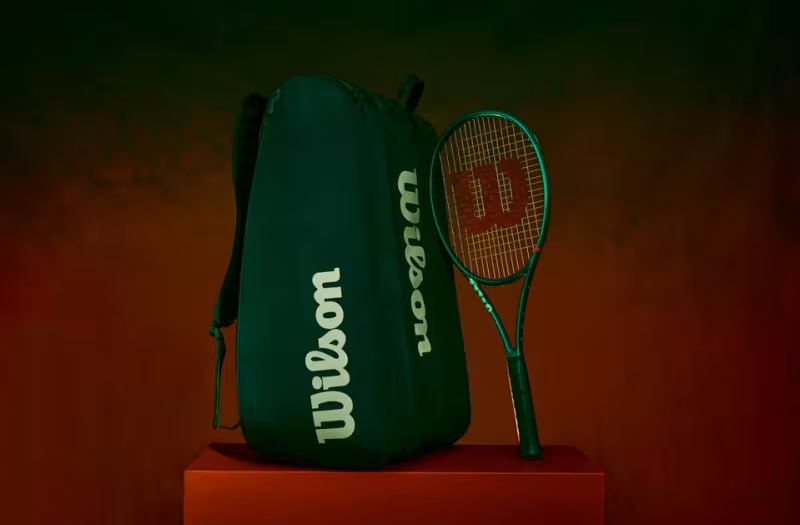
Even before hitting the first ball, the Blade V10 makes it clear that Wilson has taken special care with its aesthetics; the new Championship Green finish preserves the color that has historically identified the Blade family, albeit with a much more modern interpretation. Depending on the light, infrared reflections appear, adding a lot of personality to the frame and making the racket stand out on the court.
In addition, there are muscular relief lines distributed throughout the frame that convey a more robust and aggressive image without losing the elegance that has always characterized this franchise.
Personally, I find it one of the most harmonious Blades in terms of appearance that Wilson has released in recent years. It doesn't break radically with previous generations, but it introduces enough details to offer its own easily recognizable identity.

Continuing specifications with important innovations
On paper, the Blade V10 maintains the classic configuration that has brought so much success to this series. We're talking about a 98 square inch head, 305 grams unstrung, a balance of 320 millimeters, and a 16x19 string pattern. This combination is clearly aimed at advanced or competitive players who generate arm speed and seek a precise response in every shot.
The main innovation comes with the incorporation of TurboTaper technology, a redesign of certain areas of the frame that promote a more explosive ball exit. Wilson's goal has been clear: increase offensive potential without sacrificing the control that has always distinguished the Blade.
There's also a significant innovation in StableFeel+, an evolution that increases the stability of the overall racket and offers a more solid impact sensation. Right from the first hits, this was one of the changes I noticed the most compared to the previous generation.
Alongside these innovations, there are well-established technologies within Wilson's catalog such as FORTYFIVE°, which enhances ball connection; DirectConnect, for reinforcing stability; Parallel Drilling, optimizing string response; and Click & Go, a system that greatly facilitates the replacement of grommets and bumpers.
From the baseline: a Blade with more punch
It's from the baseline where the approach that Wilson wanted to give to this tenth generation is truly appreciated.
The Blade still offers that sense of control that has made the series a global reference. It allows precise ball placement and instills confidence when I decide to accelerate the exchange.
The difference from previous generations lies in the ball exit. The response is livelier and demands less effort to generate speed, especially when hitting aggressively with intent.
I particularly enjoyed hitting forehands and changing directions. The ball carries a lot of weight but without losing the sense of control that I've always associated with this racket family.
Another aspect that surprised me was its stability. Even in defensive situations, when I'm stretched or need to block very heavy shots, the frame maintains a solid feel. This firmness allows turning a challenging position into an opportunity to quickly regain the initiative.
Users of previous versions may perceive a slightly less surgical Blade and somewhat more powerful, although these are very subtle differences. Its DNA remains perfectly recognizable and remains among the best control rackets on the market.
A firm and very consistent volley
At the net, it once again shows a lot of confidence, a common virtue of the Blade family. The additional stability provided by StableFeel+ is particularly appreciated when blocking quick volleys or when seeking depth without needing a wide swing.
The ball exits cleanly, with good weight, and the feel maintains that characteristic balance between firmness and sensitivity. It doesn't convey an excessively dry or stiff sensation but retains that connection with the ball that has won over so many fans over the years.
Players prioritizing an extremely soft touch may find more suitable alternatives within Wilson's catalog, but for an offensive style of play, I believe this Blade strikes an excellent balance between precision, stability, and sensitivity.

The serve takes center stage
One of the areas where this new Blade evolves the most is in the serve. The additional power of the frame allows for creating flat serves more easily than in previous generations, while the 16x19 pattern aids in applying spin both in kick serves and slices.
It may not reach the spin specialization level of models like the Wilson Shift, but it provides more than enough resources to continuously vary the serve and maintain the initiative from the first shot.
Additionally, its 305 grams and 32-centimeter balance make the movement very natural. At no point did I feel like I was handling a heavy or slow racket, something I always appreciate in long training sessions.
Highly reliable on returns
In returns, it also left me with a very positive impression. The added stability makes it easier to block powerful first serves, maintaining a very interesting depth, while on second serves, it allows attacking with confidence and quickly seizing control of the point.
However, it's worth noting that it remains a 98 square inch Blade, requiring a relatively solid technique and good timing to fully unleash its potential. It's not an especially forgiving racket, but it clearly rewards players who hit with intent.
For this reason, I think intermediate players may need a short adaptation period before extracting optimal performance from the Blade V10. Once you find the point of impact and get used to its features, the racket's response is truly satisfying.
A very coherent evolution
The Wilson Blade 98 V10 16x19 doesn't deviate from the identity of one of Wilson's most successful families; instead, it practically maintains it while introducing small improvements that perfectly respond to the evolution of modern tennis.
It continues to offer outstanding control, a very direct connection with the ball, and that sense of confidence that I've always found in the Blade series when I want to play aggressively in crucial moments. The difference now is the additional power and stability that further expand its offensive capabilities.
As a user of the Blade since 2008, I believe this V10 represents one of the most coherent and interesting evolutions that the franchise has received in quite some time. Wilson hasn't tried to reinvent an already excellent racket; instead, they've managed to adapt it to the demands of modern tennis without giving up what has always made it special.
It's not a racket designed for those seeking free assistance or maximum comfort. It remains aimed at players with good technique, capable of generating arm speed, and leveraging a tool designed for competition.
If that's your profile and you're looking for a racket capable of combining control, power, stability, and fantastic feel, the new Wilson Blade 98 V10 16x19 deserves to be among the top choices on your list.
We encourage you to try it if you have the opportunity. It's a Blade at its core, but also a Blade ready to meet today's tennis demands. And that, for a racket with such a history, is probably the highest praise it can receive.
This is an automatic translation. You can read the original news, Probamos la Wilson Blade 98 V10 16x19: más agresiva, igual de Blade