

Gauff reveals the change that can change her luck at Wimbledon: "Now I know how I want to play"
The American player shows great self-confidence after the tactical changes made to adapt to the grass of Wimbledon 2026.

Cori Gauff started Wimbledon 2026 with a convincing victory, feeling like she has taken a step forward on the surface that has caused her the most trouble since turning professional. The American confidently won her debut match, confirming that the hard work put in over the past week is starting to pay off on court.
Following the match, Gauff elaborated on how she is trying to reinvent her grass-court game, why she chose to skip a tournament the previous week to focus solely on training, and expressed support for Marketa Vondrousova after her four-year ban for refusing an anti-doping test. Cori Gauff has a lot to offer in this Wimbledon 2026.
Cori Gauff analyzes her evolution on grass and the controversial ban of Marketa Vondrousova
Gauff feels she has found the way to play well on grass
After years of struggling at Wimbledon, Gauff admitted she is arriving this time with a much clearer idea of how to approach matches on grass. "I definitely didn't want to go three years without winning a match on grass. Even when I lost in Berlin, I felt like I played a good set and always try to take away the positives from defeats.
Today neither of us came in with a good grass record, so it was a matter of seeing who would break that streak first. I'm very happy it was me.
I can laugh about all of this because there's no point in dwelling on it. The past is past. I like to acknowledge what I'm good at and where I still have room to improve. I don't think I'm bad on grass; I think I can become very good, and I hope this is the year where everything starts falling into place. Honestly, I feel this has been the best grass-court preparation I've ever had."
What is changing in Gauff's game to excel on grass?
Gauff revealed she decided to skip competing in Bad Homburg to spend the entire week working on specific aspects of her game. "I was about to play Bad Homburg. I had thirty minutes left to decide whether to accept or not, but in the end, I chose not to.
It might have been a somewhat emotional decision after losing in Berlin, but I also felt I needed to train. I've been playing almost non-stop since March and I was lacking specific fundamentals on grass.
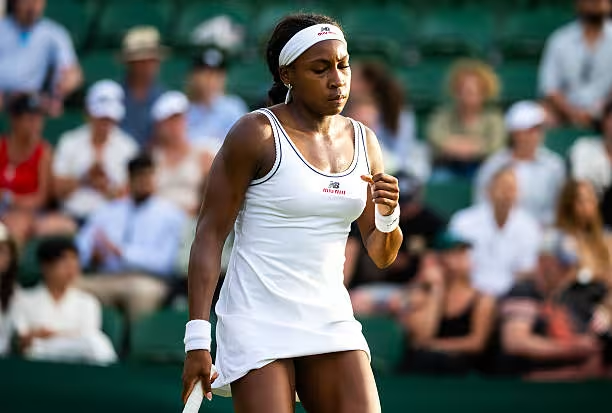
I thought a full week of training could help me more than another tournament. Even if Wimbledon doesn't go as expected, I believe this work will benefit me in the long run." That work has been focused on building a much clearer identity on grass. "Grass demands me to be more aggressive and to trust my shots much more. I can't step onto the court with doubts.
I'm serving much stronger than before, and now I have a lot of confidence in my serve. I feel like I finally know how I want to play on this surface; before, I was just reacting to what my opponent did. Now I want to be the one making the other player adjust. Footwork has also been a priority. On clay, you can allow for some small adjustments because the ball bounces higher. Here, that margin doesn't exist. Everything has to be much more compact, cleaner, and efficient."
Iga Swiatek changed the way Gauff understands grass
The American acknowledged that watching Iga Swiatek triumph at Wimbledon last year completely altered her perspective on the possibilities for players with a similar style to hers. "I think seeing her win Wimbledon completely changed my view. We have very similar grips, and that made me think that I, too, can play very well on this surface.
Beyond that, I feel I need to improve my footwork, be more aggressive, and maintain the identity I am building. I am good at the net, I am fast, and now I am also much happier with my serve. Seeing Iga win gave me the confidence to think that I don't need to change who I am; I just need to discover what the best version of my grass-court game is."
Gauff defends the importance of acting collectively on the circuit
The American was also asked about the agreement reached between players and Wimbledon regarding financial demands in recent weeks. "I can't speak much about that agreement. All I can say is that there was an understanding between the tournament and the players.
I've always believed that when we act collectively, we are much stronger. Every player is entitled to their own opinion, but if the group decides to follow a certain direction, I think the smartest thing is to stay united. That unity is what has made our demands taken much more seriously."
Cori Gauff shows her support for Marketa Vondrousova after her suspension
One of the most delicate moments of the press conference came when she was asked about Marketa Vondrousova's four-year ban for refusing to undergo an anti-doping test. "Obviously, rules are rules, but it's very tough to see a situation like that when you know a person who, from all you know about her, has always respected this sport.
Every case is different. I have also experienced strange situations with doping controls and have made complaints about how certain things were handled.
I have never refused to take a test; that has never happened. They have tried to test me outside of the hours I had indicated, and when I could, I simply took the test. There was also a time when someone called me outside my testing window, and the way they spoke to me even made me cry. Later, I found out I was right, and I wasn't obligated to take that test.
I send all my love to Marketa. Four years is a long time. I can't imagine what she's going through right now. I just hope that we can all learn something from a situation like this."
Gauff will face Krejcikova in the second round of Wimbledon 2026
The American also commented on the upcoming match in the next round, aware that grass can level out matchups significantly. "I have played against her twice this year, and they were completely different matches. In the United Cup, it was a rather comfortable encounter for me, and in Rome, I struggled much more.
She has a great serve and hits very hard. Those kinds of opponents are always dangerous on grass. I still need to study how she plays on this surface because matches on clay do not always serve as a reference."
The first victory at Wimbledon means much more than just a pass to the next round for Cori Gauff. The American feels that, for the first time, she truly understands how to compete on grass and believes she has found an identity she has been searching for years. If this work continues to solidify over the next two weeks, London could cease to be the unfinished business that has followed one of the top stars in women's tennis until now.
This is an automatic translation. You can read the original news, Gauff revela el cambio que puede cambiar su suerte en Wimbledon: "Ahora sé cómo quiero jugar"